
Close your eyes and picture the Apple logo. Now try to draw it from memory. Most people get it wrong, even though they have seen that logo thousands of times. This happens because seeing something often feels like knowing it.
This is exactly what happens when you study. Rereading notes and highlighting textbooks feel productive. But they create a false sense of mastery called the fluency illusion.
Your brain recognizes the material, so it assumes it knows the material. Then exam day arrives and the information is gone.
The good news is that real study techniques exist. This guide walks you through the best study tips for students backed by science. You will get clear steps, real examples, and simple ways to start today.
What Are the Best Study Techniques?
The one common thing between the best study tips for students is that they make you actively try to remember information, instead of just reading it again. Here are the top ones, ranked by how well they work.
| Technique | How Well It Works | Best For |
| Active recall (practice testing) | High | Almost every subject |
| Spaced repetition | High | Long-term memory, big syllabi |
| Self-explanation | Moderate | Connecting new ideas to old ones |
| Interleaved practice | Moderate | Math, science problem sets |
| Highlighting and rereading | Low | Not recommended on its own |
| Summarizing notes | Low | Only if paired with recall |
The rest of this guide shows you exactly how to use these effective study tips for students, step by step.
10 Most Effective Study Tips for Students
Before you spend another hour rereading notes, try these evidence-based study tips.
1. Active Recall: Test Yourself Instead of Rereading
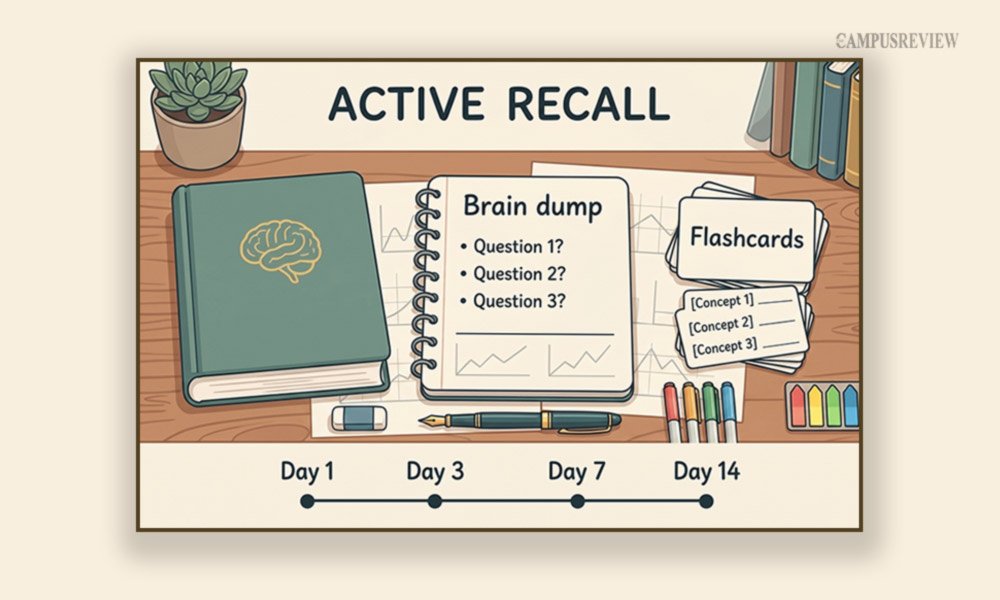
Active recall means closing your book and trying to remember the answer before you check it. This single change is one of the most effective study tips for students because it forces your brain to do real work instead of just scanning words.
Try this simple method called blurting:
- Pick one topic and study it for 10 minutes. Read your notes or textbook once with full focus.
- Close every book, notebook, and tab. Take out a blank, unlined sheet of paper.
- Write down everything you remember about the topic. Do not stop to check if you are right.
- Open your notes again. Use a different colored pen to add anything you missed.
- Circle the gaps. These are the spots that need more attention. Repeat the process just for those gaps.
Tip: Using blank paper instead of a worksheet matters. It forces your brain to organize the information on its own, instead of just filling in blanks. This extra effort is what makes the method work so well.
2. Spaced Repetition: Why Timing Matters More Than Hours
Spaced repetition means reviewing information at increasing intervals over time, instead of cramming it all in one sitting. It is one of the most reliable memory retention techniques because it works with how your brain naturally forgets.
This method will help you remember far more than cramming everything the night before.
Here is a simple way to set this up using flashcards:
- Get five boxes, folders, or digital flashcard decks. Label them Box 1 through Box 5.
- Write all your flashcards and place them in Box 1.
- Review Box 1 every day. If you get a card right, move it to Box 2. If you get it wrong, it stays in Box 1.
- Review Box 2 every 2 days, Box 3 every 4 days, Box 4 every week, and Box 5 once a month.
- Any card you get wrong drops straight back to Box 1, no matter which box it came from.
This way, the cards you struggle with show up often, and the ones you already know well take up less of your time.
| Box | Review Frequency | What Goes Here |
| Box 1 | Every day | New cards and anything you got wrong |
| Box 2 | Every 2 days | Cards you got right once |
| Box 3 | Every 4 days | Cards you got right twice |
| Box 4 | Every week | Cards you know fairly well |
| Box 5 | Once a month | Cards you have mastered |
Tip: If you prefer apps over physical boxes, tools like Anki use a similar idea with smarter math behind the scenes.
3. The Feynman Technique: Explain It Like You’re Teaching a Kid
Named after physicist Richard Feynman, this technique is one of the best exam preparation techniques for understanding tough concepts rather than just memorizing facts.
How to Use It
- Write the name of the concept at the top of a blank page.
- Explain it in plain, simple words, as if you were teaching it to a 12-year-old. Avoid technical jargon.
- When you get stuck or use a complicated word to dodge a gap, stop. That gap is exactly what you do not understand yet.
- Go back to your textbook or notes and relearn just that piece.
- Simplify your explanation again and try to use a real example or analogy.
Example: A student trying to explain Newton’s Third Law might say, “Every push has an equal push back.” If they cannot explain why a rocket launches using this idea, that gap shows them exactly what to study.
Try the Look at the Sky Test
Here is a quick way to check if you really know something. Look away from your notes, look up at the sky or a blank wall, and explain the concept out loud in your own words.
If you can do it smoothly without peeking, you have actually learned it. If you stumble, you have found a gap worth fixing.
4. Smart Note-Taking: Cornell Notes and Mind Maps
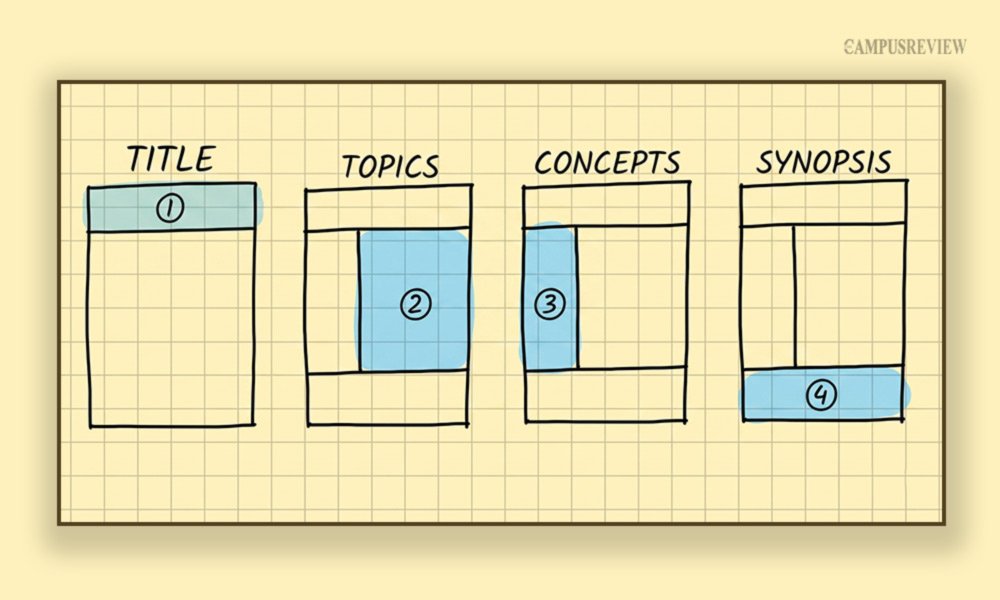
How you take notes affects how well you remember them. Plain, line-by-line notes often turn into copying, not learning. Structured note-taking forces your brain to process information rather than just transcribe it.
The Cornell Method, Step by Step
- Developed at Cornell University, this layout turns your notes into a built-in study tool.
- Split your page into two columns. A small one on the left, a bigger one on the right.
- During class, write your main notes in the right column.
- After class, write short questions in the left column based on what you wrote.
- To revise, cover the right column. Try to answer your own questions using only the left side.
- Once a week, spend 10 minutes reviewing the page.
When to Use Mind Maps Instead
For subjects with lots of connected ideas, a mind map can work better. Start with the main topic in the center of the page, then draw branches out to subtopics, and smaller branches for details. This format mirrors how your brain naturally links ideas together.
5. Set Up Your Study Environment for Focus
Your environment trains your brain whether you mean it to or not. A few small changes can make it much easier to focus.
- Pick one study spot. Use a desk or table only for studying. Do not study in bed or on the couch, since your brain links those spots with rest, not focus.
- Try the study lamp trick. Turn on a desk lamp only when you are actively studying. The moment you lose focus, turn it off and take a break. Over time, your brain learns that lamp on means deep focus.
- Read textbooks with the SQ3R method. Survey the headings first, turn each heading into a Question, Read to find the answer, Recite the answer in your own words, then review the section later.
- Take real breaks. A 5-minute break every 30 minutes keeps your focus sharp. Skipping breaks for hours at a time makes your brain associate studying with exhaustion, which kills motivation over time.
6. Choose the Right Focus Block: Pomodoro or Animedoro
The classic Pomodoro Technique uses 25 minutes of work followed by a 5 minute break. It is a great starting point, but it has one flaw. Your brain takes about 10 to 15 minutes just to settle into deep focus, so a 25-minute timer can cut you off right when you are getting started.
Animedoro is a popular alternative built around this problem. Instead of short bursts, you study in 40- to 60-minute blocks, then reward yourself with a longer 20-minute break, often used to watch one episode of a show.
Whichever you pick, set a hard limit on your break. Choose your show or activity before the break starts, and close it the moment the timer ends. This keeps the break a reward instead of a distraction.
7. Manage Your Time, So You Are Never Cramming
Good time management for students is not about planning every minute. It is about reviewing your progress and adjusting often.
Instead of a rigid weekly plan, try working backward from your exam date and tracking what you have actually studied, not just what you planned to study.
A simple version of this is the Retrospective Revision Timetable.
- List every topic in a spreadsheet.
- After each study session, mark it red if you struggled, amber if it was okay, or green if you mastered it.
- Each day, study whatever is marked red or has not been touched in the longest time. This keeps your effort exactly where it is needed.
8. Stop Procrastinating Before It Starts
Procrastination usually is not about laziness. It is often about a task feeling too big, too boring, or too uncomfortable to start. The fix is to make starting as easy as possible.
- Use the two-minute rule. Tell yourself you only need to study for two minutes. Once you start, momentum usually carries you further.
- Break big tasks into small ones. “Studying chemistry” feels heavy. “Reviewing the first 5 flashcards” does not.
- Remove friction. Keep your books, laptop, and notes ready the night before, so there is nothing to set up when it is time to study.
9. Protect Yourself From Study Burnout
Pushing through exhaustion does not make you learn faster. It usually makes you learn less, since a tired brain cannot encode new memories well.
Watch for early signs of burnout, like dreading study sessions, feeling foggy even after sleep, or losing interest in subjects you used to enjoy.
Protecting your sleep is one of the most underrated study tips for students.
During deep sleep, your brain replays what you learned that day and moves it into long-term storage. Skipping sleep to cram does not just make you tired.
10. Try the Memory Palace for Tough Material
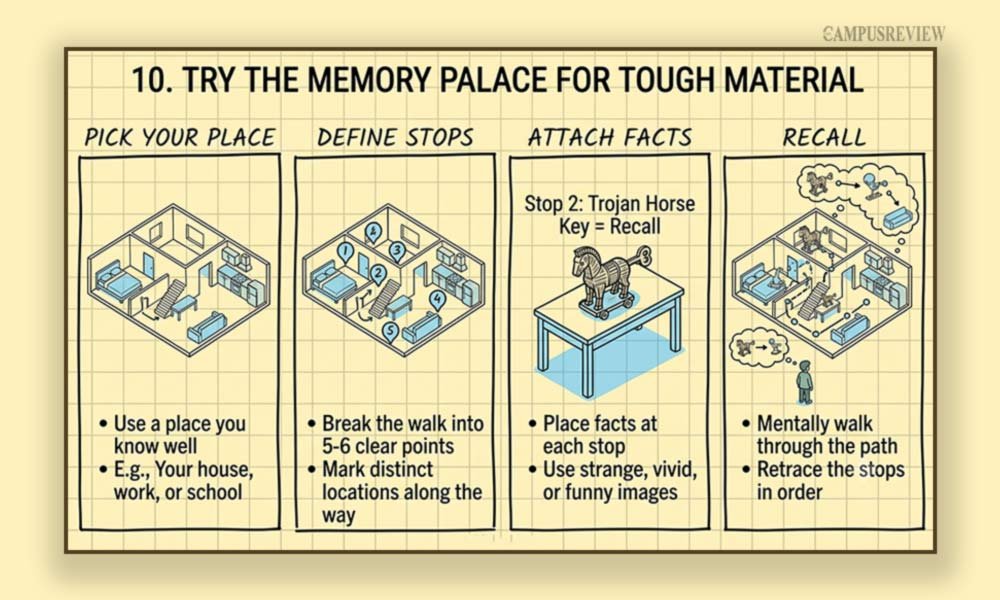
The Memory Palace, also called the Method of Loci, is an ancient memory technique one of the best study tips for students where you attach facts to specific locations in a place you know well, like your house. To recall the facts, you mentally walk through that place.
This works especially well for lists, sequences, or vocabulary that do not connect to anything you already know.
Here is how to build one:
- Pick a place you know by heart, like your walk from your bed to your kitchen
- Break that walk into 5 to 6 clear stops, like your bedroom door, the hallway, and the stairs
- Attach one fact to each stop using a strange or exaggerated image
- Walk through the place in your head, stop by stop, to recall the facts in order
Your brain finds it far easier to remember a place than a list, so the facts come back attached to something solid. This works best for short lists of 5 to 15 items, not entire chapters.
A Simple Weekly Plan
You do not need to use every tip from this study tips for students guide at once. Here is a simple way to combine the best ones into a routine that actually fits into a normal week.
| Day | Focus | Technique to Use |
| Monday to Friday | New material | Cornell notes in class, blurting method same evening |
| Every evening | Flashcard review | Leitner box, 15 to 20 minutes |
| Wednesday | Mixed practice | Interleave 2 to 3 subjects together |
| Saturday | Deep review | Feynman technique on your hardest topic |
| Sunday | Planning | Update your retrospective revision tracker |
Final Thoughts
Good grades do not come from studying harder. They come from studying smarter. Every technique in this guide does one simple thing: it makes your brain work to find the answer, instead of just looking at it.
Start small. Pick any one tip from this 10 study tips for students guide and use it in your next study session. Once it feels easy, add another. In a few weeks, you will notice you remember more while studying less.
Frequently Asked Questions
1. How many hours should students study each day?
There is no fixed number of study hours. Most students benefit from 40–90 minute focused study sessions with short breaks, using techniques like active recall instead of passive rereading.
2. What is the best time of day to study?
The best time to study is when you feel most alert and focused. Schedule difficult subjects during your peak energy hours, whether that’s in the morning, afternoon, or evening.
3. Is it better to study alone or in a group?
Both are effective for different goals. Study alone for deep focus and revision, and join a group to discuss concepts, test each other, and fill knowledge gaps.
4. Do effective study techniques work for every subject?
Yes. Methods like active recall and spaced repetition improve learning across most subjects, while practice problems and interleaving are especially useful for math and science.
5. How long does it take to see results from better study habits?
Many students notice improved focus and recall within 1–2 weeks of consistent practice. Long-term memory and learning continue to improve over several weeks with regular revision.