Your exam is two weeks away, and your notes feel like a foreign language. You read the same page three times, and nothing sticks.
This happens to almost every student, and it is not because you have a bad memory. It is because plain memorization fights against how your brain actually works.
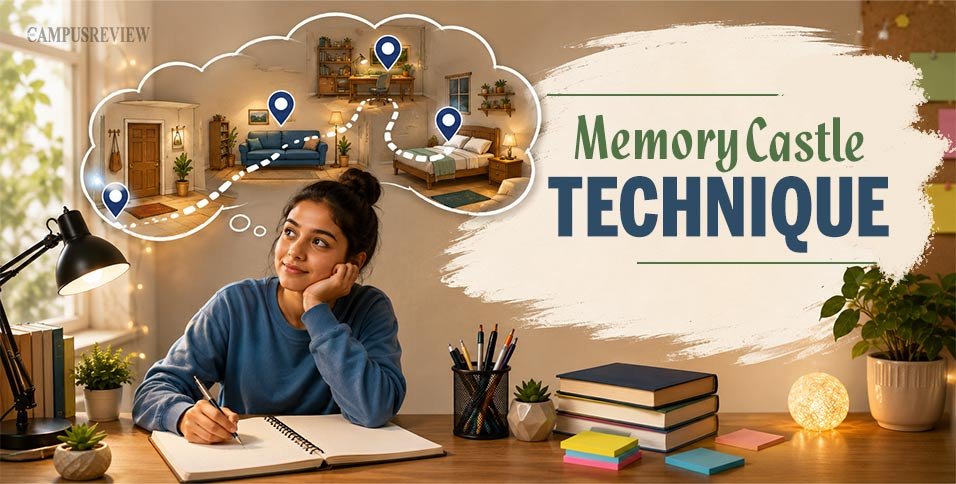
A memory castle fixes this fast. Also called the memory palace Technique or the Method of Loci, it turns a place you already know into a mental storage system.
You place facts inside spots along a path in your mind, and your brain holds onto them far longer than it holds onto plain text.
This guide walks you through a complete Memory Castle Technique example, showing exactly how information moves through each of the four steps. By the end, you’ll understand how to create your own memory palace and use it to remember information more effectively for exams.
What Is a Memory Castle Technique?
A memory castle technique is a memory improvement technique that links facts to specific spots inside a place you know well. You walk through that place in your mind, and each spot holds one piece of information.
Here is the short version of how it works:
- Pick a real place you can picture with your eyes closed.
- Choose a fixed path through it, like a hallway you always walk.
- Place one fact at each stop along that path.
- Turn each fact into a strange, vivid picture so it sticks.
- Walk through the path in your head to recall everything in order.
Once you build one palace, you can reuse the same skill for every subject. That is what makes it one of the most powerful memorization techniques for students.
Does It Actually Work for Students?
Memory Castle Technique is not just a fun trick. Researchers tested it in a real classroom setting. Medical students learning a tough topic, the body’s insulin system, were split into two groups.
One group studied the normal way. The other group used the memory castle Technique on top of the same lectures.
| Student Group | Study Method | Average Score (out of 10) |
| Group 1 | Lectures + self-study | 8.10 |
| Group 2 | Lectures +memory castle | 9.31 |
The memory castle technique group scored higher and reported something else worth noting. They said the technique helped them connect ideas, not just recall single facts.
The Example We Will Use Throughout This Guide
Say you need to memorize the three states of matter for your science exam, in order:
- Solid, where particles are packed tightly and hold a fixed shape
- Liquid, where particles move freely but stay close together
- Gas, where particles spread out and move apart from each other
We will build a full memory castle technique for this exact list. Watch how it grows from a bare room into a complete, working memory system, one step at a time.
Step 1: Pick a Place You Know by Heart
Choose one real, physical place that you can picture clearly without straining. The less effort it takes to imagine, the more mental energy you save and less burnout you feel.
- Good choices: your bedroom, your home’s entryway, your school hallway, or your daily walk to class.
- Avoid places you have visited only once or twice. Your brain needs a space it already trusts completely.
- Start small. One room or one short hallway is enough for your first try.
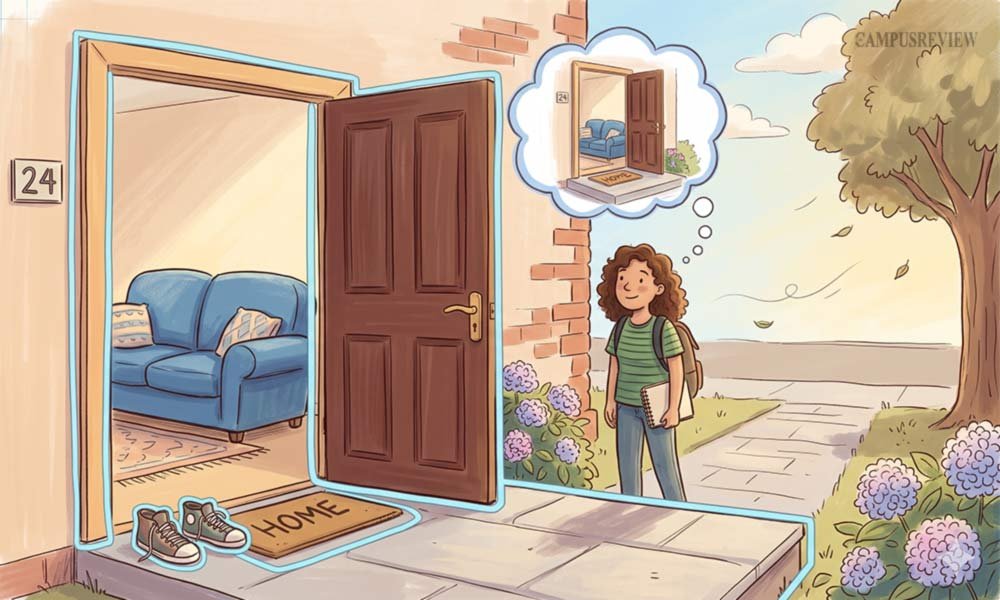
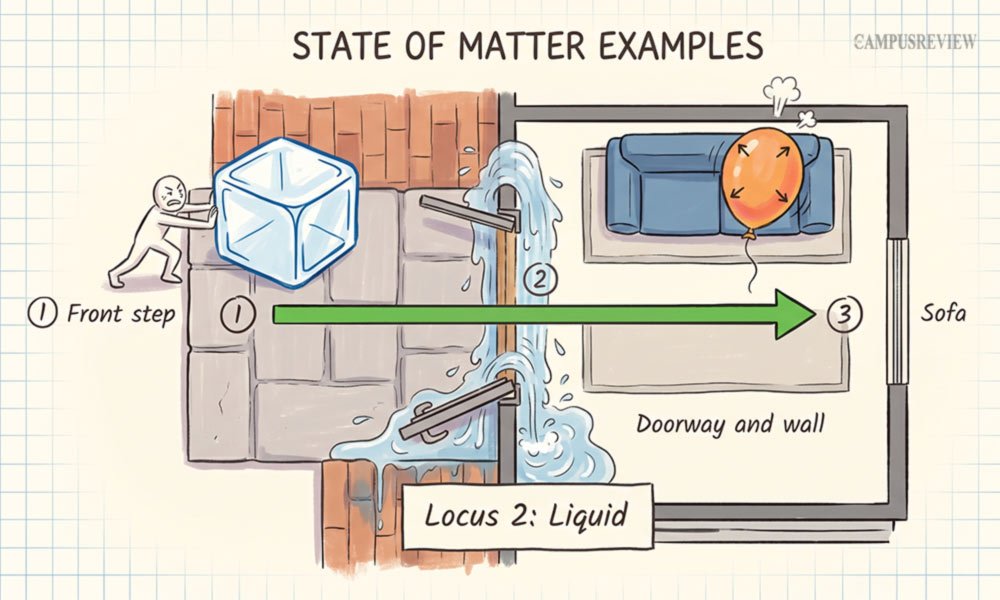
For our example, we will use the entryway of a home. It has three clear spots already built into it: the front step, the doorframe above the door, and the sofa just inside.
That is exactly enough room for our three facts.
Step 2: Draw One Clear Path Through It
Your path is the exact order you will always follow in your mind. A messy path leads to a messy memory, so set two rules before you place a single fact.
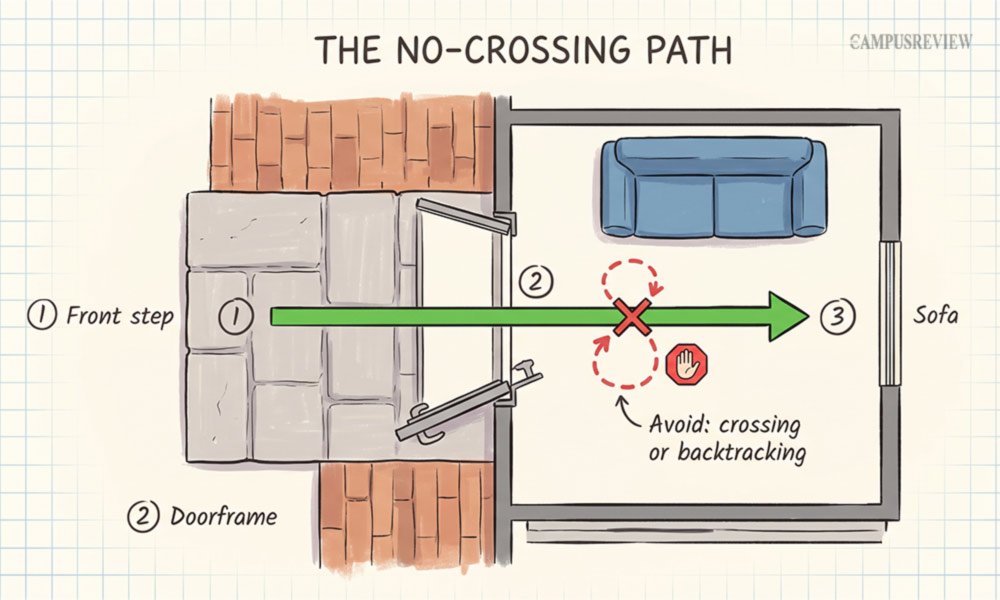
- The no-crossing rule: pick one direction, such as moving inward from outside to inside, and never let your path cross over itself.
- The no-dead-end rule: your path should move forward smoothly, not loop back or get stuck in a corner with no clear next stop.
Once your direction is set, mark out your fixed stops, called loci. Each locus will hold exactly one fact. Walk the path in your head a couple of times before you add anything to it, just to make sure the order feels natural.
For our example, the path moves from outside to inside, in this order:
- Locus 1: The front step
- Locus 2: The doorframe above the door
- Locus 3: The sofa just inside
Notice that this path never crosses itself. You simply move forward, one stop after another, the same way every time you walk through it.
Step 3: Turn Each Fact Into One Vivid Picture
This is the step that actually creates the memory. Take each fact and turn it into a picture that is strange, oversized, or funny. A plain, logical image gets forgotten. A weird one sticks.
Use these four questions to build a strong image for any fact:
- Can you make it move? A picture with motion is easier to recall than a still one.
- Can you make it too big or too small? Strange size grabs your attention.
- Can you add a sound? A loud noise or voice helps the image stay with you.
- Can you make it funny or shocking? Strong emotion locks a memory in place.
Now, let us place our three facts using these questions.
- Locus 1, Front Step: Solid. Picture a giant ice cube sitting on the step, so solid and frozen that it does not move at all, even when you try to push it.
- Locus 2, Doorframe: Liquid. Picture water dripping and flowing down the doorframe like a small waterfall, splashing onto the step below.
- Locus 3, Sofa: Gas. Picture a balloon floating just above the sofa, slowly puffing up bigger and bigger until it almost fills the room.
Step 4: Walk Through It, Then Review on Schedule
Right after you build your images, close your eyes and walk the path from start to finish. Stop at each locus, look at the picture, and say the fact out loud. Then walk it backward, from the sofa to the front step, to prove you can recall it out of order too.
For our example, that walk looks like this: front step, see the frozen ice cube, say ‘Solid.’ Doorframe, see the flowing water, say ‘Liquid.’ Sofa, see the floating balloon, say ‘Gas.’ That full walk should take you less than ten seconds once the images are set.
A memory castle fades just like any other memory if you never revisit it. To make it stick for the long term, follow a simple review schedule called the Rule of Five, used by memory champion Dominic O’Brien.
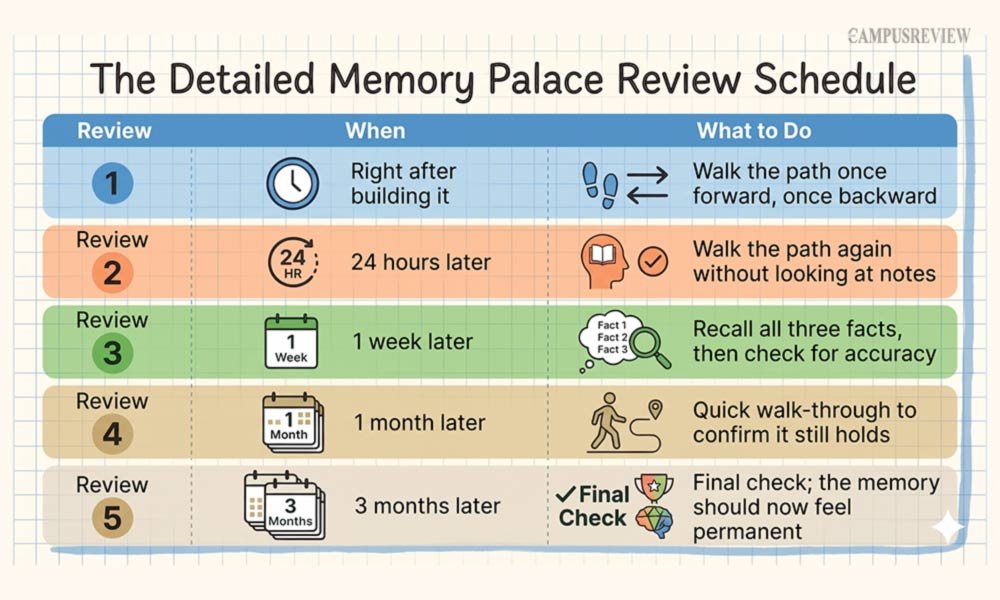
This step also pairs well with active recall study methods. Instead of rereading your notes, close them and try to walk the palace from memory first. Only check your notes afterward, to confirm what you got right. This trick will help you manage exam time effectively.
Find the Right Memory Palace for Your Subject
Not every subject fits the same kind of space to make use of the memory castle technique effectively. Match this table with a location that makes building your palace easier.
| Subject | Best Type of Location | Why It Fits |
| History dates and timelines | A route with many stops, like your walk to school | Long paths give you room for long timelines |
| Vocabulary or language terms | Your bedroom or home | Small, familiar spaces work for short, repeated review |
| Science formulas or elements | Your school lab or classroom | The setting already connects to the subject |
| Long lists or chapter summaries | A multi-room space like your whole house | More rooms mean more loci without feeling crowded |
Two Real Examples From Students Like You
Example A: Egyptian Social Hierarchy (History)
A student needs to remember the Egyptian social classes in order: Pharaoh, Viziers, Nobles.
Here is how student will use memory castle technique:
They use a clockwise path around their apartment.
- Locus 1, Front Step: A Pharaoh wearing a heavy gold mask bangs on the door because the mask is too heavy to lift.
- Locus 2, Doorframe: A giant glowing sports visor sits balanced on top of the door.
- Locus 3, Sofa: Three copies of a strict teacher named Miss Noble lounge across the cushions, looking unimpressed.
During the exam, the student mentally walks from the front step to the sofa and reads off each fact in order.
Example B: Key Psychologists (Psychology)
A student needs to remember three psychologists in order: Wundt, Pavlov, Thorndike. They use their own home.
- Locus 1, Kitchen: Wilhelm Wundt stirs a bubbling pot of “experimental soup” on the stove.
- Locus 2, Living Room: Ivan Pavlov rings a giant bell while dogs in party hats drool on the rug.
- Locus 3, Bedroom: Edward Thorndike sits trapped inside a wire puzzle box on the bed, trying to escape.
A Few Mistakes to Avoid
Crossing your own path, which confuses the order of your facts.
Using a flat, logical image instead of a strange one. If a picture feels boring, make it bigger, louder, or weirder.
Skipping the review schedule. Building the palace once is not enough; the Rule of Five is what makes it last.
Final Thoughts
A memory castle technique is not a shortcut that skips real studying. It is a smarter way to study, one that matches how your brain already works best.
Pick a place you know, draw one clear path, turn each fact into a strange picture, and walk through it on schedule.
Try it with a small list before your next quiz, the same way we built the states of matter example above. Once you see how well it works, you will want to build a new palace for every exam ahead.
FAQs
1. How many facts can one room hold?
You can hold five to ten facts per room at the start. As you get more practice, you can split a room into smaller spots, such as a chair, a corner, and a windowsill, to hold more.
2. Can I combine this with other memorization techniques for students?
Yes. A memory castle technique works well with active recall and flashcards. Use the palace to store and order facts, then use active recall to test yourself without looking at the images.
3. Does this work if I am not good at visualizing pictures?
Yes. You can lean on other senses instead of strong visuals. Add sounds, textures, or smells to each spot rather than focusing only on what you see in your mind.
4. How long does it take before I notice results?
Most students notice a difference after their first full review cycle, usually within one week. The memory castle technique gets faster and easier each time you build a new palace.