Ebenezer Scrooge hates Christmas. He hates giving, he hates joy, and he hates people. Then the ghost of his former business partner and three Christmas spirits turn his life upside down in one night. That is the heart of A Christmas Carol by Charles Dickens.
Charles Dickens published this short novel in 1843. It is one of the most loved Christmas stories in the English language. It follows a cold, selfish businessman who gets one last chance to change.
This guide gives you a full A Christmas Carol by Charles Dickens summary, stave by stave. You will meet every major character, understand the key themes, and see exactly what happens in the story.
Read this before your exam, before class discussion, or before you decide if the full book is worth your time. If you already love Shakespeare or Jane Austen, Dickens deserves a place on your shelf too.
Quick Facts: A Christmas Carol by Charles Dickens Summary
Here is a fast snapshot before you dive into the full A Christmas Carol by Charles Dickens summary of the plot.
| Detail | Information |
| Author | Charles Dickens |
| First published | 19 December 1843 |
| Genre | Novella, Gothic fiction, Christmas story |
| Setting | London, Victorian England |
| Structure | 5 chapters, called “staves” |
| Point of view | Third-person narrator |
| Famous line | “God bless us, every one!” – said by Tiny Tim |
Main Characters in A Christmas Carol
Meet the people who drive this story before you read the plot. It will help the A Christmas Carol by Charles Dickens summary make more sense.
| Character | Who They Are |
| Ebenezer Scrooge | A wealthy but selfish and miserly businessman. The story follows his transformation. |
| Bob Cratchit | Scrooge’s poorly paid clerk. A kind, hardworking family man. |
| Tiny Tim | Bob Cratchit’s young, sick son. He stands for innocence and hope. |
| Jacob Marley | Scrooge’s dead business partner. He warns Scrooge about his future. |
| Fred | Scrooge’s cheerful nephew. He keeps inviting Scrooge to celebrate Christmas. |
| The Three Spirits | The Ghosts of Christmas Past, Present, and Yet to Come. Each one shows Scrooge a different part of his life. |
A Christmas Carol by Charles Dickens: Summary of Plots (By Stave)
Dickens tells this story in five parts. He calls them “staves” instead of chapters, like verses in a Christmas carol. Here is a summary of christmas carol by stave, followed by the full detailed version.
| Stave | What Happens |
| One | Marley’s ghost visits Scrooge and warns him that three more spirits are coming. |
| Two | The Ghost of Christmas Past shows Scrooge his lonely childhood and lost love. |
| Three | The Ghost of Christmas Present shows Scrooge how others celebrate, including the Cratchits. |
| Four | The Ghost of Christmas Yet to Come shows Scrooge a bleak, lonely future and his own death. |
| Five | Scrooge wakes up a changed man and spends the rest of his life spreading joy. |
That’s the plot in a nutshell. Below is the detailed A Christmas Carol by Charles Dickens summary, stave by stave, so you don’t miss a single moment.
Stave One: Marley’s Ghost
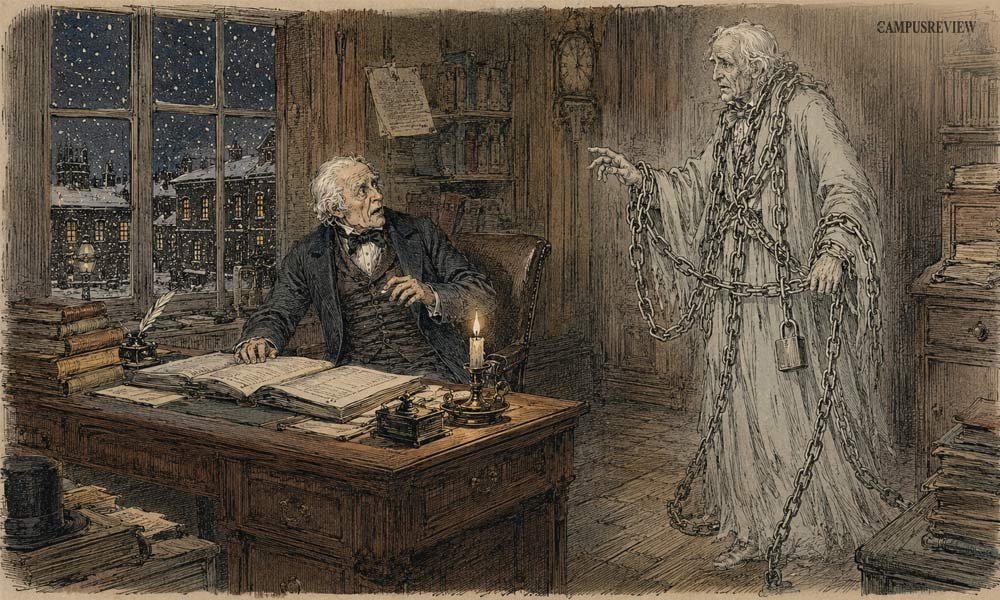
The story opens on a freezing Christmas Eve in London. Scrooge sits in his cold office and barely pays his clerk, Bob Cratchit, enough to survive. He turns away carol singers. He refuses to give money to charity. He even snaps at his own nephew, Fred, who invites him to Christmas dinner.
That night, Scrooge gets a visitor. It is the ghost of Jacob Marley, his old business partner, who died seven years earlier. Marley wears heavy chains built from his own greed in life. He warns Scrooge that the same fate waits for him unless he changes. Marley then tells Scrooge that three spirits will visit him, one by one, over the next three nights.
Stave Two: The Ghost of Christmas Past
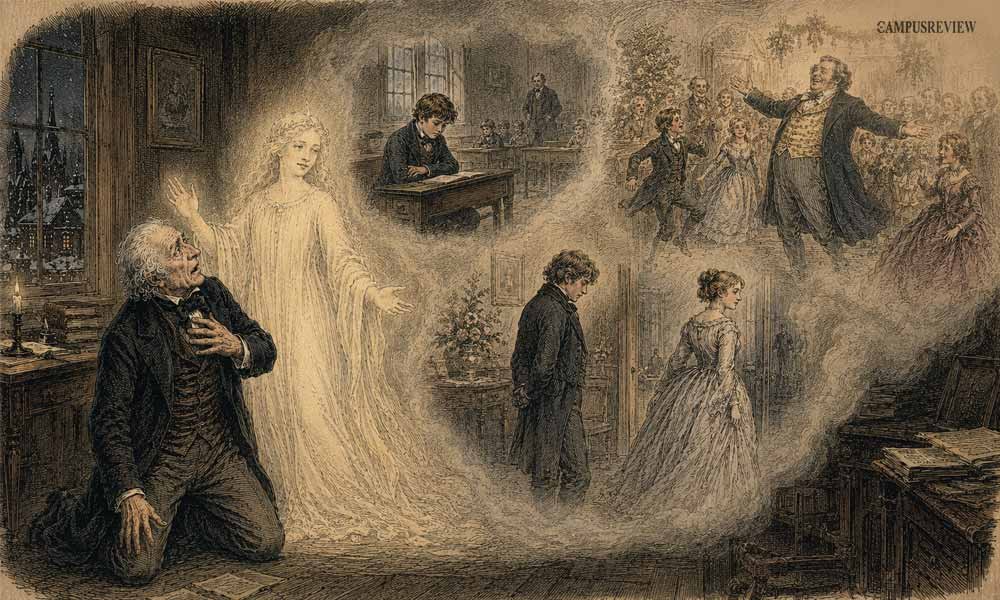
The first spirit arrives at exactly one in the morning. It carries Scrooge back through his own memories. He sees himself as a lonely schoolboy, left behind while other children go home for the holidays. He sees his happier years as a young apprentice, full of warmth and dancing.
Then the mood shifts. Scrooge watches his younger self choose money over love.
He sees Belle, the woman he once planned to marry, walk away because his greed had taken over his heart. Scrooge, now old and full of regret, begs the spirit to stop showing him these scenes. But the past cannot be undone. Only the present and future are still his to shape.
Stave Three: The Ghost of Christmas Present
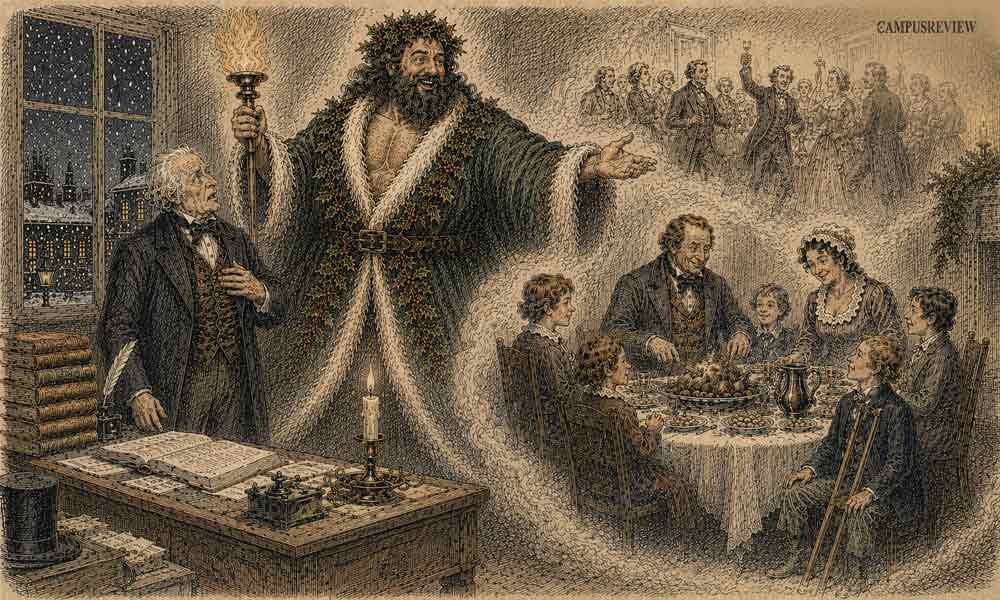
The second spirit is loud, warm, and larger than life. It shows Scrooge how Christmas looks for everyone else. He watches the Cratchit family share a small, simple meal with real joy. Tiny Tim, weak from illness, still manages to stay hopeful and kind. The spirit warns Scrooge that Tiny Tim may not survive unless things change.
Scrooge also visits his nephew Fred’s Christmas party, where guests laugh and play games, and even joke gently about Scrooge himself. For the first time, Scrooge sees how much life is happening around him, without him. Before the spirit leaves, it reveals two ragged children hiding under its robe: Ignorance and Want. It is a warning about the real cost of a society that looks away from poverty.
Stave Four: The Ghost of Christmas Yet to Come
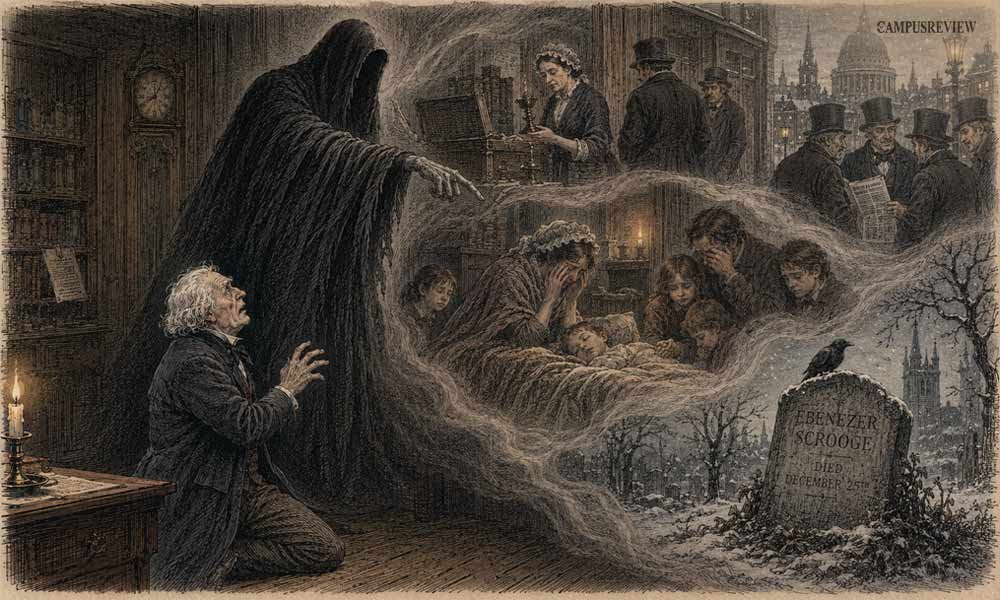
The final spirit says nothing. It simply points. It shows Scrooge a future London where a rich man has died alone, and nobody mourns him. His housekeeper and others sell off his belongings without a hint of grief. Businessmen mention his death only in passing, more curious about lunch than loss.
Scrooge also sees the Cratchit family grieving. Tiny Tim has died. The family is heartbroken but still tender with each other. Finally, the spirit drags Scrooge to a neglected grave. Scrooge reads his own name on the headstone and realizes the lonely dead man was himself all along. He begs for a chance to change and promises to honor Christmas in his heart all year.
Stave Five: The End of It
Scrooge wakes up in his own bed. It is Christmas morning, and he is alive, and there is still time. Relief turns into joy, and joy turns into action. He sends the biggest turkey in the shop to the Cratchit family. He gives generously to the charity workers he once turned away. He shows up at Fred’s house for Christmas dinner.
The next day, Scrooge raises Bob Cratchit’s pay and becomes like a second father to Tiny Tim, who does not die after all. Scrooge keeps his promise. He carries the spirit of Christmas with him every single day, for the rest of his life.
Main Themes in A Christmas Carol
A few big ideas run through the whole story. Here are the themes that matter most.
- Redemption and Transformation: Scrooge starts the story cold and closed off. He ends it open and generous. This full change of heart sits at the center of the book, which is exactly why redemption in A Christmas Carol is the most quoted theme in every classroom discussion.
- Poverty and Social Responsibility: The Ghost of Christmas Present shows the Cratchit family’s hardship and the two children, Ignorance and Want. Dickens uses the story to push wealthy readers to notice and help the poor.
- Family and Community: The happiest scenes in the book happen around a table, at a party, or by a fire, surrounded by people. Scrooge’s loneliness only ends when he chooses connection.
- Generosity and Compassion: Small acts, a gift, a shared meal, a kind word, carry more weight in this story than money ever does. Generosity is what finally makes Scrooge happy.
End Note:
If you are wondering whether to read it, read it; read the actual book, not just this summary.
What makes A Christmas Carol special is not the plot twist. You already know Scrooge changes by the end.
What makes it special is how Dickens writes the fear, the regret, and the small, quiet relief of getting a second chance. A summary can tell you what happens. Only the book can make you feel it.
If you are short on time, this A Christmas Carol by Charles Dickens summary will carry you through your exam or your class discussion. But if you love a story about second chances, keep this book on your shelf. It takes only a few hours to read, and it is the kind of story that stays with you long after December ends.
FAQs
1. Is A Christmas Carol based on a true story?
No, A Christmas Carol is not based on a true story. Charles Dickens invented the story and the characters. He wrote it to highlight real poverty in Victorian England, which he had seen firsthand as a child.
2. How long is A Christmas Carol?
A Christmas Carol is short. The book runs around 30,000 words across five staves, so most readers finish it in a few hours.
3. What is the message of A Christmas Carol?
The message of A Christmas Carol is that kindness and generosity matter more than money. It is never too late to change, no matter how many years you have wasted.
4. Is A Christmas Carol appropriate for kids?
Yes, A Christmas Carol is appropriate for kids, with light guidance. Some scenes, like the ghost of Marley or the final gravestone, may feel intense for very young readers, but the story is a classic school read for a reason.
Also read: Novels by Jane Austen: A Complete Guide to Her Six Famous Books