The Campus Review
November 24, 2026
A 100-million-year-old flower fossil no bigger than a grain of rice is offering fresh insight into the early history of modern plants. Scientists from the United States and the United Kingdom identified the tiny blossom, newly named Tomlinsoniella pedicellata, inside a Kansas sandstone rock stored in a museum drawer for more than 130 years.
Published in the American Journal of Botany, the discovery represents the earliest unequivocal fossil evidence of the classic monocot flower structure. Researchers also suggest that the fossil of a flower from the age of dinosaurs may belong to the coryphoid palm lineage, potentially extending the known fossil record of fan palms.
Quick Facts About the Flower From the Age of Dinosaurs
| Feature | Details |
| Scientific Name | Tomlinsoniella pedicellata |
| Age & Era | 100 million years old (mid-Cretaceous Period) |
| Size | No larger than a grain of rice |
| Origin Rock | Dakota Sandstone / Dakota Formation, Kansas |
| Possible Affinity | Coryphoid palm lineage (fan palms) |
| Original Collector | Leo Lesquereux (specimens collected during the 1870s-1890s) |
How a Hidden 100-Million-Year-Old Flower Fossil Emerged
The journey of this prehistoric flower discovery spans more than a century and two continents. Paleobotanist Leo Lesquereux originally collected rock samples from the Dakota Formation in Kansas during the 1870s-1890s. The specimen then sat in the collections of the Smithsonian National Museum of Natural History for over 130 years.
While scanning the specimen, Steven Manchester of the Florida Museum of Natural History unexpectedly noticed a flower-shaped cavity inside the sandstone.
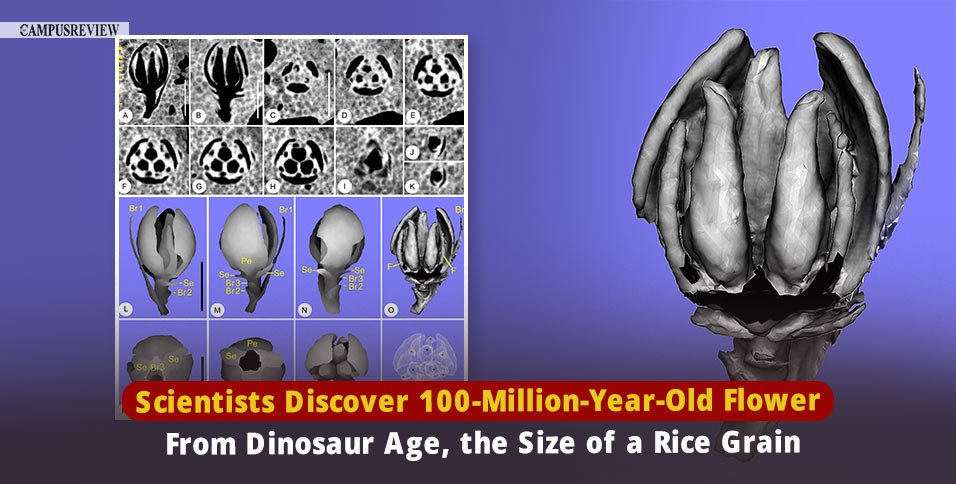
The flower had decomposed after being surrounded by clay-rich sand, leaving behind a negative impression that preserved its external structure. Using micro-CT scanning, researchers created digital sections and a 3D reconstruction of the hidden flower.
“This is the magic of collaboration reaching across 130 years,” said lead author Bruce Tiffney, professor emeritus at UC Santa Barbara.
The Cretaceous Period was also a time of major evolutionary developments. Fossils such as a 150-million-year-old Jurassic bird fossil offer further evidence of how life evolved during the age of dinosaurs.
Why This Discovery Matters for Palm Evolution
Monocots make up roughly 20 percent of all flowering plant species today, including palms, grasses, lilies, and orchids. While DNA studies suggested these plants emerged during the age of dinosaurs, physical fossils from that era remained rare.
The 3D scan of Tomlinsoniella pedicellata proved that the ancient flower followed the exact blueprint seen in modern monocot flowers:
- Rule of Threes: The flower follows a trimerous-pentacyclic arrangement, with three sepals, three petals, six stamens arranged in two whorls of three, and three separate carpels.
- Complete Anatomy: The blossom holds three sepals, three petals, six stamens (male parts), and three carpels (female parts).
- Fan Palm Connection: The flower has three separate, unfused carpels, a feature found in relatively few living monocot groups. Combined with its other structural characteristics, this feature makes the fossil most similar to flowers from the coryphoid palm lineage.
To evaluate the plant’s identity, Tiffney, Manchester, and botanist Walter Judd consulted palm specialists William J. Baker and John Dransfield at the Royal Botanic Gardens, Kew.
The researchers considered the 100-Million-Year-Old Flower fossil most consistent with the fan palm lineage, although an extinct monocot group with similar floral features cannot be ruled out. If confirmed as a fan palm, it pushes back the fossil record of this group by nearly 20 million years.
“It is simply astounding to find a flower, which would seem familiar to us if we saw it alive today, in such an ancient rock,” Baker said.
Timeline of the Discovery
- 100 Million Years Ago: The flower grows in what is now Kansas during the mid-Cretaceous.
- 1870s-1890s: Paleobotanist Leo Lesquereux collects and studies specimens from the Dakota Formation.
- Modern Era: Steven Manchester examines a historical specimen using micro-CT scanning and discovers the hidden flower.
- November 2, 2026: Researchers publish their findings in the American Journal of Botany.
- November 23, 2026: The discovery is announced publicly by the Royal Botanic Gardens, Kew and UC Santa Barbara.
What Happens Next in Botanical Research
The discovery of this Flower From the Age of Dinosaurs highlights how modern imaging technology can reveal previously overlooked fossils in historical museum collections. Further research is needed to establish the exact evolutionary position of Tomlinsoniella pedicellata and determine how it fits into the wider history of flowering plants.
Ultimately, studying this 100-million-year-old flower fossil gives scientists a clearer window into the early evolutionary history of the plants that shape our world.
Also read – UN Climate Talks Collapse: What Happened at COP31 as Countries Clash Over Fossil Fuels