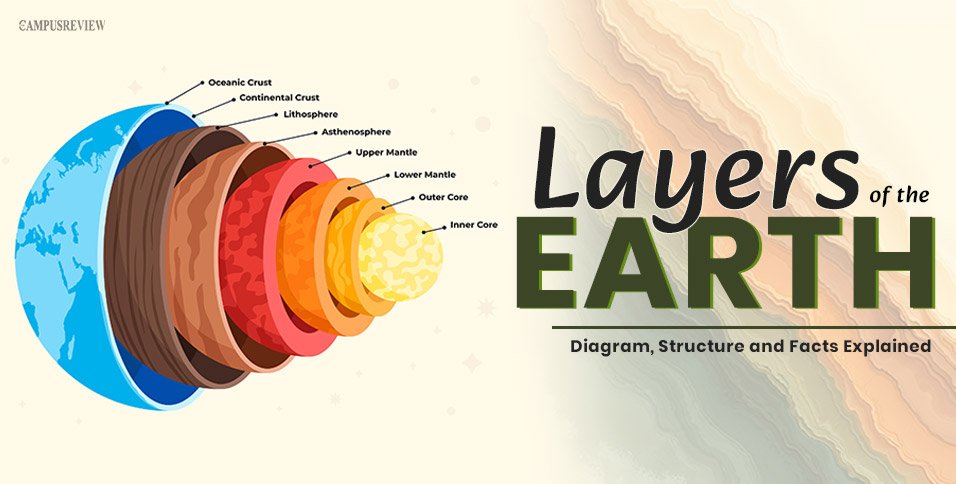
You are standing on a giant ball of rock, metal, and heat right now. Have you ever wondered what lies beneath your feet? Earth has four main layers called the crust, mantle, outer core, and inner core. Each layer differs in thickness, temperature, and composition.
Scientists cannot directly see these layers. The deepest hole ever drilled reaches only about 12 kilometers, barely scratching Earth’s surface. Instead, scientists study earthquake waves, which change speed and direction as they pass through different layers. These changes help scientists map Earth’s interior.
In this guide, you will learn about each layer of Earth’s interior, with a labeled diagram, a quick comparison table, and key facts about the scientists who mapped this hidden world.
What Are the Layers of the Earth?
Earth is a bit like a boiled egg. The outside is thin and hard. The inside is thick and hot. The very center is a solid ball.
Geologists group Earth’s interior layers in two ways.
- By what they are made of: crust, mantle and core.
- By how they behave: lithosphere, asthenosphere, mesosphere, outer core and inner core.
Here is a way to picture the scale. If Earth were the size of an apple, the crust would be thinner than the apple’s skin. Almost everything you can see, touch, or study directly sits inside that thin skin. Everything else, the mantle and the core, is hidden below.
Earth’s Layers in Order
From the surface to the center, the structure of the Earth goes like this:
1. Crust
2. Mantle
3. Outer Core
4. Inner Core
Each layer sits inside the next one, like a set of nested shells.
Earth’s Layers Diagram
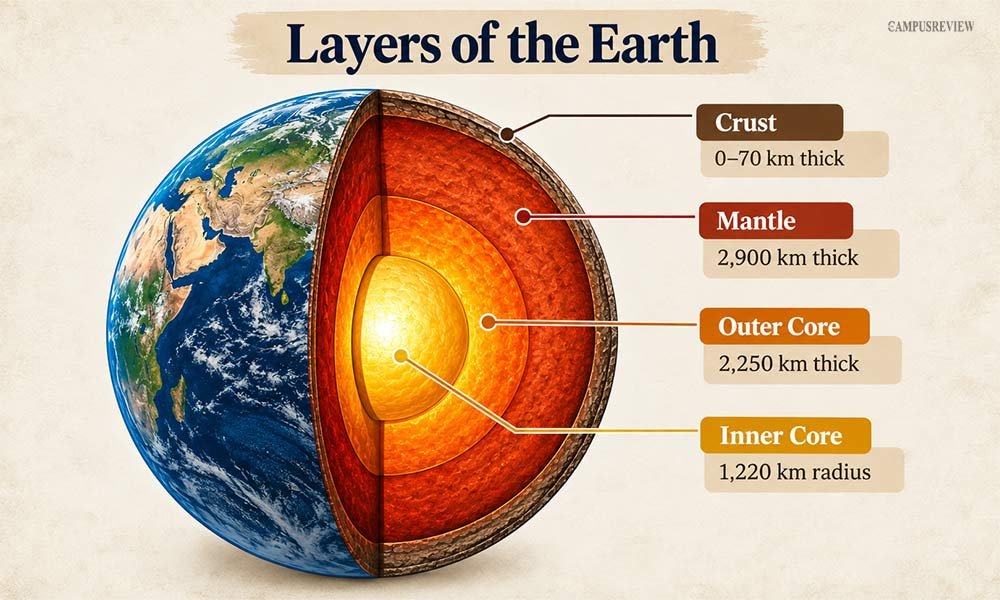
This Earth’s layers diagram is built from decades of seismic data. Earthquake waves travel through Earth at different speeds and can bend, reflect, or change direction when they encounter different materials or boundaries. Geologists study these changes from thousands of earthquakes to identify major boundaries deep inside Earth and build a picture of its internal structure.
Crust: Earth’s Thin Outer Shell
The crust is the outermost and thinnest layer of Earth. It forms the solid surface we live on and makes up less than 1% of Earth’s total volume.
Facts about the Crust
- Location: 0 to 70 kilometers deep, the outermost layer
- Thickness: 5 to 10 km under the oceans, 35 to 70 km under continents
- State: Solid rock
- Made of: Granite (continental crust) and basalt (oceanic crust)
- Share of Earth’s volume: Less than 1%
Continental Crust vs. Oceanic Crust
There are two types of crust, and they behave quite differently.
Continental crust forms the land you walk on. It is thick, ranging from about 35 kilometers under flat plains to more than 70 kilometers under tall mountain ranges like the Himalayas. It is made mostly of lighter rock rich in silica, such as granite. This is why continents sit higher than the ocean floor.
Oceanic crust lies under the sea. It is much thinner, only 5 to 10 kilometers deep. It is made of darker, denser rock called basalt. Because it is heavier, oceanic crust sits lower than continental crust. This is one reason the oceans are so deep.
Tectonic Plates: Why the Crust Keeps Moving
The crust is not one solid shell. It is broken into large pieces called tectonic plates. These plates float on the softer rock below and drift a few centimeters every year, about as fast as your fingernails grow. Their slow movement causes earthquakes, volcanoes, and the shape of mountains over millions of years.
This is also why the crust matters so much in daily life. Most earthquakes and volcanoes happen where tectonic plates meet.
A famous example is the Ring of Fire, a horseshoe-shaped belt around the Pacific Ocean where several plates grind against each other. It produces about 90% of the world’s earthquakes.
Mantle: The Thickest Layer of Earth
The mantle is the thickest layer of Earth, lying beneath the crust. It extends to about 2,900 kilometers deep and makes up nearly 84% of Earth’s total volume.
Facts about the Mantle
- Location: 70 to 2,900 kilometers deep
- Thickness: About 2,900 kilometers
- State: Solid rock that flows slowly, like warm toffee
- Made of: Silicate rock rich in iron and magnesium, mainly the mineral bridgmanite
- Share of Earth’s volume: About 84%, the largest of all four layers
How the Mantle Moves: Convection
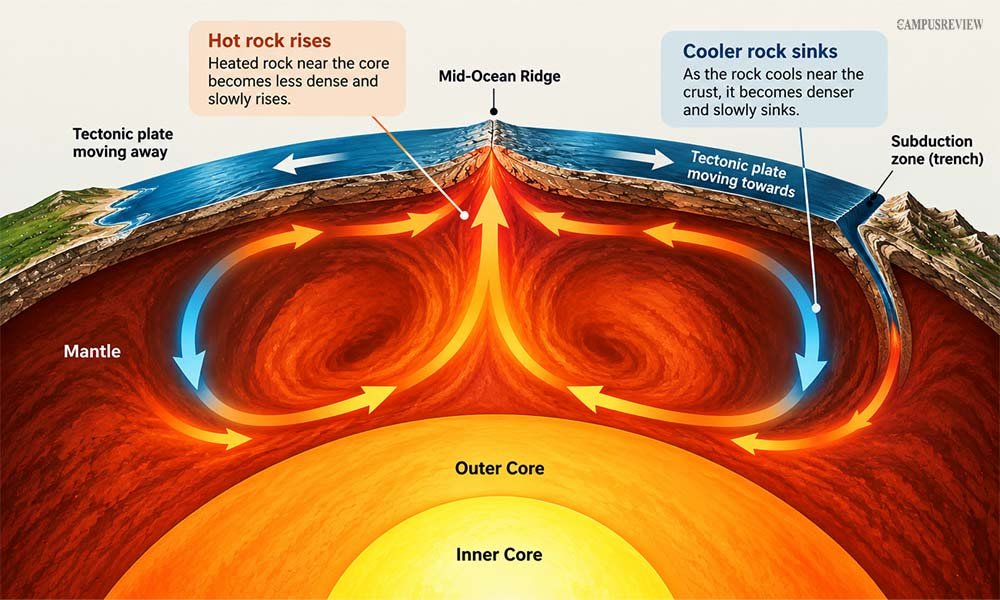
Do not picture the mantle as hard and still. Under huge heat and pressure, this rock behaves like warm toffee. It flows very slowly, moving only a few centimeters each year.
This slow movement is called convection. Hot rock near the core rises. Cooler rock near the crust sinks. This cycle works like a conveyor belt. It drags the tectonic plates above it, which is why continents slowly drift apart or crash together over time.
What the Mantle Is Made Of
The mantle is mostly silicate rock rich in iron and magnesium. Its most common mineral, called bridgmanite, makes up about 80% of the lower mantle. It is the single most abundant mineral on the planet, yet it did not even get its official scientific name until 2014.
Diamonds and Volcanic Islands
The mantle also has a sparkling side. Diamonds form under the huge heat and pressure found in the upper mantle, roughly 150 kilometers down. Volcanic eruptions then carry them up to the surface inside narrow rock pipes. In places like Hawaii, rising columns of hot mantle rock called mantle plumes punch through the crust and build entire chains of volcanic islands.
Outer Core: A Sea of Molten Metal
The outer core is the layer beneath the mantle, extending from about 2,900 to 5,150 kilometers deep. It is roughly 2,250 kilometers thick.
Facts about the Outer Core
- Location: 2,900 to 5,150 kilometers deep
- Thickness: About 2,250 kilometers
- State: Liquid
- Made of: Iron and nickel, mixed with lighter elements
- Temperature: Well over 4,000 degrees Celsius
Why the Outer Core Stays Liquid
The outer core is made mostly of iron and nickel, just like the inner core. But at this depth, the pressure is not yet strong enough to force the metal into a solid state. The intense heat wins out, so the outer core stays molten even though it sits closer to the surface than the solid inner core.
Earth’s Magnetic Field: The Geodynamo
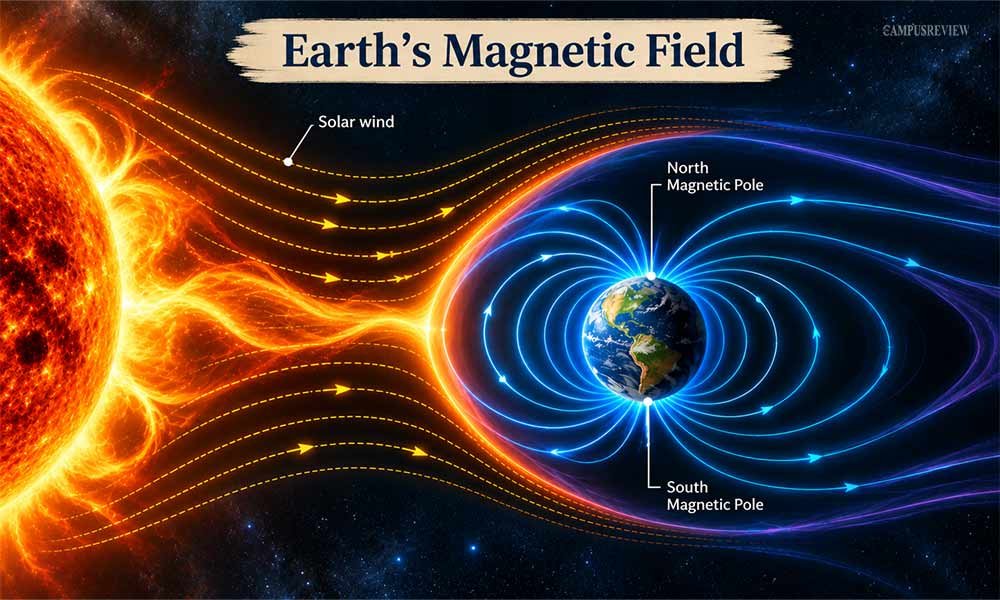
The molten iron and nickel in the outer core is constantly moving. As Earth spins, this movement creates swirling electric currents. This process, called the geodynamo, generates Earth’s magnetic field. This invisible shield helps protect the planet from harmful solar radiation and causes a compass needle to point toward magnetic north.
The Northern and Southern Lights
Earth’s magnetic field helps create the northern and southern lights, also called the aurora borealis and aurora australis.
Charged particles from the Sun enter Earth’s upper atmosphere near the poles, where they collide with gases such as oxygen and nitrogen. These collisions release energy as colorful glowing lights in the sky.
Inner Core: A Solid Metal Heart
The inner core is the innermost layer of Earth, located at the planet’s center. It begins about 5,150 kilometers deep and extends to Earth’s center at 6,371 kilometers.
Facts about the Inner Core
- Location: 5,150 kilometers deep to Earth’s center
- Size: Radius of about 1,220 kilometers, roughly 70% the width of the Moon
- State: Solid
- Made of: Iron and nickel
- Temperature: About 5,400 degrees Celsius, close to the surface of the Sun
Why the Inner Core Is Solid Despite the Heat
Temperatures at the inner core rival the surface of the Sun, so why does it not melt? The answer is pressure. At the center of the Earth, pressure reaches more than 3 million times the pressure at sea level. This crushing force squeezes iron atoms so tightly that they cannot shift into a liquid state, even at extreme heat. The metal stays solid, not from cold, but from sheer pressure.
The Innermost Inner Core
Recent research adds another twist. Scientists have found a ball within the ball, sometimes called the innermost inner core. Seismic waves travel through this hidden center at a different angle than the rest of the inner core. This hints that Earth went through a major change deep in its past, though experts are still working out exactly why.
A Core That Spins Differently
The inner core also has a strange habit of spinning. Some studies suggest it rotates at a slightly different speed than the rest of the planet, sometimes edging ahead and sometimes falling behind over decades. Researchers are still debating exactly how and why this happens.
Meet the Scientists Who Mapped Earth’s Layers
We cannot directly see inside the Earth. Scientists have learned about its internal layers by studying earthquake data and how seismic waves travel through the planet.
Andrija Mohorovicic (1909)
This Croatian scientist studied earthquake waves in 1909. He noticed that wave speed suddenly jumped at a certain depth. This marked the boundary between the crust and the mantle. Today, geologists call this boundary the Moho, named after him.
Beno Gutenberg (1912)
A few years later, German seismologist Beno Gutenberg studied waves that seemed to vanish at a certain depth. He worked out that this happened because the waves hit a liquid layer, the outer core. This boundary, 2,900 kilometers down, is now called the Gutenberg discontinuity.
Inge Lehmann (1936)
Danish scientist Inge Lehmann made one of the biggest discoveries in geology. While studying earthquake waves in 1936, she found signals that should not exist if the whole core was liquid. She proposed that a solid inner core sat inside the liquid outer core. Later research proved she was right, well before modern computers even existed.
Adam Dziewonski and Don Anderson (1981)
In 1981, these two scientists combined decades of earthquake data into one model called PREM, the Preliminary Reference Earth Model. It maps out density, pressure and wave speed at every depth inside the Earth. Geologists still use this model as a reference today.
Why Earth’s Layers Matter to You
Learning about Earth’s interior is not just trivia. It explains many things you already notice in everyday life.
- Earthquakes and volcanoes: Most happen at the edges of tectonic plates in the crust.
- Navigation: Compasses and some GPS systems rely on Earth’s magnetic field from the outer core.
- Mining and energy: Minerals, metals, and geothermal heat all come from processes inside the crust and mantle.
- Climate over deep time: Volcanic activity linked to the mantle has shaped Earth’s atmosphere for billions of years.
Once you understand these layers, news about earthquakes, volcanic eruptions, or shifting magnetic poles starts to make a lot more sense.
Layers of the Earth Compared
| Layer | Location | State | Main Composition |
| Crust | Outermost, 0-70 km deep | Solid | Rock (granite and basalt) |
| Mantle | 70 – 2,900 km deep | Solid, flows slowly | Silicate rock (peridotite) |
| Outer Core | 2,900 – 5,150 km deep | Liquid | Iron and nickel |
| Inner Core | 5,150 – 6,371 km (center) | Solid | Iron and nickel |
Key Facts About Earth’s Interior
Learn the key facts about Earth’s interior, including its four layers, depth, composition, and temperature.
- Earth’s radius is about 6,371 kilometers.
- The mantle alone makes up 84% of Earth’s total volume.
- The deepest hole ever drilled reaches only 12 kilometers, barely past the crust.
- The inner core’s temperature is close to 5,400 degrees Celsius, similar to the surface of the sun.
- Earth’s magnetic field comes from the moving liquid metal in the outer core.
- The inner core grows slightly every year as the outer core cools and freezes onto it.
- Diamonds form in the upper mantle, about 150 kilometers below the surface.
- The Ring of Fire around the Pacific Ocean produces about 90% of the world’s earthquakes.
End Note
Layers of the Earth work together like a well-tuned machine. The crust gives us solid ground to stand on. The mantle drives the slow-moving plates that shape continents. The outer core creates the magnetic field that protects us from the Sun. The inner core anchors the whole system at the center.
Next time you feel the ground beneath your feet, remember: you are standing on top of a churning, sizzling world, 6,371 kilometers deep to the very center.
FAQs
1. Which layer creates Earth’s magnetic field?
The outer core creates Earth’s magnetic field. Its moving liquid iron and nickel generate electric currents through a process called the geodynamo.
2. What is Earth’s core made of?
Earth’s core is made of both the outer core and inner core are made mostly of iron and nickel. The outer core is liquid, while the inner core is solid due to extreme pressure.
3. How thick is each layer of Earth?
The crust ranges from 5 to 70 kilometers thick. The mantle is about 2,900 kilometers thick. The outer core is roughly 2,250 kilometers thick. The inner core has a radius of about 1,220 kilometers.
4. How does Earth’s magnetic field form?
Earth’s magnetic field forms in the outer core. As this liquid iron and nickel layer moves and Earth rotates, it generates electric currents through a process called the geodynamo. This process powers the invisible magnetic field around the entire planet.