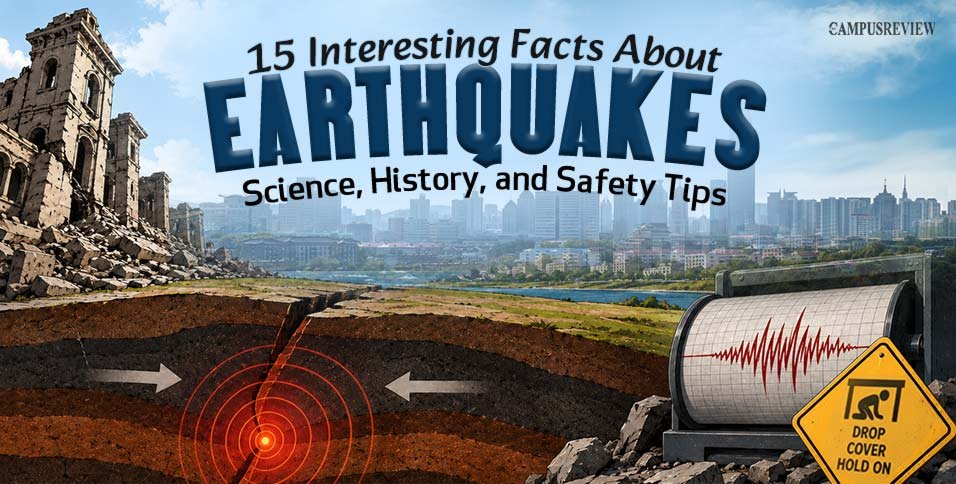
Earthquakes are sudden movements of the ground caused by energy released inside the Earth. They can be very small and go unnoticed, or they can be strong enough to damage buildings and roads. Most earthquakes happen when tectonic plates move against each other. This movement can send waves through the ground, making the surface shake.
Earthquakes can also cause landslides, fires, and tsunamis in some cases. They happen in many parts of the world, but some areas experience them more often than others. Scientists study earthquakes to understand when, where, and why they happen. These facts about earthquakes help us learn more about one of the most powerful natural events on Earth.
What Is an Earthquake?
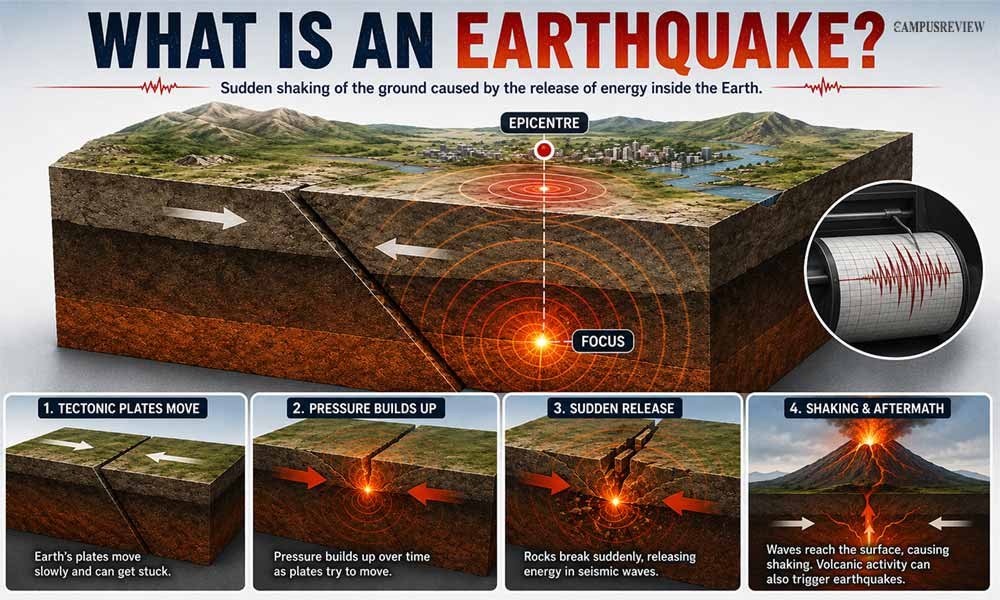
An earthquake is the sudden shaking of the ground caused by the release of energy inside the Earth. This energy travels through the ground as seismic waves, which can make the surface shake. Most earthquakes happen when tectonic plates move along faults beneath the Earth’s surface.
The Earth’s outer layer is divided into huge slabs of rock called tectonic plates. These plates move slowly over a softer layer below them. When plates get stuck, pressure builds up until the rocks suddenly break, causing an earthquake. Earthquakes can also occur near volcanoes because volcanic activity can create pressure and movement underground.
The point where an earthquake starts is called the focus, while the point directly above it on the surface is the epicentre. Shaking is usually strongest near the epicentre.
Where Do Earthquakes Occur Most?
Most earthquakes strike along the Pacific Ring of Fire. This is a horseshoe-shaped zone around the edges of the Pacific Ocean. It runs through countries like Japan, Indonesia, the Philippines, Chile, and the western coast of the United States.
About 90% of the world’s earthquakes happen in this zone, according to the USGS. That’s because it sits right on the boundaries of several major tectonic plates.
15 Interesting Facts About Earthquakes
Here are 15 verified and genuinely surprising facts about earthquakes. Some are common knowledge. Others are things even seismology students may not have learned yet.
1. Earthquake warnings can now travel at the speed of light
For decades, scientists believed no warning could travel faster than a seismic wave. That has changed. A massive earthquake actually disturbs Earth’s gravity field for a split second.
Sensitive instruments can detect this gravity signal before the destructive shaking arrives, because it moves at the speed of light. Scientists call this signal PEGS (Prompt Elasto-Gravity Signals). It could give early warning systems a valuable head start on the biggest quakes.
2. Earthquakes can create gold
This sounds unbelievable, but it is real geology. Deep underground, cracks open suddenly during an earthquake. Hot mineral-rich water trapped in these cracks instantly turns to steam.
This flash of pressure change causes gold and silica to separate from the water and stick to the rock walls. Repeat this over thousands of earthquakes, and you get gold veins. Many of the world’s gold deposits formed this way.
3. The Earth “rings like a bell” after a huge quake
After a massive earthquake, the whole planet vibrates, not just the local area. Scientists call this a “free oscillation.” Following the 2004 Sumatra and 2011 Tōhoku earthquakes, sensitive instruments detected the entire Earth ringing for several months before the vibrations faded away.
4. A satellite once detected an earthquake from space
During the 2011 Tōhoku earthquake in Japan, ground shaking pushed sound waves up through the atmosphere. By the time these waves reached the edge of space, they had grown much stronger. The European Space Agency’s GOCE satellite, flying in low orbit, picked up the disturbance. It became the first spacecraft to detect an earthquake from orbit.
5. Big earthquakes can shorten your day
A powerful earthquake can shift huge amounts of rock closer to Earth’s center. This changes the planet’s mass balance slightly, which speeds up its spin. The 2011 Tōhoku earthquake shortened the length of a day on Earth by a tiny fraction of a second. The 2004 Sumatra earthquake did something similar.
6. The Moon and Mars have earthquakes too
They are called moonquakes and marsquakes. Because the Moon and Mars are dry, with no water in their rocks, seismic waves travel through them for much longer than on Earth.
A moonquake can make the Moon “ring” for over an hour, while a quake on Earth usually fades within minutes.
7. Some earthquakes break the sound barrier
Most ruptures move along a fault at a set speed. But under the right conditions, a rupture can accelerate past the speed of sound in rock. This is called a supershear earthquake.
It creates a shockwave effect, similar to a jet breaking the sound barrier, and it can spread intense shaking across a much wider area.
8. Earthquakes can create flashes of light
People have reported strange glowing lights in the sky before and during earthquakes for centuries. Scientists now think stress on certain rocks releases electric charges. These charges travel to the surface and ionise the air, creating a glow. This is known as the earthquake lights theory.
9. Some Earthquakes Shake the Ground Without Causing Damage
Certain faults slip very slowly, over days or even weeks, without producing strong shaking. These are called “silent earthquakes” or slow slip events. They release the same amount of energy as a large earthquake, but so gradually that people never feel it. GPS instruments are usually the only way to detect them.
10. The Moon and Sun can nudge earthquakes along
Ocean tides are not the only thing the Moon and Sun affect. Their gravity also flexes the solid Earth slightly, twice a day. This is called a solid Earth tide. On a fault that is already close to breaking, this tiny extra stress can be the final push that triggers the slip.
11. Earthquakes leave fossil evidence
When rock grinds against rock at high speed during a quake, friction can heat it past its melting point in seconds. This melted rock cools quickly into a dense, glassy material called pseudotachylyte. Geologists use these glassy veins to identify earthquakes that happened millions of years ago.
12. Shaking can turn solid ground into liquid
This is called soil liquefaction. During strong shaking, water-soaked sandy soil can lose its strength and start behaving like a liquid. Buildings and roads can sink or tilt into ground that suddenly acts like quicksand.
13. Earthquakes can shake water thousands of kilometres away
Long earthquake waves can make water slosh back and forth in lakes, swimming pools, and harbours far from the epicentre. This sloshing is called a seiche. In 1950, an earthquake in Assam-Tibet caused seiches in lakes as far away as Norway and England.
14. A 2012 earthquake showed a tectonic plate breaking apart in real time
In April 2012, a massive earthquake struck off the coast of Sumatra, far from any known plate boundary. It turned out to be the largest strike-slip earthquake ever recorded. Scientists later confirmed it was evidence of the Indo-Australian Plate slowly splitting into separate pieces.
15. Japan records more earthquakes than almost anywhere else
Japan sits directly on the Pacific Ring of Fire, where four tectonic plates meet. This is why Japan experiences thousands of small earthquakes every year and has some of the strictest earthquake building codes in the world.
Strongest Earthquakes in History
Scientists today measure earthquake size using the Moment Magnitude scale, not the older Richter scale. The Richter scale often underestimated the size of very large earthquakes. The moment magnitude scale is logarithmic. Each whole number increase means about 32 times more energy released.
Here are the 10 largest and strongest earthquakes ever recorded, based on verified USGS data:
| Rank | Year | Location | Notable Impact |
|---|---|---|---|
| 1 | 1960 | Valdivia, Chile | The strongest earthquake ever recorded. Triggered a Pacific-wide tsunami and killed over 1,600 people. |
| 2 | 1964 | Prince William Sound, Alaska, USA | Known as the Great Alaska earthquake. Caused $2.3 billion in damage. |
| 3 | 2004 | Sumatra, Indonesia | Triggered the Indian Ocean tsunami, one of the deadliest disasters in history. |
| 4 | 2011 | Tōhoku, Japan | Caused a massive tsunami and the Fukushima nuclear disaster. |
| 5 | 1952 | Kamchatka, Russia | The first magnitude 9+ earthquake ever recorded. |
| 6 | 2025 | Kamchatka, Russia | One of the largest earthquakes of the 21st century so far. |
| 6 (tied) | 2010 | Biobío, Chile | Destroyed more than 370,000 homes. |
| 8 | 1906 | Ecuador-Colombia | Triggered a tsunami felt as far as San Francisco. |
| 9 | 1965 | Rat Islands, Alaska, USA | Generated a 35-foot tsunami. |
| 10 | 1950 | Assam-Tibet, India | Triggered massive landslides across the Himalayas. |
Can Earthquakes Be Predicted?
Scientists cannot predict the exact time, place, and size of an earthquake in advance. This is one of the biggest myths people still believe.
What scientists can do is:
- Calculate the long-term probability of a quake in a known fault zone.
- Detect the first, weaker seismic waves and send an early warning a few seconds before stronger shaking arrives.
- Track slow-building stress along fault lines using GPS and satellite data.
A few seconds of warning may not sound like much, but it is enough time to stop trains, pause surgeries, and get under cover.
Earthquake Safety Tips
Most earthquake injuries do not come from buildings collapsing. They come from falling objects, broken glass, and tipping furniture. That means simple precautions can genuinely save lives.
Myths you should stop believing
| Myth | Reality |
|---|---|
| Stand in a doorway | Modern doorways are no stronger than the rest of the wall. You get no extra protection, and swinging doors can injure your hands. |
| Use the “triangle of life” | This method tells you to lie next to furniture. But buildings rarely collapse flat. Furniture usually slides or tips, which is dangerous to lie beside. |
| Run outside during shaking | Most injuries happen near building exits. Glass, bricks, and signs fall from the outside of buildings during shaking. |
What to do during an earthquake
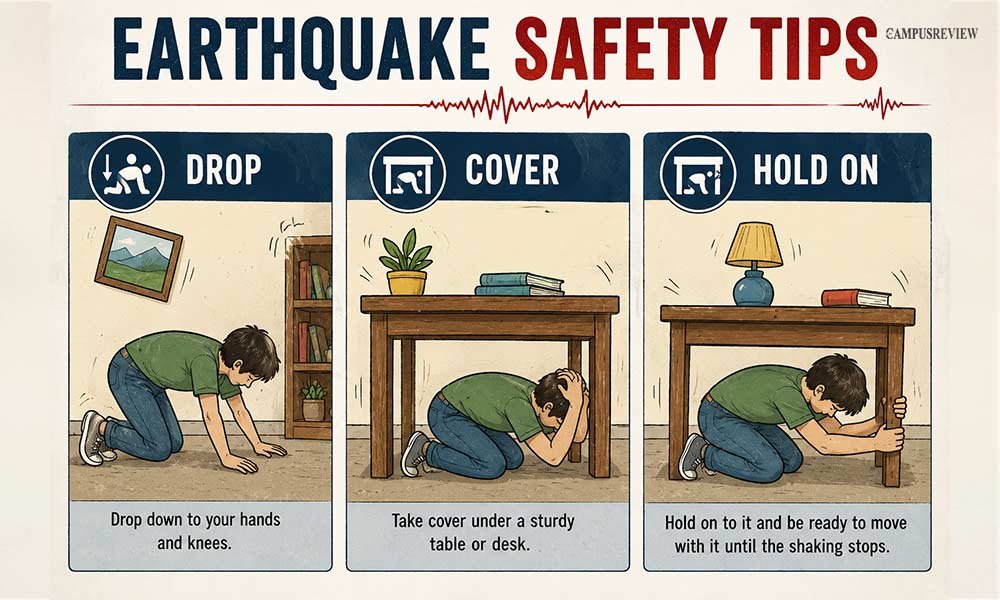
The method endorsed by FEMA, USGS, and the Red Cross is simple: Drop, Cover, and Hold On.
- Drop to your hands and knees before the shaking knocks you down.
- Cover your head and neck. Get under a sturdy table or desk if you can.
- Hold on to your shelter and stay covered until the shaking fully stops.
A few quick adjustments for different situations:
In bed: Stay in bed. Cover your head with a pillow instead of running across a dark room full of debris.
In a car: Pull over away from bridges, trees, and power lines. Stay inside with your seatbelt on.
Near the coast: If the shaking is strong or lasts more than 20 seconds, move to higher ground immediately. Do not wait for an official tsunami alert.
After the shaking stops
- Check yourself and others for injuries first.
- Put on sturdy shoes before walking through debris.
- If you smell gas, turn off the supply and avoid using switches or open flames.
- Expect aftershocks, and stay away from damaged buildings.
- Use text messages instead of phone calls, since networks get congested quickly.
Final Thoughts
Earthquakes are one of the most powerful forces on our planet. They can shift coastlines, create gold, and even shorten a day, yet most people only know the basics from school. These facts about earthquakes show how much there is to learn about how they happen and affect the world around us. Understanding earthquakes and how to stay safe is useful knowledge for every student, not just those studying geology.
If you take one thing away from this guide, let it be this: Drop, Cover, and Hold On. It is the one action, backed by real science, that can help keep you safe when the ground starts to move.