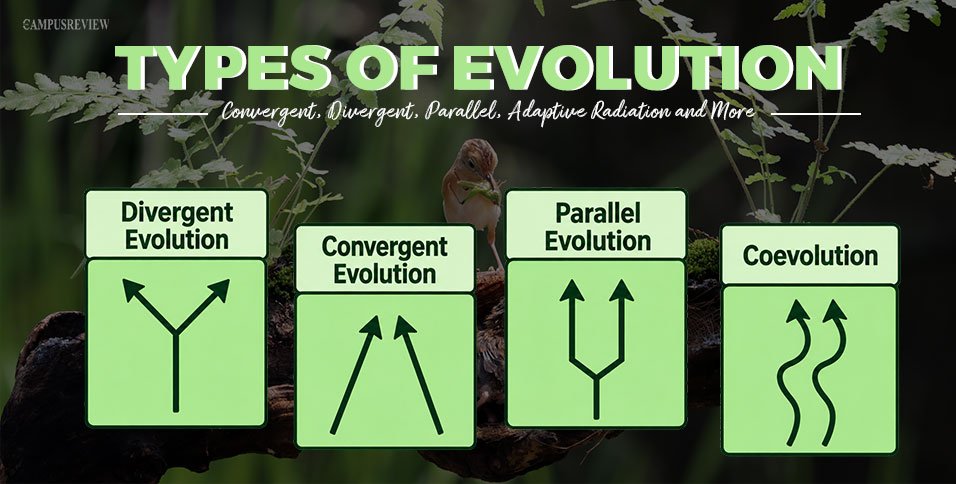
Why do sharks and dolphins look alike despite belonging to different animal groups? The answer lies in evolution.
Scientists identify seven main types of evolution: divergent, convergent, parallel, coevolution, adaptive radiation, gradualism, and punctuated equilibrium. Each explains how species change, adapt, and develop over time.
From Darwin’s finches to antibiotic-resistant bacteria, these patterns help us understand how evolution shapes life on Earth. This guide explains each type with simple examples and a comparison table.
What Is Evolution?
Evolution is the change in the inherited traits of a population from one generation to the next. A single person does not evolve during a lifetime. A gym-built muscle or a summer tan stays with that person. Only changes in genes pass to children.
Four ingredients drive biological evolution:
- Genetic variation: Members of a species differ in inherited traits, such as beak size or fur color.
- Mutation: Random DNA changes create brand-new traits.
- Natural selection: Organisms that fit their surroundings better survive and have more offspring. Their helpful traits spread.
- Adaptation: Over many generations, selection builds traits that suit a habitat. A snow leopard’s thick fur is one case of species adaptation.
Charles Darwin (1809 to 1882) laid the foundation of evolutionary theory. He sailed on HMS Beagle from 1831 to 1836 and published On the Origin of Species in 1859.
Alfred Russel Wallace reached the same idea on his own, and his letter pushed Darwin to publish. Biologists also separate two ideas. Patterns describe the shape of evolution, such as divergence. Mechanisms cause it, such as natural selection. This guide covers the patterns first.
What Are the Main Types of Evolution?
Biologists teach seven main types of evolution. Five describe how lineages relate to each other: divergent, convergent, parallel, coevolution, and adaptive radiation. Two describe speed: gradualism and punctuated equilibrium. Each pattern shows a different way that species diversification builds the variety of life on Earth.
1. Divergent Evolution
Divergent evolution happens when groups of one species move apart and slowly become different species. They share a common ancestor. They end up with different traits because they live in different places or eat different foods.
The process takes thousands to millions of years. It usually follows four steps:
- Step 1: One group splits. A mountain, river, or new island separates part of a population from the rest.
- Step 2: Each group faces different conditions. One habitat may be cold and dry. The other may be warm and wet. Food sources differ as well.
- Step 3: Natural selection works in each place. Individuals with traits that suit their habitat survive and raise more young.
- Step 4: Differences add up. After many generations, the groups look and behave differently. Eventually, they become separate species.
Scientists find strong proof of divergence in homologous structures. These are body parts that share the same basic bone plan, inherited from a common ancestor, even though they now do different jobs.
Example:
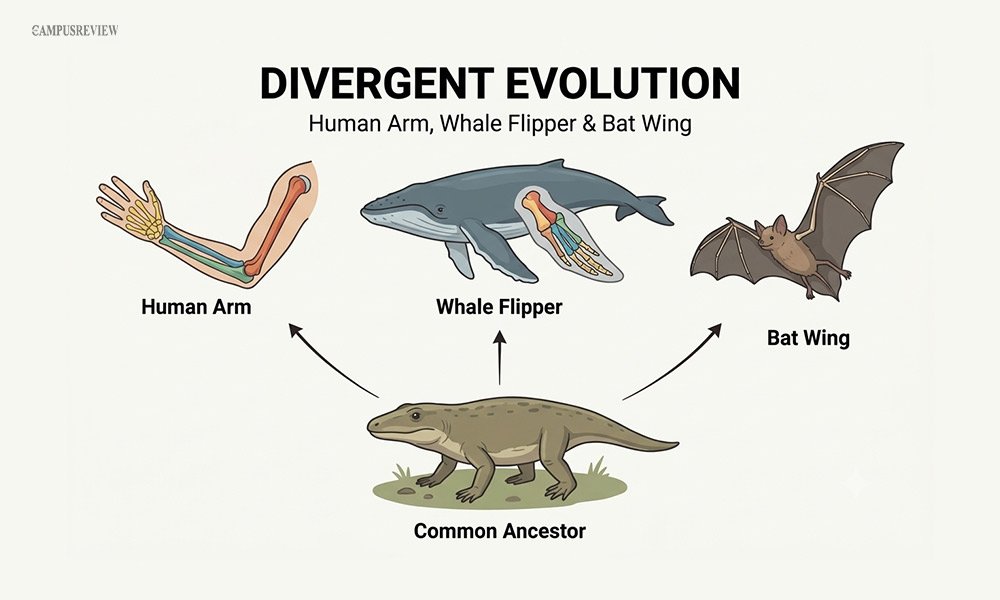
The human arm, the whale flipper, and the bat wing.
All three contain the same set of bones: one upper arm bone, two forearm bones, wrist bones, and finger bones. Humans use theirs to grasp and carry objects. Whales use theirs to steer through water. Bats stretch their finger bones to hold up a thin wing. Humans, whales, and bats all descend from an ancient four-limbed mammal.
Evolution did not build new limbs from scratch. It reshaped the same bones for different lives. These similarities and differences between species point to common ancestry.
2. Convergent Evolution
Convergent evolution happens when species that are not closely related develop similar traits because they face similar challenges. It works as the opposite of divergence. The starting points differ, but the results look alike.
The process has three steps:
- Step 1: Unrelated species face the same problem. For example, both need to move fast through water.
- Step 2: Natural selection rewards the same helpful traits. Individuals with the best-suited bodies survive in each group.
- Step 3: Different bodies reach similar solutions. Each group builds the solution from its own starting material.
Scientists call the results analogous structures. These body parts look alike and do the same job, but they have different origins.
Example:
Sharks and dolphins.
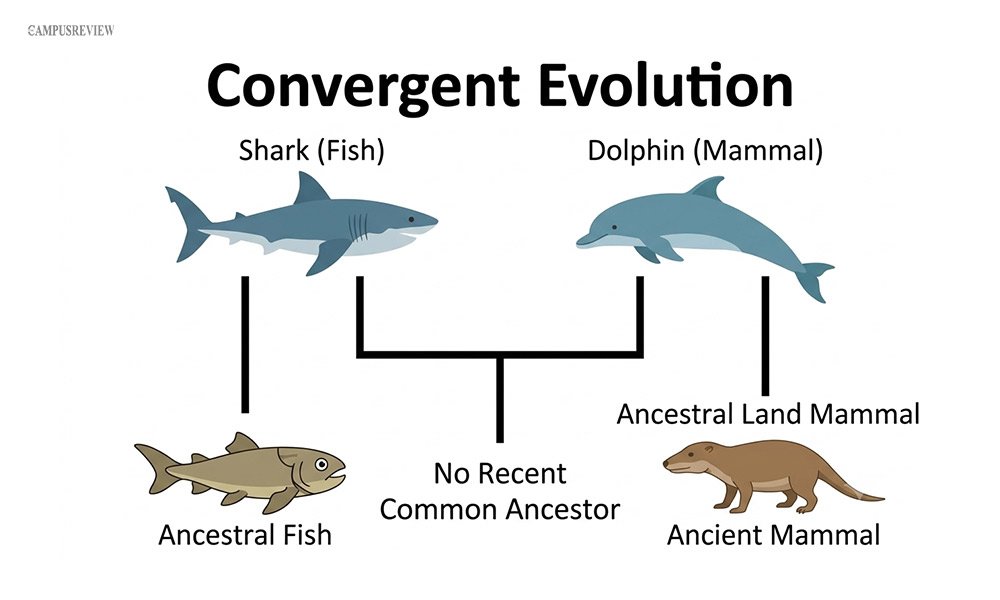
Both animals have a smooth, torpedo-shaped body, a fin on the back, and flippers at the sides. Water pushes back against anything that moves through it. A streamlined shape lets an animal swim faster with less effort. Yet the two are not close relatives.
A shark is a fish that breathes underwater through gills and swings its tail from side to side. A dolphin is a mammal that breathes air through lungs, feeds milk to its young, and moves its tail up and down. Their last shared ancestor lived long before the dinosaurs.
How to spot it: Check the family tree. If two animals look alike but are distant relatives, convergent evolution is the likely cause.
3. Parallel Evolution
Parallel evolution happens when closely related groups evolve the same trait independently, after splitting from a common ancestor, in similar environments. The groups do not share the trait through inheritance. Each one develops it on its own.
The process follows four steps:
- Step 1: One ancestral group splits into several populations.
- Step 2: The populations settle in separate but similar places.
- Step 3: Because they are close relatives, they carry similar genes and body plans. Natural selection pushes each population in the same direction.
- Step 4: Each population ends up with the same trait, without copying it from the others.
Example:
The threespine stickleback.
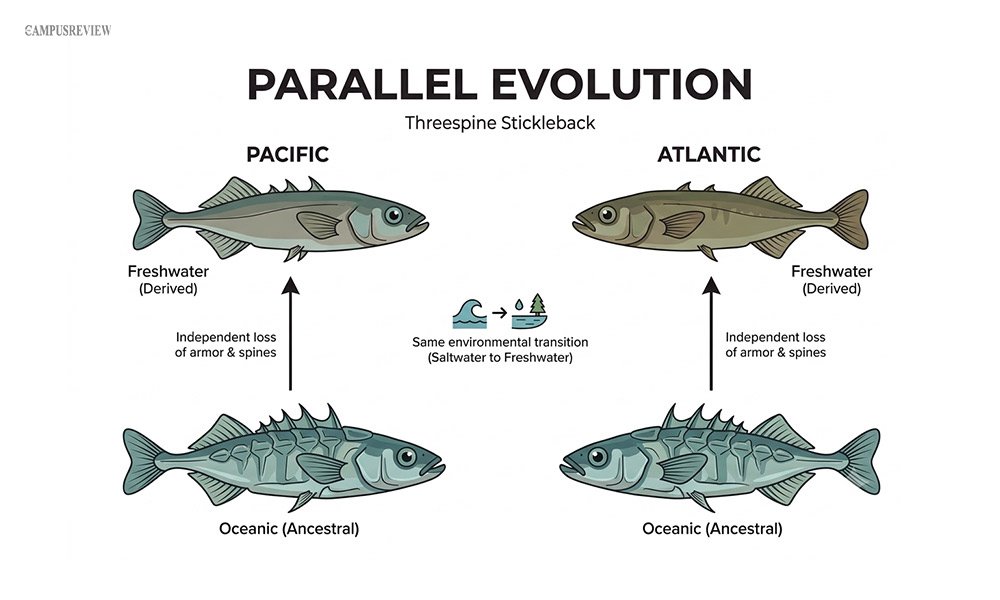
This small fish lives in the ocean, where bony armor plates along its sides help protect it. Over time, ocean sticklebacks moved into freshwater lakes in North America, Europe, and other regions. In lake after lake, the freshwater fish lost most of their armor.
Heavy armor seems less useful in many lakes, and researchers link lighter armor to faster growth in young fish. Studies of Scottish populations show that the same gene changed again and again in separate lakes. The lakes never exchanged fish, yet the fish reached the same result.
4. Coevolution
Coevolution happens when two or more species live in close contact and shape each other’s evolution. A change in one species creates new pressure on the other. The second species adapts, and that change pressures the first species in return.
The cycle works in four steps:
- Step 1: Two species depend on or affect each other. Examples include a flower and its pollinator, or a hunter and its prey.
- Step 2: One species develops a helpful trait.
- Step 3: The partner faces new pressure and adapts.
- Step 4: The cycle repeats over many generations, and the traits fit each other more closely.
Coevolution takes two main forms:
- Cooperative coevolution: Both species benefit, as with plants and the animals that pollinate them.
- Competing coevolution: Species act like opponents in an arms race. Predators become faster, and prey become more alert.
Example:
Hummingbirds and long, tube-shaped flowers.
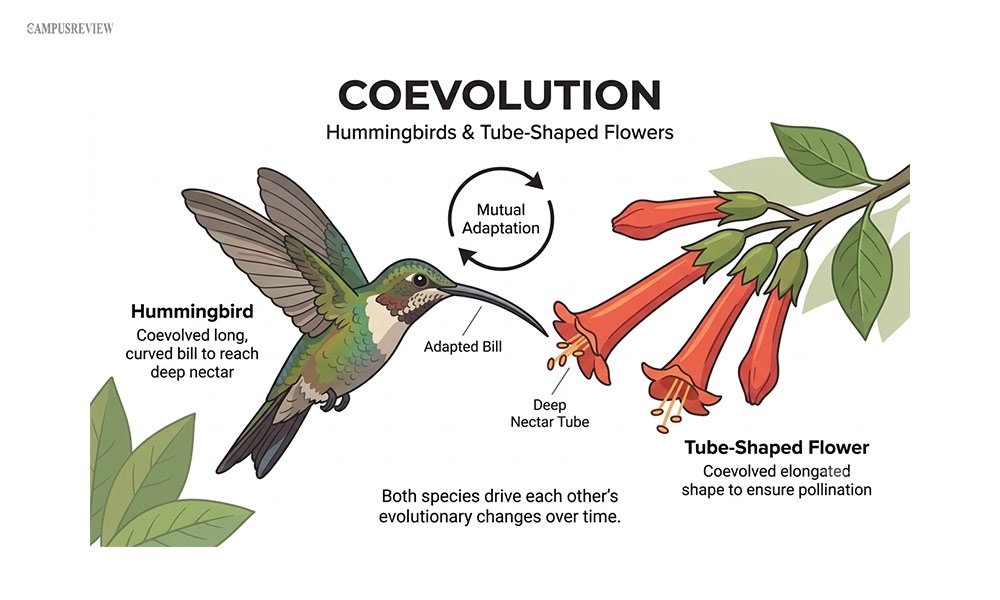
Hummingbirds drink nectar. Flowers with deep tubes hide nectar so that only birds with long bills can reach it. The bird gets food, and the flower gets its pollen carried to another flower of the same kind.
Over time, longer tubes favored longer bills, and longer bills favored longer tubes. In the Andes, several passionflower species grow nectar tubes 6 to 14 cm long.
5. Adaptive Radiation
Adaptive radiation is a fast burst in which one ancestral species splits into many new species, each suited to a different way of life. Scientists call that way of life a niche. A niche covers what an animal eats, where it lives, and how it survives.
It starts when a new opportunity opens, such as a fresh island or an empty habitat left after a mass extinction. The process has four steps:
Step 1: A few individuals reach an area with few competitors.
Step 2: The area offers many foods and homes that nobody uses yet.
Step 3: Natural selection shapes different groups to use different resources.
Step 4: The groups become separate species, each with its own body shape and habits.
Example:
Darwin’s finches.
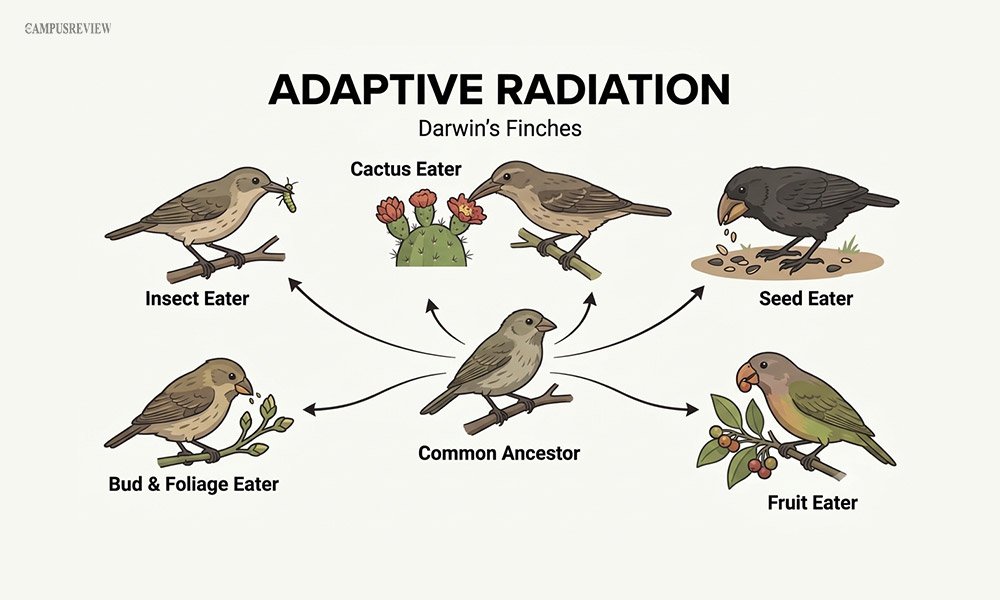
A small group of finches flew from South America to the Galápagos Islands about 2 to 3 million years ago. The islands had few rival birds and many types of food.
The finches’ descendants now form more than a dozen species. Some have thick, strong beaks that crack hard seeds. Others have slim, pointed beaks that catch insects. Darwin noticed these beak differences in 1835, and they helped shape his thinking about evolution.
What Are the Types of Evolution Based on Speed?
Scientists also ask how fast species change. Two models answer this question. Both describe evolutionary changes over time.
6. Gradualism
Gradualism describes slow, steady change. Each generation differs only a little from the one before. Over millions of years, those small steps add up to large changes. This pattern fits species that live in a steady environment for a long time.
Example:
The horse.
The first horses lived more than 50 million years ago. They were about the size of a fox, with several toes on each foot and teeth built for soft forest leaves.
As forests slowly gave way to open grasslands, horses grew taller, lost their side toes, and developed strong teeth for tough grass. Modern horses run on a single hoof. Fossils also show that horse evolution looked like a branching bush, not a straight line.
7. Punctuated Equilibrium
Punctuated equilibrium describes long periods of little change, broken by short bursts of rapid change. Scientists Niles Eldredge and Stephen Jay Gould proposed it in 1972. A species usually stays stable because it already fits its environment well. Quick change happens when a small group becomes isolated or when the environment shifts suddenly. In a small group, a helpful trait spreads fast, so a new species can appear within a short span of geological time.
Example:
Trilobites.
Trilobites were small sea animals that lived long before the dinosaurs. Eldredge studied their fossils and found that species stayed almost the same through many rock layers. New forms then appeared fairly suddenly.
The American Museum of Natural History explains his work.
Both models are real. Some species change steadily, and others change in bursts. Environment and population size decide which pattern appears.
What Are the Mechanisms of Evolution?
Mechanisms are the processes that change gene variants inside a population. They explain how evolution works at the gene level.
| Mechanism | What it does | Simple example |
| Natural selection | Helpful traits become more common | Dark moths survived better on soot-covered trees |
| Genetic drift | Chance changes gene frequencies, mostly in small groups | A hunted animal group shrinks, and survivors pass on only some genes |
| Gene flow | Migration moves genes between populations | Texas pumas released into Florida added new genes to panthers |
| Mutation | Creates brand-new gene variants | A DNA copying error gives a bacterium a new trait |
| Sexual selection | Traits that win mates become common | A peacock’s large tail attracts peahens |
What Are Examples of Evolution Happening Today?
Evolution continues around us. These examples of evolution in nature affect daily life.
Antibiotic resistance: Doctors began using methicillin in 1959. The first resistant strain, MRSA, appeared in the UK by 1961. A 2024 Lancet study estimated that resistant bacteria directly caused 1.14 million deaths in 2021.
Pesticide resistance: Repeated spraying leaves resistant insects alive. The Colorado potato beetle has become resistant to more than 25 insecticides.
Elephants without tusks: Heavy poaching in Mozambique’s Gorongosa National Park favored tuskless females. This is an example of survival of the fittest, as tuskless elephants were more likely to survive and reproduce. A 2021 Science study found that their proportion increased from 18.5% to 50.9% of females after the war.
Flu viruses: Flu viruses change a little every year. For that reason, health agencies update the flu vaccine each year, as the CDC explains.
What Is the Difference Between the Types of Evolution?
Use this table to compare the different patterns of evolution.
| Type | Main idea | Ancestry and driver | Example |
| Divergent | Related species become different | Common ancestor; different habitats | Human arm, whale flipper, bat wing |
| Convergent | Unrelated species develop similar traits | Distant ancestors; similar challenges | Sharks and dolphins |
| Parallel | Related groups evolve the same trait separately | Recent ancestor; similar environments | Freshwater sticklebacks losing armor |
| Coevolution | Interacting species change each other | Close partners or opponents | Hummingbirds and tube-shaped flowers |
| Adaptive radiation | One ancestor becomes many species fast | Open niches such as new islands | Darwin’s finches |
| Gradualism | Small changes add up slowly | Steady selection, stable conditions | Horse evolution |
| Punctuated equilibrium | Long stability, then quick change | Small isolated groups, sudden shifts | Trilobite fossils |
Why Is Understanding Evolution Important?
- Biodiversity: Common ancestry explains evolution and biodiversity, including why islands hold species found nowhere else.
- Medicine: Knowing how bacteria and viruses evolve helps doctors manage antibiotics and update vaccines.
- Conservation: Protecting a species means protecting its genetic variety, not only its numbers. The Florida panther recovered after gene flow from Texas pumas.
Final Thoughts
The types of evolution show how life builds variety. Divergent evolution splits related species. Convergent and parallel evolution create matching designs. Coevolution links species together.
Adaptive radiation fills empty niches fast. Gradualism and punctuated equilibrium describe the pace. Remember one rule: patterns describe what happens, and mechanisms explain why.
Pranjal Kharche
Common Questions About the Types of Evolution
1. Does evolution have a goal?
No. Evolution has no fixed goal or finish line. It occurs as inherited traits that improve survival and reproduction become more common over generations.
2. How does human evolution fit into the types of evolution?
Human evolution is an example of divergent evolution. Humans share a common ancestor with other primates, and their lineages developed different traits over millions of years.
3. Which type of evolution is easiest to identify?
Convergent evolution is often easiest to identify because unrelated species develop similar features independently, such as sharks and dolphins developing streamlined bodies.