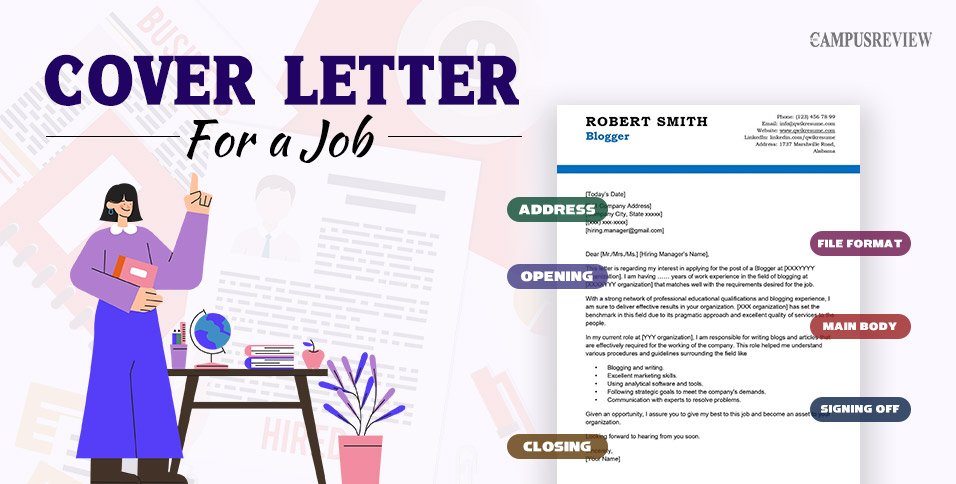
You’ve built the perfect resume. Then a job form asks for a cover letter, and you freeze.
A cover letter for a job is a short, one-page letter you send along with your resume. It explains why you want the role and why you fit it well. Your resume lists your skills. Your cover letter tells your story.
Employers read a cover letter to understand your motivation, not just your qualifications. A strong one can turn a maybe into an interview call.
This guide explains what a cover letter for a job is, how to write one, and what to include. A step-by-step writing method and a beginner-friendly cover letter example for students and freshers.
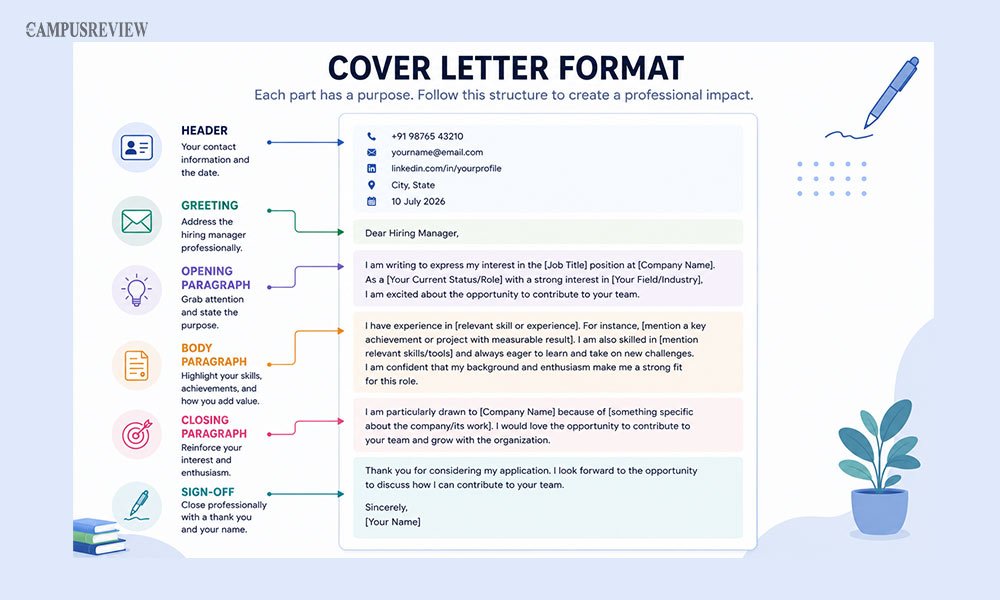
Cover Letter Format
Now that you know what is a cover letter for a job is, let’s look at the format employers expect.
1. Your name and contact details
2. Date
3. Hiring manager’s name and company name
4. Greeting
5. Opening paragraph
6. Body paragraph
7. Closing paragraph
8. Sign-off
Cover Letter Format Example
How Long Should a Cover Letter Be?
A cover letter for a job should be one page long. Keep it between 250 and 400 words and organize it into three or four short paragraphs. Recruiters often scan applications in seconds, so a concise cover letter is more likely to be read than a lengthy one.
How to Write a Cover Letter for a Job Step by Step
This is the part that actually matters. Each step below explains how to actually write a cover letter for a job. Write your own version under each one before you move to the next step.
1. Research the Company (5 minutes, not 5 hours)
You don’t need a deep-dive. Here, to research means looking at one specific detail you can mention by name, because that’s what proves you didn’t mass-apply to fifty companies with the same letter.
Open the company website first and read the “About” or “Our Story” page. That tells you their mission and tone. Then check their LinkedIn or Instagram for their most recent post. Look for a product launch, a campaign, an award, or a value they repeat often.
Write down one line about it in your own words. That line becomes your hook in Step 3 or your reason in Step 6.
Weak: “I am impressed by your company’s work in the industry.”
Strong: “Your recent campaign for local startups is the kind of hands-on, small-budget marketing I want to learn.”
2. Address the Hiring Manager by Name
A name instead of a generic greeting is a small thing that signals real effort. Recruiters read hundreds of “To Whom It May Concern” letters. A name makes yours feel personal from the first word.
Look in three places, in this order: the job posting itself, since some list the recruiter’s name near the bottom; the company’s “Team” or “Careers” page; and LinkedIn, where you can search the company name plus “HR” or “Talent Acquisition” to find the right person and greeting. If none of that works, don’t guess a spelling. Use a safe fallback instead.
Weak: “To Whom It May Concern,”
Strong: “Dear Ms. Kapoor,” or, if you truly can’t find a name, “Dear Hiring Manager,”
3. Write a Strong Opening Line
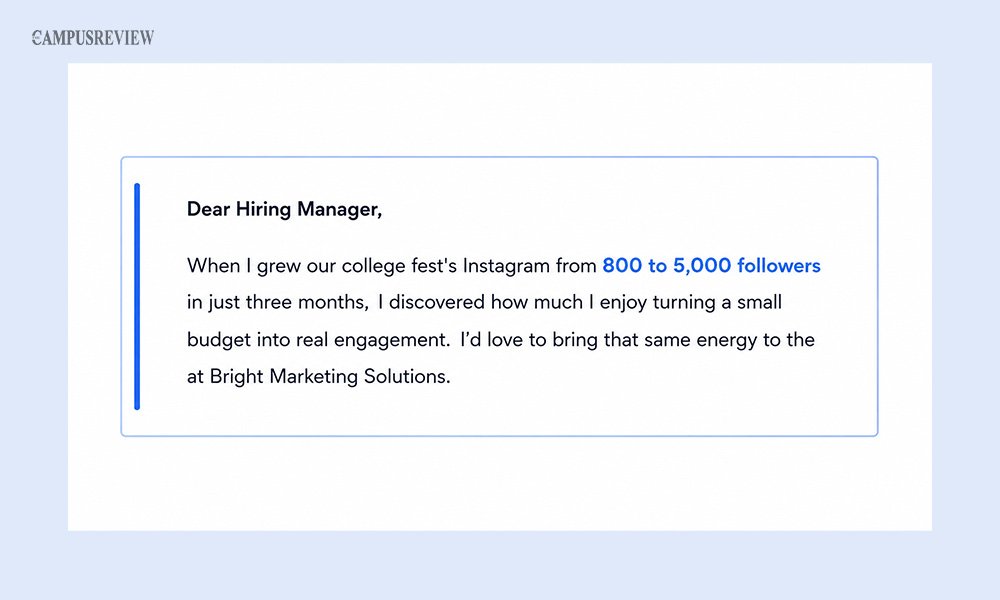
While writing a cover letter for a job, your first sentence decides if the recruiter reads the rest. Most students waste it by restating the job title, which the recruiter already knows since they wrote the posting. Instead, open with a real moment: something you did, learned, or achieved that connects straight to the role.
Use this 3-part formula:
Part 1: Name one real achievement or moment.
Part 2: Say what it taught you or what you enjoyed about it.
Part 3: Connect it directly to the role you’re applying for, in the same sentence or the next.
4. Match Your Skills to the Exact Job Post
This step is what makes a cover letter feel tailored rather than generic, and it also helps applicant tracking systems that scan for keywords.
Open the job description in another tab. Highlight two or three requirements listed near the top, since those are usually the ones that matter most. For each one, write one sentence that answers it directly using your own experience, in the same language the job post uses.
Job post says: “Looking for someone comfortable with social media analytics.”
Your line: “In my digital marketing course, I checked Instagram Insights every week to track engagement and adjust posting times, which raised our reach by 40 percent.”
Notice how the response echoes the exact phrase “social media analytics” through a specific tool and result, instead of a vague claim like “I’m good with social media.”
5. Add One Measurable Achievement
Numbers do the convincing that adjectives can’t. “Hardworking” and “dedicated” are claims anyone can make. A number is proof; add measurable achievements. When you write this line, think in three parts: what you did, how big or how often, and what happened as a result.
Weak: “I helped organize events.”
Strong: “I organized 3 college fests with over 500 attendees each, managing a team of 10 volunteers on a ₹50,000 budget.”
No hard number available? Use a scale word instead of a vague verb: “weekly,” “every semester,” “a team of 6,” “across 3 branches.” Anything more specific than “helped” or “worked on” moves you from vague to credible.
6. Explain Why You Want this Role, Specifically
Hiring managers can spot a copy-paste line about “passion” immediately, because it says nothing about their company in particular.
Go back to the detail you found in Step 1 and connect it to something real about your own goals: a skill you want to build, a kind of work you want exposure to, or a problem you’d like to help solve.
Weak: “I would be a great fit for this position.”
Strong: “I’m drawn to Bright Marketing Solutions because you work directly with small businesses, and I want to see how strategy changes when budgets are tight.”
7. End with a Clear Call to Action
Don’t fade out with a passive line that just hopes for the best. Close the cover letter the way you’d close a conversation you actually want to continue: thank them, restate that you’re interested, and tell them you’re available for the next step. Keep it to one or two sentences.
Weak: “I hope you consider my application.”
Strong: “I’d welcome the chance to talk about how I can contribute to your team. I’m available for a call any weekday afternoon.”
8. Proofread Before You Send It
A single typo in the company name or the hiring manager’s name can undo everything else you did right. Don’t proofread right after writing, since your brain fills in gaps automatically. Take a short break, then read the letter out loud.
Reading aloud catches awkward phrasing your eyes skip over on screen. Then check these four things by hand:
- The company name is correct everywhere, not copied from a different application
- The hiring manager’s name is spelled right
- The job title matches the one you’re applying for
- No leftover template brackets like [Company Name]
Cover Letter Examples
If you’re still unsure what is a cover letter for a job looks like, the examples of cover letters for a job are listed below for different roles.
Marketing Role Cover Letter Example
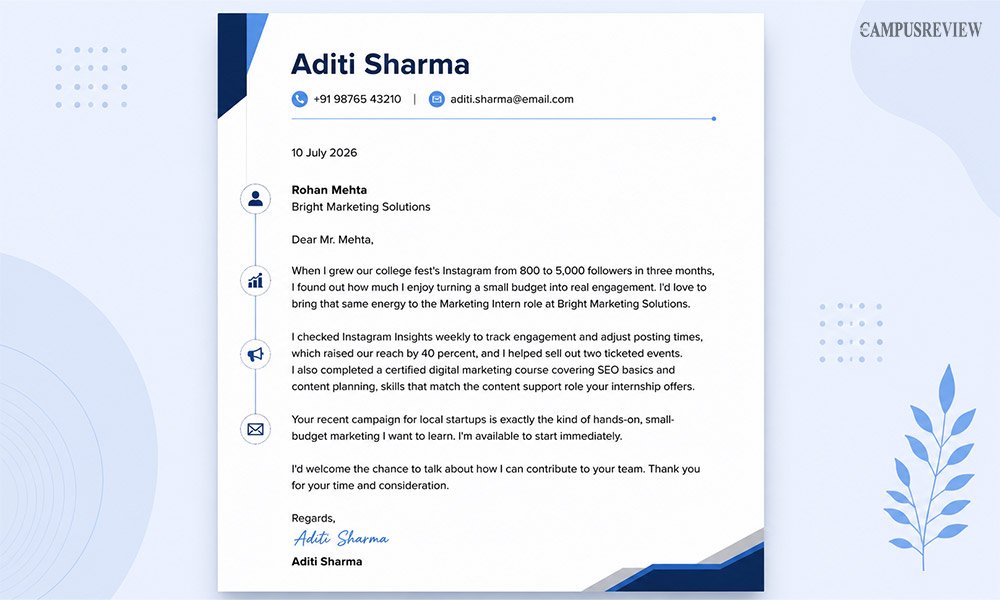
A cover letter for a job of marketing should highlight creativity, campaign results, and an understanding of the company’s brand. The example below shows how to connect your achievements with the employer’s goals.
Aditi Sharma
+91 98765 43210 | aditi.sharma@email.com
10 July 2026
Rohan Mehta
Bright Marketing Solutions
Dear Mr. Mehta,
Step 3, opening hook:
When I grew our college fest’s Instagram from 800 to 5,000 followers in three months, I found out how much I enjoy turning a small budget into real engagement. I’d love to bring that same energy to the Marketing Intern role at Bright Marketing Solutions.
Steps 4 and 5, skill match plus measurable achievement:
I checked Instagram Insights weekly to track engagement and adjust posting times, which raised our reach by 40 percent, and I helped sell out two ticketed events. I also completed a certified digital marketing course covering SEO basics and content planning, skills that match the content support role your internship offers.
Steps 1 and 6, company research plus motivation:
Your recent campaign for local startups is exactly the kind of hands-on, small-budget marketing I want to learn. I’m available to start immediately.
Step 7, call to action:
I’d welcome the chance to talk about how I can contribute to your team. Thank you for your time and consideration.
Regards,
Aditi Sharma
Finance Role Cover Letter Example
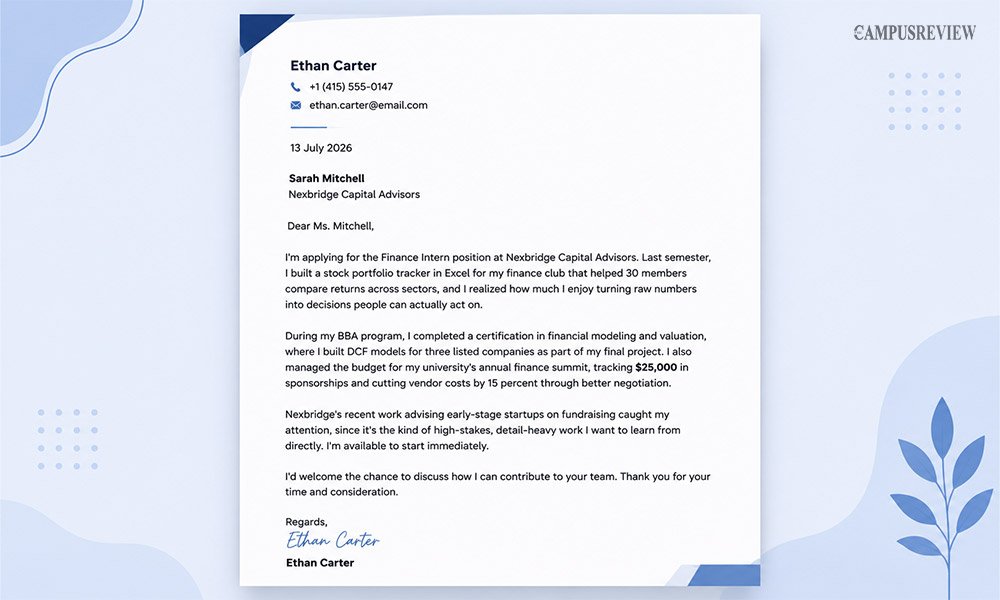
Finance professionals need to demonstrate analytical skills, attention to detail, and an understanding of business decisions. This example shows how to highlight those strengths in a cover letter.
IT Role Cover Letter Example
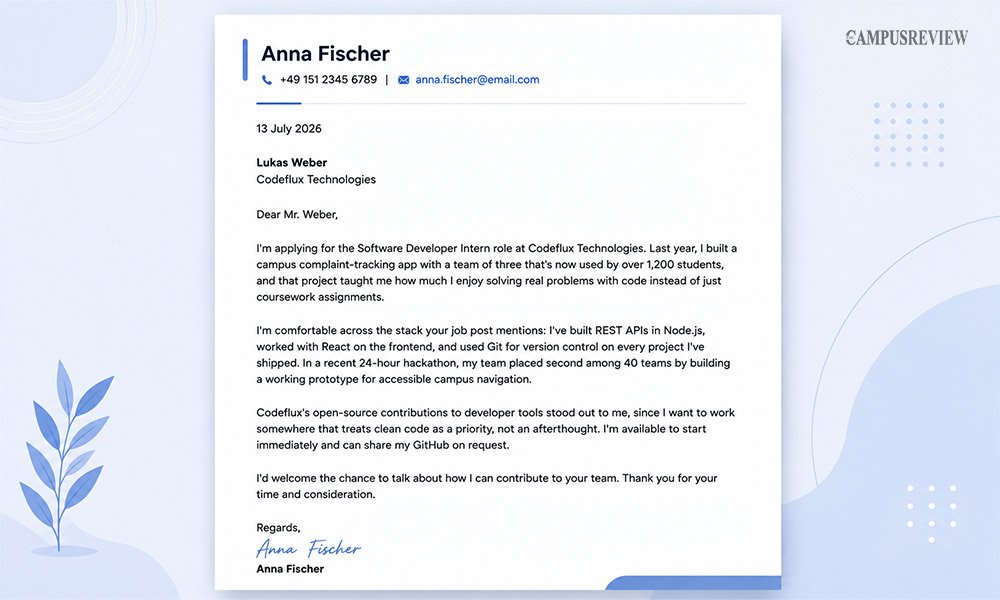
A cover letter for a job in the IT sector should showcase your technical skills, real-world projects, and problem-solving abilities. The example below demonstrates how to connect your experience with what the employer is looking for.
Teacher Role Cover Letter Example
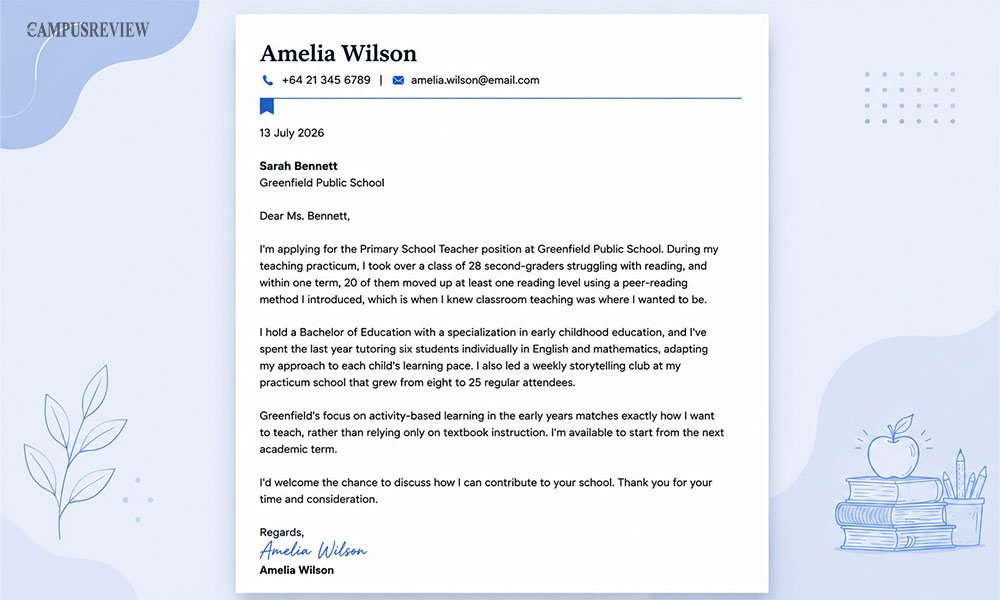
A teacher cover letter should highlight your classroom experience, teaching approach, and commitment to student success. The example below shows how to combine measurable achievements with a genuine passion for education.
Cover Letter for Freshers and Students with No Experience
Worried you don’t have enough experience? You have more than you think. A cover letter for freshers can lean on:
- Relevant coursework or certifications
- College projects and group assignments
- Internships, even short or unpaid ones
- Volunteer work or college fest organizing
- Part-time jobs, tutoring, or freelance gigs
Other than that, keep your LinkedIn optimized and resume updated. Frame each one around a skill the job needs. A group project becomes proof of teamwork. A tutoring gig becomes proof of communication skills.
Common Cover Letter Mistakes to Avoid
| Mistake | Quick Fix |
| Repeating the resume word for word | Explain the story behind the facts instead |
| Using “To Whom It May Concern” | Find the hiring manager’s name or use “Dear Hiring Manager” |
| Sending the same letter to every job | Customize the opening and body for each role |
| Writing more than one page | Cut it down to 250 to 400 words |
| Skipping the proofread | Read it aloud before sending |
End Note
Understanding what a cover letter for a job is the first step toward writing an application that stands out. A cover letter for a job doesn’t need to feel intimidating. Once you understand the format and follow the steps in this guide, writing one becomes a quick, repeatable task.
Use the cover letter template and example here as your starting point, then adjust the details for each company you apply to. A little customization goes a long way toward landing the interview.
FAQs
1. Is a cover letter necessary for every job?
Not every employer asks for one, but sending a cover letter even when it’s optional shows extra effort and often helps you stand out.
2. What is the difference between a resume and a cover letter?
A resume lists your qualifications and work history in bullet points. A cover letter explains those qualifications in short paragraphs and shows your motivation for the role.
3. Can I use the same cover letter template for every job?
You can reuse a cover letter template for structure, but always customize the opening, the skills you highlight, and the reason you want that specific role.
4. Do freshers need a cover letter?
Yes. A cover letter for freshers helps make up for a short resume. It lets you highlight projects, internships, and coursework in a way a resume alone cannot.