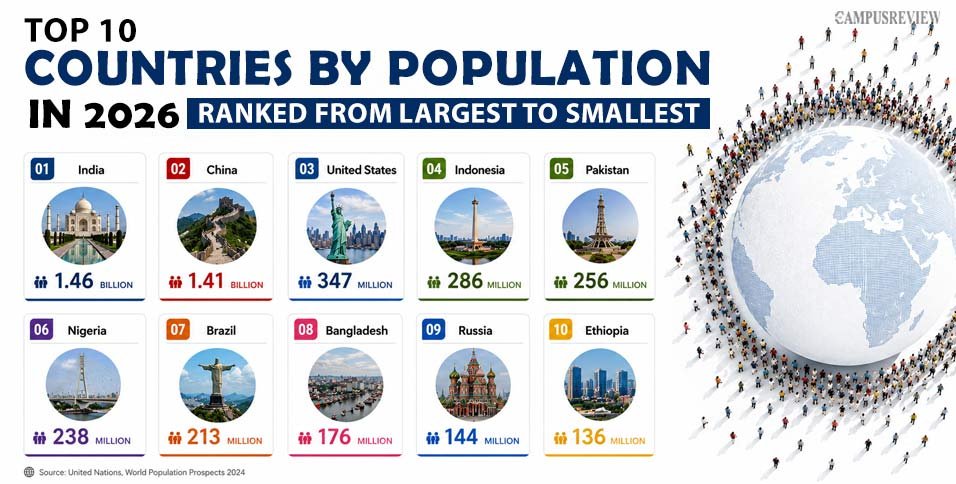
India is the most populated country in the world, with more than 1.46 billion people, just ahead of China. Together, the two countries account for about a third of the global population. These figures highlight how quickly population patterns can shape our world.
World Population Day, celebrated on July 11 every year, raises awareness about global population trends and related challenges. This guide covers the most populated countries in the world, using 2026 estimates from the United Nations World Population Prospects and recent census data.
Countries by Population: Top 20
India tops the list of countries by population in 2026. China holds second place, and the United States sits third. Here are the 20 most populated countries in the world right now.
| Rank | Country | Population (2026 Est.) | Share of World Pop. |
| 1 | India | 1.46 billion | 17.8% |
| 2 | China | 1.41 billion | 17.2% |
| 3 | United States | 347 million | 4.2% |
| 4 | Indonesia | 285 million | 3.5% |
| 5 | Pakistan | 255 million | 3.1% |
| 6 | Nigeria | 237 million | 2.9% |
| 7 | Brazil | 212 million | 2.6% |
| 8 | Bangladesh | 176 million | 2.1% |
| 9 | Russia | 144 million | 1.8% |
| 10 | Ethiopia | 131 million | 1.6% |
| 11 | Mexico | 131 million | 1.6% |
| 12 | Japan | 123 million | 1.5% |
| 13 | Egypt | 118 million | 1.4% |
| 14 | Philippines | 117 million | 1.4% |
| 15 | DR Congo | 112 million | 1.4% |
| 16 | Vietnam | 101 million | 1.2% |
| 17 | Iran | 92 million | 1.1% |
| 18 | Turkey | 88 million | 1.1% |
| 19 | Germany | 84 million | 1.0% |
| 20 | Thailand | 72 million | 0.9% |
The United Kingdom just misses this list, at around 68 million people, close behind Thailand.
Twelve of these top 20 countries are in Asia. That is not an accident. Fertile river valleys, like the Indo-Gangetic plain and the Yangtze basin, supported farming and dense settlement for thousands of years before Africa’s population boom or Europe’s industrial growth. The pattern is shifting now.
Africa is growing the fastest, and countries like Nigeria and the Democratic Republic of the Congo are expected to climb this ranking by 2050.
Largest and Smallest Countries by Population
Some countries hold over a billion people. Others fit their entire population into a single city block. Here is a closer look at both extremes.
10 Largest Countries by Population
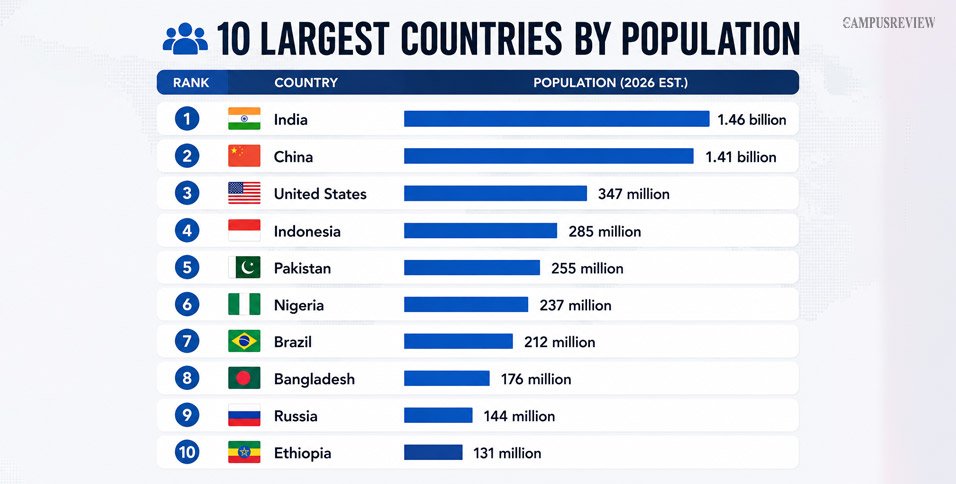
These countries have the world’s largest populations, but their population size reflects different factors, including geography, birth rates, migration, and urbanisation.
1. India (1.46 Billion People)
India passed China in 2023 to become the most populous country on Earth, and it is still growing. Its fertility rate sits close to 2.0 births per woman, and its median age is only around 28. The country adds roughly 12 million people to its working-age population every year, which fuels economic growth but also creates constant pressure to generate enough jobs.
2. China (1.41 Billion People)
China’s population is already shrinking. Its fertility rate fell to about 1.1 births per woman, so deaths now outnumber births each year. Close to one in five people in China is over 60, and the country is racing to support an ageing population with a smaller workforce coming up behind it.
3. United States (347 Million People)
The US is the only G7 nation still growing at a steady pace, and immigration drives most of that growth rather than births. Its own fertility rate has dropped to about 1.6 children per woman, well below the level needed to replace the population without new arrivals.
4. Indonesia (285 Million People)
Indonesia is the world’s largest archipelago nation, spread across more than 17,000 islands. More than half its population lives on the island of Java, even though Java holds only a small share of its total land. A fertility rate near 2.2 keeps growth steady without being explosive.
5. Pakistan (255 Million People)
Pakistan has one of Asia’s highest fertility rates, around 3.4 births per woman, and a median age of just 22. That combination points to strong future growth, with projections putting the country near 370 million people by 2050.
6. Nigeria (237 Million People)
Nigeria is Africa’s most populous country, with a fertility rate close to 5 births per woman. Its population is expected to keep climbing fast enough to pass the United States by around 2050, making it the third-largest country in the world.
7. Brazil (212 Million People)
Brazil’s fertility rate has dropped below the replacement level, to about 1.7 births per woman. Growth is slowing, and the population is expected to plateau near 220 million by the 2040s before it starts to shrink.
8. Bangladesh (176 Million People)
Bangladesh cut its fertility rate from 6.5 births per woman in the 1970s to about 2.1 today, one of the fastest declines ever recorded. Even with slowing births, its population stays large, and packed into a small land area, it is the most densely populated big country on Earth.
9. Russia (144 Million People)
Russia’s population is falling due to low birth rates, high adult mortality, and outward migration. About two-thirds of Russians live in the European part of the country, leaving most of its vast Siberian territory nearly empty.
10. Ethiopia (131 Million People)
Ethiopia climbed into the global top 10 from 20th place in the early 1990s. Its fertility rate, near 4.2 births per woman, and a young population keep it on a fast growth path, with projections putting it over 200 million people by 2050.
The gap between rank two and rank three tells the real story here. China and India each hold over a billion people. The United States, in third place, holds a fraction of that. Population size does not always match economic power, but it shapes labour supply, consumer markets, and political weight on the world stage.
10 Smallest Countries by Population
The smallest populations are often found in island nations and small states, where geography and limited land area influence population size.
| Rank | Country | Population |
| 1 | Vatican City | 500-800 |
| 2 | Tuvalu | 10,000 |
| 3 | Nauru | 12,000 |
| 4 | Palau | 18,000 |
| 5 | San Marino | 34,000 |
| 6 | Monaco | 38,000 |
| 7 | Liechtenstein | 40,000 |
| 8 | Saint Kitts and Nevis | 47,000 |
| 9 | Marshall Islands | 45,000 |
| 10 | Dominica | 68,000 |
1. Vatican City (Fewer Than 800 People)
Vatican City isn’t a country in the usual sense. The Catholic Church runs it, and its population is made up mostly of clergy, officials, and the Swiss Guard, not ordinary families. That is why it has no real population growth or decline to track.
2. Tuvalu (About 10,000 People)
Tuvalu is a Pacific island nation with just 26 square kilometers of land. Rising sea levels threaten to make parts of it uninhabitable within decades, which limits how many people the land can support long-term.
3. Nauru (About 12,000 People)
Nauru is a single tiny island whose interior was stripped bare by decades of phosphate mining in the 20th century. With little usable land left, its population has stayed small ever since.
4. Palau (About 18,000 People)
Palau’s economy runs on tourism, fishing, and a special agreement with the United States for aid and defence. Its population size matches its small, spread-out archipelago.
5. San Marino (About 34,000 People)
San Marino sits entirely inside Italy and calls itself the world’s oldest surviving republic. Its tiny land area limits both its population and its room to grow.
6. Monaco (About 38,000 People)
Monaco is one of the most crowded places on Earth for its size, packed onto a strip of French coastline. Most residents were not born there; they moved in for its wealth and low taxes, which keeps the population small but dense.
7. Liechtenstein (About 40,000 People)
This small Alpine nation between Switzerland and Austria runs on precision manufacturing and banking rather than farming, an economy that never needed a large population to sustain it.
8. Saint Kitts and Nevis (About 47,000 People)
This is the smallest country in the Americas by both land and population. Its economy depends mainly on tourism, which supports a small resident population year-round.
9. Marshall Islands (About 45,000 People)
The Marshall Islands are a group of remote Pacific atolls facing flooding and rising seas. Many residents move to the United States under a special agreement, which keeps the population from growing.
10. Dominica (About 68,000 People)
Dominica is a mountainous volcanic island with limited farmland and frequent hurricane damage. Its rugged terrain has always limited how many people it can support.
Most of the smallest countries fall into two groups. European micro-states like Monaco, San Marino, and Liechtenstein survive on banking, tourism, or their location. Pacific and Caribbean island nations like Tuvalu, Nauru, and Dominica survive on tourism and fishing, but face a bigger threat: rising sea levels and shrinking farmland.
Their population stays small because there is only so much land, and so much economy, to support.
Population by Continent
Asia holds more people than every other continent combined. Here is how population by continent breaks down.
| Continent | Population (2026 Est.) | Share of World | Notable Trend |
| Asia | 4.77 billion | 59% | Growth slowing; expected to peak mid-century |
| Africa | 1.44 billion | 18% | Fastest-growing continent; could double by 2054 |
| Europe | 744 million | 9% | Population shrinking; propped up by migration |
| Latin America & Caribbean | 659 million | 8% | Fertility now below replacement level |
| Northern America | 378 million | 5% | Growing mainly through immigration |
| Oceania | 45 million | 0.6% | Steady growth, led by Australia |
| Antarctica | No permanent residents | 0% | Research stations only |
Africa’s share of world population is climbing fast. It sits around 18% today, but United Nations projections put it near 25% by 2050 and over 32% by 2100. Europe is heading the other way. Deaths already outnumber births there, so without immigration, its population would already be falling.
Population patterns vary across continents because of differences in geography, climate, economic development, and historical settlement. Looking at the world map with countries can also help put these population patterns into geographic context.
Population Density by Country
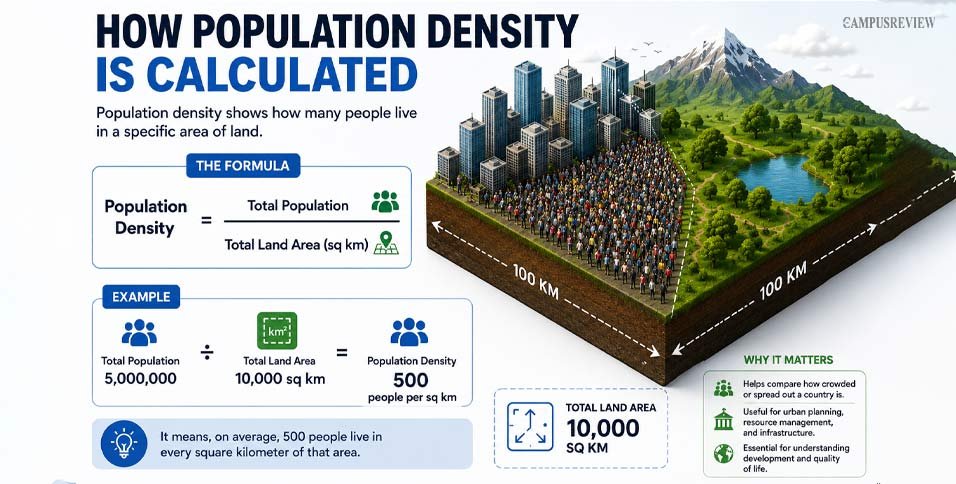
Population and density are not the same thing. A country’s population tells you how many people live there. Density tells you how crowded it feels, based on how many people share each square kilometre of land.
Russia has more people than most countries, but its land is so vast that it feels empty. Bangladesh has far fewer people, but they are packed into a much smaller space.
| Country | Population | Density (people/km2) | Why |
| Monaco | 38,000 | 19,000 | Tiny city-state; almost no open land |
| Singapore | 5.9 million | 8,500 | Compact island city, built vertically |
| Bangladesh | 176 million | 1,180 | Most people live along fertile river deltas |
| Netherlands | 18.5 million | 548 | Small country, farmland engineered for high yield |
| India | 1.46 billion | 485 | Most crowded along the Indo-Gangetic plain |
| United States | 347 million | 36 | Huge country; population spread across large cities |
| Australia | 26.5 million | 3.4 | Mostly desert interior; people cluster on the coast |
| Mongolia | 3.5 million | 2.2 | One of the least densely populated countries on Earth |
Notice the pattern. Small city-states like Monaco and Singapore rank as the most crowded places on Earth, even though their total population is tiny. Russia and Mongolia have plenty of people, but so much land that density stays low.
When someone asks which country is the most crowded, they usually mean density, not total population.
How Countries Are Ranked by Population
Population rankings come from a mix of national population censuses, birth and death records, and surveys.
- National censuses: Most countries conduct a population census about every 10 years to count their residents.
- Birth and death records: Population estimates also use birth and death registration data to track demographic changes.
- Surveys: Countries without recent census data may rely on household surveys and other population studies.
- UN data: The United Nations Population Division, part of UN DESA, combines national data into the World Population Prospects.
- Data adjustments: The UN adjusts population figures for factors such as undercounting, migration, and gaps in reporting to make country-to-country comparisons more consistent.
- Different figures: Population numbers can vary between websites because they may use national census results, UN estimates, or private projections.
- Data used in this guide: This guide uses United Nations population estimates and population census data updated for 2026 as its primary sources.
Key Takeaways
- India is the world’s most populated country, with over 1.46 billion people, ahead of China.
- The top 10 countries by population hold more than half of everyone on Earth.
- Vatican City is the smallest country by population, with fewer than 800 people.
- Population and density are different. Bangladesh has fewer people than Russia, but is far more crowded, since its land area is much smaller.
- Asia holds about 59% of the world’s population, but Africa is the fastest-growing continent.
- World population is expected to peak around 10.3 billion in the 2080s, before it starts to decline.
FAQs
1. Which country has the youngest population in the world?
Niger has one of the youngest populations in the world, with a very large share of its population made up of children and young adults.
2. Which country has the highest birth rate in the world?
Niger has one of the highest birth rates in the world, contributing to its rapid population growth and young age structure.
3. Which countries are expected to see the biggest population increases by 2050?
Several African countries, including Nigeria, the Democratic Republic of the Congo and Ethiopia, are expected to record some of the world’s largest population increases by 2050.
4. Which country has the fastest-declining population?
Countries such as Bulgaria, Latvia and Lithuania have experienced significant population decline due to low birth rates, ageing populations and migration.
5. How does population growth affect a country’s economy?
Population growth can expand a country’s workforce and consumer market, but it can also increase pressure on jobs, housing, healthcare, education and infrastructure.