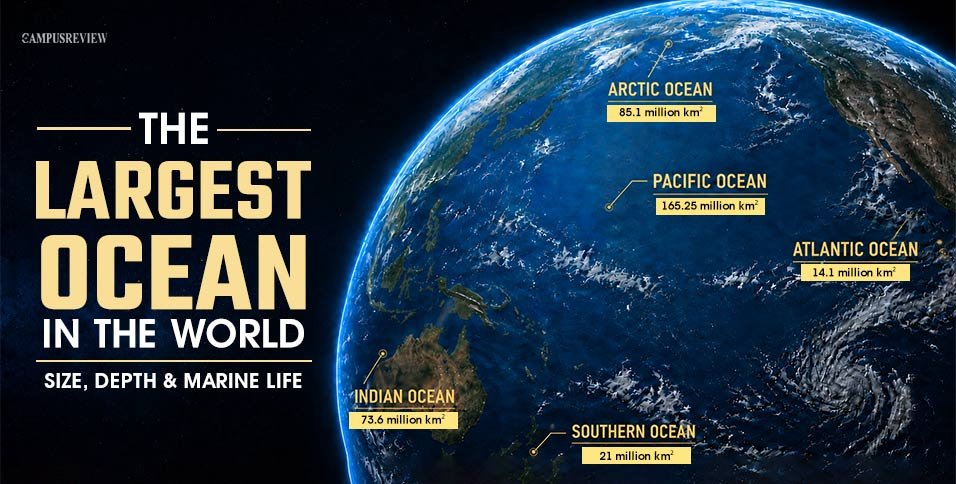
Earth has five oceans: the Pacific, Atlantic, Indian, Southern, and Arctic. Together, they cover about 71% of the planet and hold 96.5% of all the water on Earth. But every one of the five oceans of the world has its own story.
The Atlantic drives the Gulf Stream and keeps Europe’s winters mild. The Indian Ocean powers monsoon rains that feed over a billion people. The Southern Ocean, only recognised in the year 2000, circles Antarctica with the strongest current on Earth. The small, icy Arctic Ocean sits frozen at the top of the world, home to polar bears and narwhals.
This guide covers all five oceans in detail, including their size, depth, wildlife, and record-breaking animals. Discover the biggest oceans in the world, the largest fish in the ocean, and the biggest animal ever known to exist.
What Is the Largest Ocean in the World?
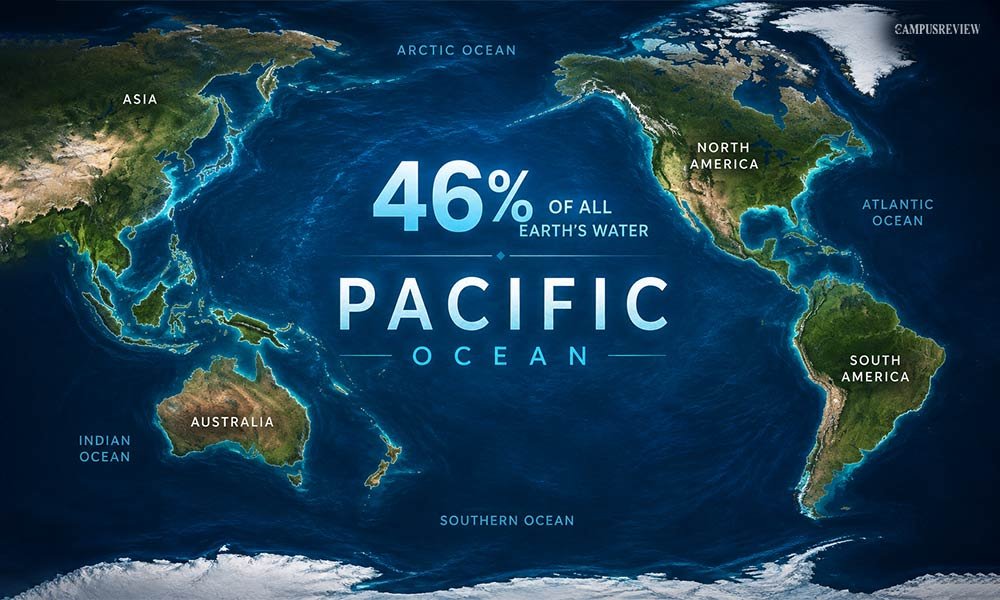
The Pacific Ocean is the largest ocean in the world by surface area, depth, and water volume. It covers more than one-third of Earth’s surface and holds more water than any other ocean. Its vast size makes it the world’s largest and deepest ocean.
Here is a quick snapshot of the Pacific Ocean:
| Metric | Pacific Ocean |
| Area | 165-168.7 million km² (63.8- 65.1 million sq mi) |
| Share of global ocean | 45%- 46.6% |
| Average depth | 3,970-4,282 meters |
| Deepest point | Challenger Deep, Mariana Trench (10,924 m) |
| Coastline | 135,663 km |
Where the Pacific Ocean Sits
The Pacific stretches across almost the entire planet, from the Arctic Ocean in the north to the Southern Ocean in the south. On one side it touches Asia and Australia. On the other, it touches North and South America, making it one of the most prominent features on the world map.
How Deep the Pacific Ocean Goes
The Pacific Ocean’s average depth runs between 3,970 and 4,282 meters, deeper than any other ocean. It also holds the single deepest point on the planet: the Challenger Deep, inside the Mariana Trench. This spot drops to 10,924 meters below the surface. If you lowered Mount Everest into the Challenger Deep, its peak would still sit more than a mile underwater.
The Pacific Ring of Fire
The Pacific holds the Ring of Fire, a 40,000-kilometre belt of volcanoes and earthquake zones that circles the ocean’s edge. It formed because the Pacific sits on some of the oldest ocean floor on Earth, dating back around 200 million years. This ring produces most of the world’s earthquakes and active volcanoes, and it shapes life along the entire Pacific coastline.
Life in the Pacific Ocean
The Pacific supports more marine life than any other ocean, simply because it has more room to support it. Blue whales, humpback whales, whale sharks, and giant Pacific octopuses all live here. The western Pacific holds the Coral Triangle, the richest coral reef system on Earth, home to more than 75% of all known coral species and thousands of reef fish.
The Pacific is also the birthplace of El Niño, a weather pattern that shifts rainfall and temperatures across the globe every few years. Scientists watch the Pacific closely, because changes here affect weather patterns worldwide, from droughts in Australia to storms in California.
Biggest Oceans in the World by Size
There are five of the biggest oceans in the world. Together, they cover about 71% of the Earth’s surface. Here is the ocean size ranking, from the largest ocean by area down to the smallest.
| Rank | Ocean | Approx. Area (km²) | Share of Global Ocean |
| 1 | Pacific Ocean | 165- 168.7 million | 45%- 46.6% |
| 2 | Atlantic Ocean | 85.1- 106 million* | 22.2%- 23.5% |
| 3 | Indian Ocean | 70.6- 73.6 million | 19.5%- 20% |
| 4 | Southern Ocean | 20.3- 22 million | 5.4%- 6.1% |
| 5 | Arctic Ocean | 14- 15.6 million | 3.3%- 4.3% |
*The Atlantic’s area depends on whether you count marginal seas like the Mediterranean and Caribbean.
The Pacific Ocean’s full profile is above. Here is what makes the other four oceans different, in area, depth, and the animals that call each one home.
Atlantic Ocean
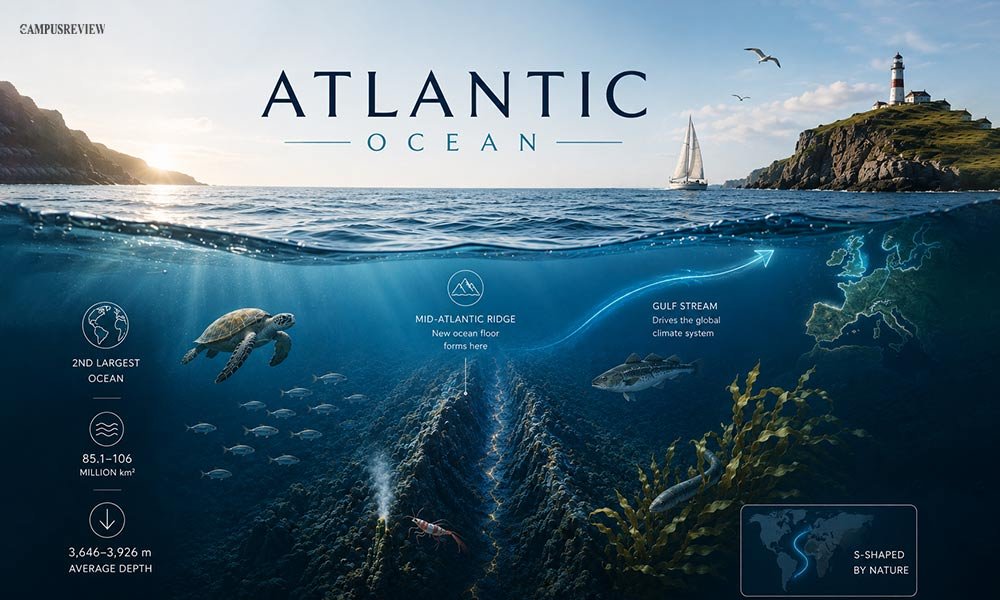
The Atlantic Ocean is the second-largest ocean in the world, covering about 85.1 million to 106 million square kilometres, depending on whether marginal seas are included. Its average depth is about 3,646 to 3,926 meters.
The Atlantic formed when Pangaea split apart, giving the ocean its distinctive S-shape. The Mid-Atlantic Ridge runs through its centre, where new ocean floor forms as the seafloor spreads.
The ocean also drives the Gulf Stream, which carries warm water north and helps keep Western Europe’s winters milder. This circulation is part of the Atlantic Meridional Overturning Circulation (AMOC), which plays an important role in Earth’s climate.
The Atlantic supports diverse marine life, including cod, haddock, herring, sea turtles, eels, and hydrothermal-vent species.
The Atlantic’s deepest point is the Brownson Deep, inside the Puerto Rico Trench, at 8,378 meters below sea level. That is close to the height of the world’s highest mountain, Mount Everest, at 8,849 meters.
Indian Ocean
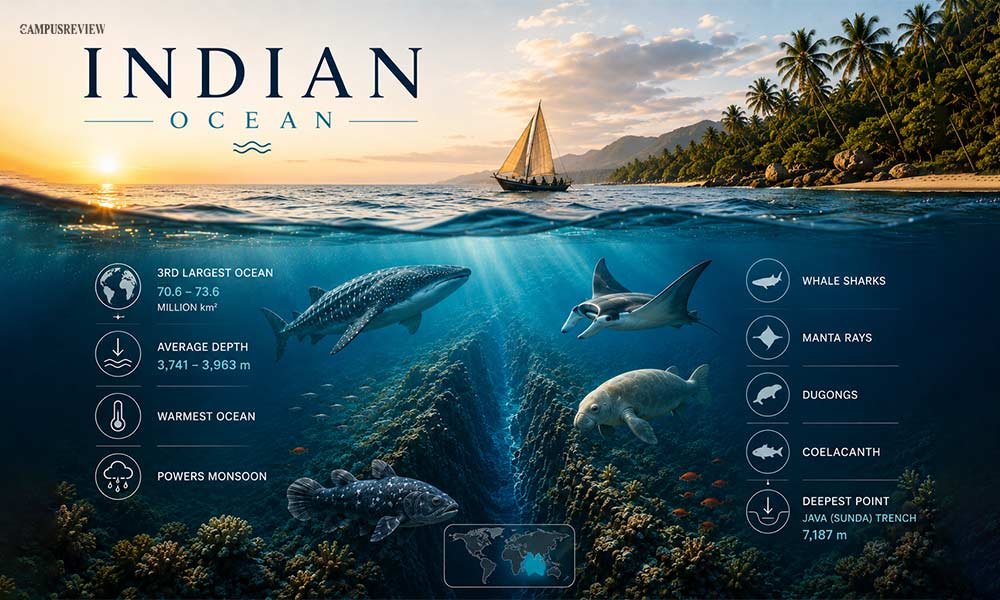
The Indian Ocean is the third largest ocean, covering roughly 70.6 to 73.6 million square kilometres. It runs about 3,741 to 3,963 meters deep on average, which makes it slightly deeper than the Atlantic despite being smaller in area.
This is the warmest ocean on Earth. It has no direct link to the cold Arctic, so its surface waters stay warm all year. That warmth powers the monsoon winds, which bring seasonal rain to South Asia and East Africa and support farming for over a billion people.
The Indian Ocean is home to whale sharks, manta rays, and dugongs, gentle sea mammals related to manatees. It also shelters the coelacanth, a strange, ancient fish once thought to have gone extinct with the dinosaurs, until a living one was caught off South Africa in 1938.
Its deepest point sits in the Java Trench, also called the Sunda Trench, south of Indonesia, reaching about 7,187 meters.
Southern Ocean
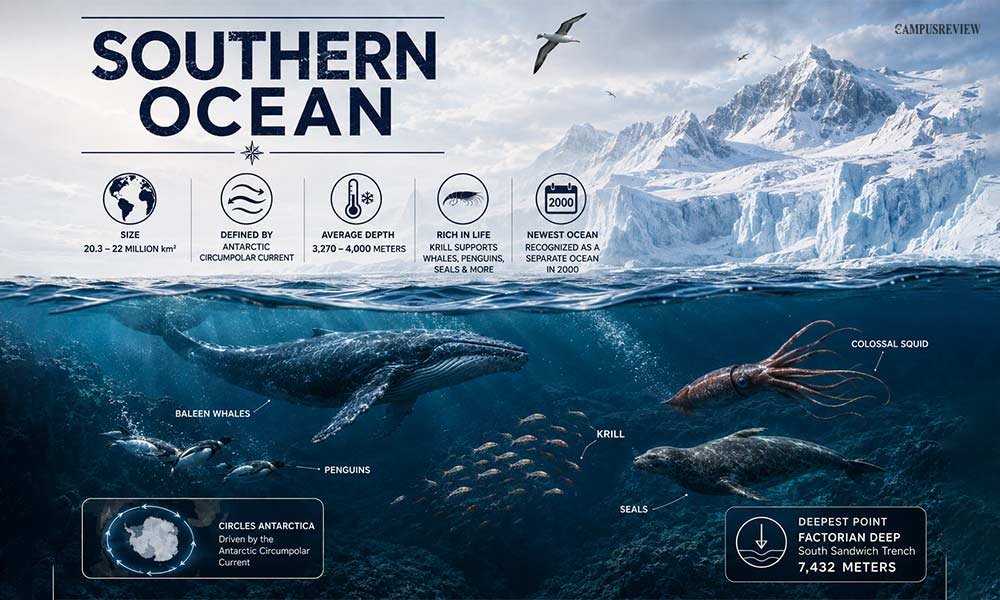
The Southern Ocean circles Antarctica and covers about 20.3 to 22 million square kilometres, making it one of the biggest oceans in the world. Scientists only agreed to treat it as a separate ocean in the year 2000, which makes it the newest of the five oceans.
Instead of coastlines, the Southern Ocean is defined by the Antarctic Circumpolar Current, the strongest current on Earth. It moves more water than any other current on the planet, flowing uninterrupted around the globe since no land blocks its path.
This ocean runs about 3,270 to 4,000 meters deep. Its cold waters host Antarctic krill, tiny shrimp-like creatures whose combined weight across the ocean is estimated at over 400 million metric tons. Krill feed nearly everything here, from baleen whales to penguins to seals.
The Southern Ocean is also home to the colossal squid, the heaviest invertebrate on Earth, which lives in its deep, dark waters.
The Southern Ocean’s deepest point, the Factorian Deep in the South Sandwich Trench, reaches 7,432 meters.
Arctic Ocean
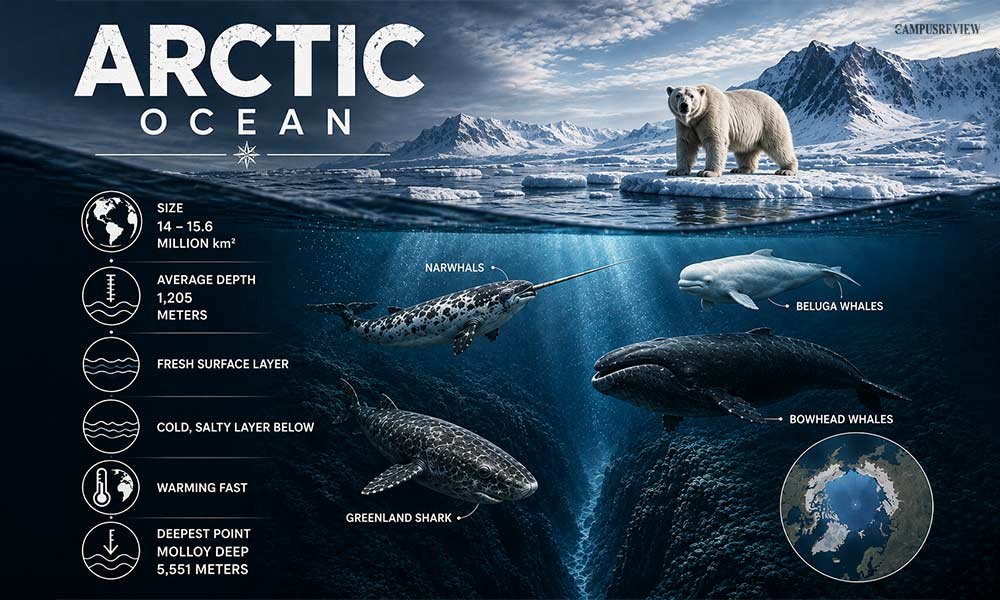
The Arctic Ocean is the smallest and shallowest ocean, covering only about 14 million to 15.6 million square kilometres, roughly a tenth the size of the Pacific. Wide, shallow shelves make up half of the Arctic seafloor, which is why its average depth is just 1,205 meters, far less than any other ocean.
The Arctic sits at the top of the world, mostly covered in ice. Its surface water is fed by huge rivers and melting sea ice, which keeps it low in salt. Below that sits a colder, saltier layer that stops warm water from rising and melting the ice above it.
Polar bears rule the ice here, while narwhals, beluga whales, and bowhead whales swim beneath it. The Arctic also shelters the Greenland shark, one of the longest-living vertebrates on Earth, with some individuals believed to be centuries old.
The Arctic is warming more than twice as fast as the rest of the planet. This is melting its ice cover fast and reshaping ocean wildlife across the whole region. Its deepest point, the Molloy Deep, reaches 5,551 meters.
Largest Animals in the Ocean
The ocean is home to some of the biggest animals ever known, in size, in weight, or both. Here are four record holders, and the title each one owns.
Whale Shark: Largest Fish in the Ocean
The whale shark is the largest fish in the ocean, and the largest fish species alive today. Despite the name, it is not a whale. It is a shark, and it breathes through gills, not lungs.
- Size: 8 to 14 meters long on average, with some past 18 meters
- Weight: 10 to 15 metric tons, with large ones over 20 tons
- Diet: plankton, small fish, and fish eggs
- Habitat: warm, tropical waters around the world
- Lifespan: 80 to 130 years
The whale shark does not hunt like other sharks. It swims with its mouth open and filters food out of the water, much like a whale does. That is how it got its name.
You can spot whale sharks near coral reefs in places like Ningaloo Reef in Australia, the Galápagos Islands, and the Gulf of Mexico. This gentle giant is listed as Endangered, mainly due to fishing nets and ship strikes.
Blue Whale: Largest Animal to Ever Exist
The blue whale is the largest animal in the ocean, and the largest animal known to have ever lived on Earth, bigger than even the largest dinosaurs.
- Size: 24 to 30 meters on average, with record females up to 33 meters
- Weight: 100 to 150 metric tons, with the largest over 180 tons
- Diet: krill, up to 4.5 metric tons a day during feeding season
- Heart: weighs up to 450 kilograms, roughly the size of a small car
- Calves: born at about 7 meters long, gaining up to 90 kilograms a day on their mother’s milk
Blue whales feed by lunging into swarms of krill, opening their jaws almost 90 degrees, then pushing the water back out through comb-like baleen plates that trap the krill inside. They live in every ocean except the Arctic, and like the whale shark, they are listed as Endangered.
Colossal Squid: Largest Invertebrate in the Ocean
The colossal squid is the largest invertebrate in the ocean, meaning the largest animal without a backbone. It lives deep in the cold, dark waters of the Southern Ocean, which is why so few people have ever seen one alive.
- Size: up to 10 meters long
- Weight: confirmed up to 495 kilograms, with some estimates over 600 kilograms
- Eyes: up to 30 centimeters across, the largest eyes of any animal on Earth
- Diet: fish, including the Patagonian toothfish
- Predators: sperm whales, which dive deep specifically to hunt them
Unlike most squid, the colossal squid has sharp, swiveling hooks, not just suckers, on its arms and tentacles. Scientists have recovered only a handful of full specimens, so much about this animal is still a mystery.
Giant Pacific Octopus: Largest Octopus Species
The giant Pacific octopus is the largest octopus species in the world, and it lives up to its name in the Pacific Ocean, from California to Japan.
- Size: typically 4 to 5 meters arm to arm, with the largest recorded near 9 meters
- Weight: usually 15 to 50 kilograms, with the largest recorded around 270 kilograms
- Arms: eight, covered in over 2,000 suction cups that can taste and smell
- Diet: crabs, shrimp, clams, and fish
- Lifespan: only 3 to 5 years, among the shortest of any large ocean animal
Despite its short life, the giant Pacific octopus is remarkably intelligent. It can solve mazes, open jars, and squeeze its entire body through a hole the size of a lemon, since its beak is the only hard part of its body.
| Animal | Record Holder For | Max Size approx | Max Weight approx |
| Whale Shark | Largest fish | 18- 20 m | 20 metric tons |
| Blue Whale | Largest animal ever | 30- 33 m | 190 metric tons |
| Colossal Squid | Largest invertebrate | 10 m | 495- 700 kg |
| Giant Pacific Octopus | Largest octopus | 9 m arm span | 270 kg |
Final Thought
The Pacific Ocean is the largest ocean in the world, leading all five oceans in surface area, depth, and water volume. But size is only part of the story. The Atlantic drives major ocean currents such as the Gulf Stream, while the Arctic Ocean supports wildlife adapted to extreme cold. Across these vast waters, the oceans are home to remarkable species, from whale sharks to colossal squids.
Together, the five oceans cover about 71% of Earth’s surface and connect continents, regulate global climate, support marine ecosystems, and provide food and livelihoods for millions of people. From the biggest oceans in the world to the smallest, each has unique features, ecosystems, and records that make it worth exploring.
Frequently Asked Questions
1. What is the deepest ocean in the world?
The Pacific Ocean is the deepest ocean in the world. Its deepest point, the Challenger Deep in the Mariana Trench, reaches nearly 11,000 meters below sea level.
2. Which ocean has the most islands?
The Pacific Ocean has the most islands of any ocean. Its island groups include Polynesia, Micronesia, and Melanesia, along with thousands of smaller islands.
3. Which ocean is the coldest?
The Southern Ocean is one of the coldest oceans, with waters surrounding Antarctica that remain extremely cold throughout the year. Its waters also play an important role in global ocean circulation.
4. Which ocean has the most marine life?
The Pacific Ocean supports an enormous variety of marine life because of its vast size, diverse habitats, coral reefs, and nutrient-rich waters. It is home to species ranging from tiny plankton to whales and sharks.
5. Could all the continents fit inside the Pacific Ocean?
Yes. The Pacific Ocean covers about 165 million square kilometres. That is larger than the total land area of all seven continents combined.