The ancient Maya built one of the most advanced civilisations in the ancient Americas. They lived across what is now Mexico, Guatemala, Belize, Honduras, and El Salvador. They built their civilisation without wheels, iron tools, or large animals for transport.
Their story began around 2000 BCE with small farming communities. Over time, these communities grew into powerful city-states such as Tikal, Palenque, and Chichén Itzá. The Maya developed zero, accurate calendars, and a complex writing system.
Around 900 CE, many major cities were abandoned, but the Maya people did not disappear. Millions of Maya people still live in the region today. This guide explores their history, culture, achievements, and lasting legacy.
Ancient Maya Civilisation Map
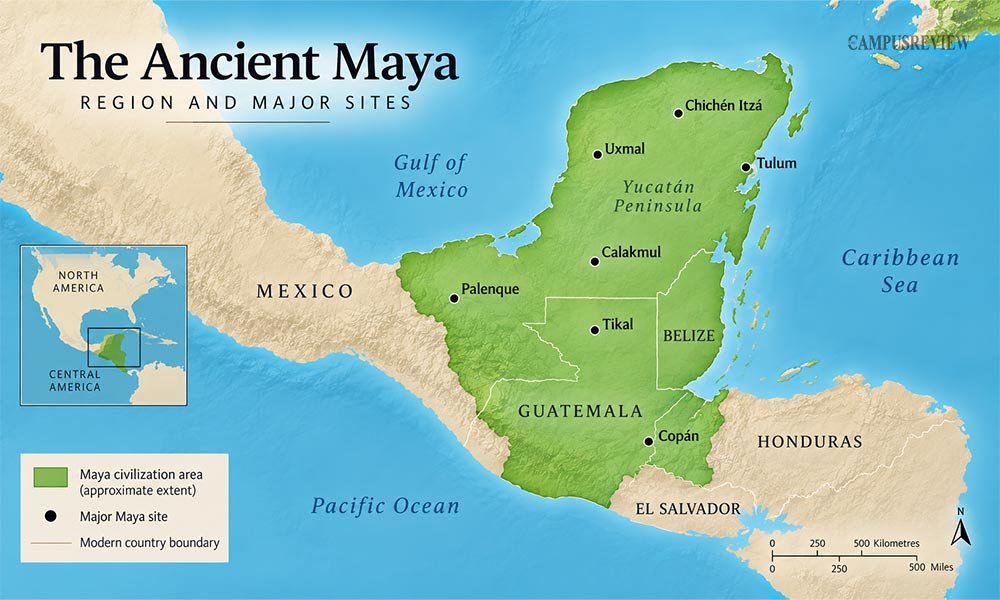
The Maya civilisation covered a large part of Mesoamerica. It included southern Mexico, Guatemala, Belize, western Honduras, and El Salvador. The region had rainforests, mountains, coastal plains, rivers, and natural water sources.
Where Were the Major Maya Cities?
The Maya built cities across different parts of this region. Some became large urban centres, while others remained smaller farming settlements.
| Maya City | Modern Location | Why Was It Important? |
| Tikal | Guatemala | Its high limestone location helped protect the city from seasonal flooding. |
| Palenque | Mexico | Rivers and fertile land supported farming and trade. |
| Chichén Itzá | Mexico | Nearby cenotes provided an important water source in the drier northern Yucatán. |
| Copán | Honduras | Fertile land and access to water supported farming and trade. |
Why did location matter?
Water and fertile land played a major role in where Maya communities developed. Rivers, cenotes, and fertile lowlands helped the Maya grow food, access water, and trade with other communities.
Where Did the Maya Civilisation Develop?
The ancient Maya civilisation developed across Mesoamerica, mainly in southeastern Mexico, Guatemala, Belize, western Honduras, and El Salvador. The region had different landscapes, and each one shaped how Maya communities farmed, built cities, and managed water.
Three Regions Shaped Maya Life
- Southern Highlands: This region had volcanoes and cooler air, creating a different environment for Maya farming and settlements.
- Central Lowlands: The Petén region had dense rainforests. Cities such as Tikal and Calakmul relied on reservoirs because natural water sources were limited.
- Northern Lowlands: The Yucatán Peninsula was flatter and drier, with few rivers. Cenotes became important water sources, especially for cities such as Chichén Itzá.
Maya communities began as farming settlements. Archaeological evidence from Cuello in present-day Belize shows that farmers grew maize, beans, and squash.
They did this between 1800 and 1500 BCE. By about 1000 to 200 BCE, some communities had grown into larger settlements and ceremonial centres such as Nakbe and El Mirador.
This gradual development explains why historians place the beginnings of Maya civilisation around 2000 to 1000 BCE. The famous Maya cities came much later, especially during the Classic period.
Ancient Maya Civilisation Timeline
Maya history is usually split into three main periods. The table below gives you a quick snapshot of each one.
| Period | Timeframe | Key Features |
| Preclassic | c. 2000 BCE – 250 CE | Farming villages, early temples, and social hierarchy. |
| Classic | 250 – 900 CE | Major city-states, writing, astronomy, and pyramids flourished. |
| Postclassic | 900 – 1500s CE | Northern cities grew, cultural influences blended, and Spanish contact began. |
Maya City-States and Political System
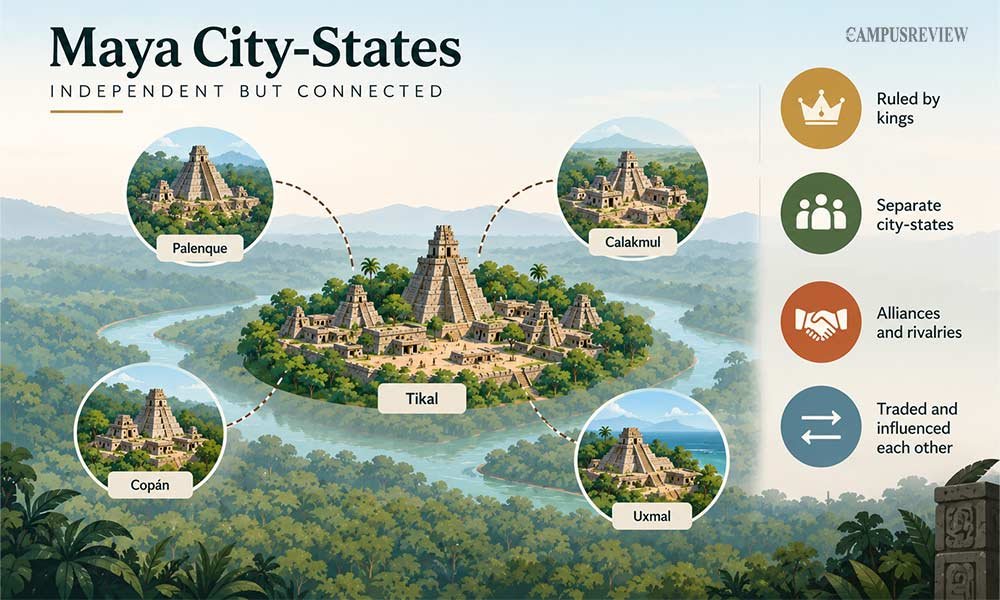
The Maya were never one empire. Instead, their world consisted of independent city-states, with powerful cities such as Tikal, Calakmul, Copán, and Palenque ruling their own territories.
Each city-state had a ruler called an ajaw, who controlled religion, warfare, and tribute. Maya cities traded goods such as jade, cacao, and obsidian, but they also fought for power. Rivalries between Tikal and Calakmul shaped Maya politics for centuries.
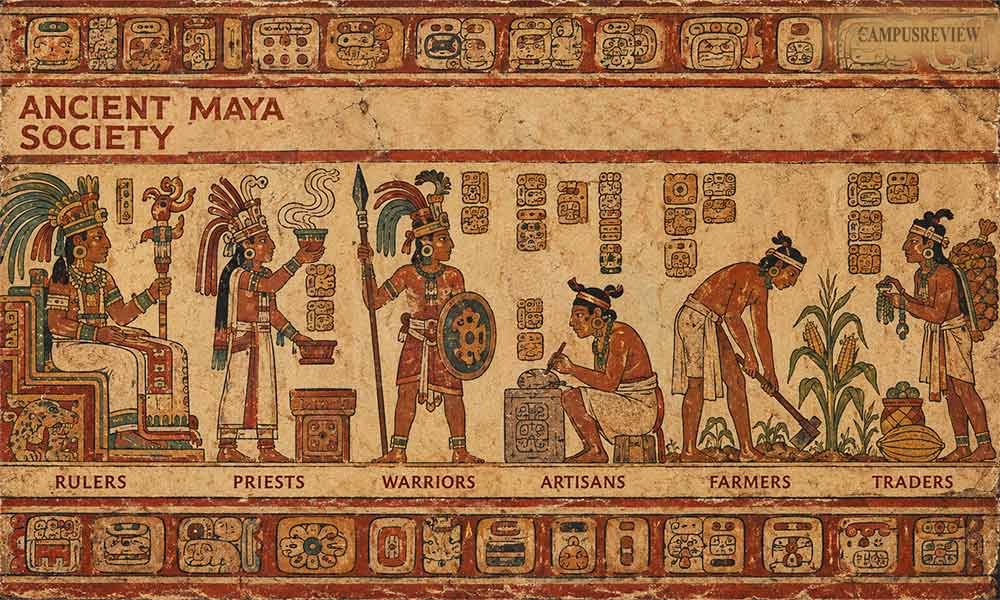
Below each ajaw sat a layered society:
- Nobles: governors, war captains, and provincial rulers
- Priests: managed temples, rituals, and the calendar, which touched almost every part of public life
- Scribes and artists: held high status; carving a king’s history onto a stela was considered a sacred act
- Farmers (the majority): grew maize, beans, and squash, and paid tribute in crops or labour to support the royal court, temple building, and warfare
This structure helped city-states mobilise thousands of workers to build pyramids. It also supported trade networks. Ancient Mesopotamian cities also became important centres of trade and economic activity, helping connect communities across the region.
Major Achievements of the Maya Civilisation
The Maya made lasting contributions to math, science, writing, and building. Here is a closer look at their biggest achievements.
Maya Mathematics
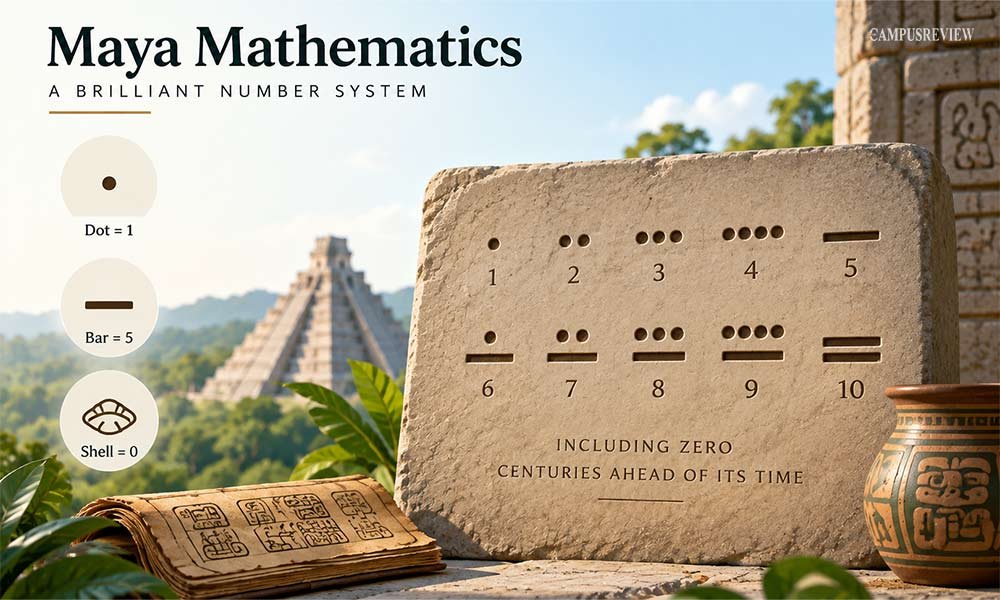
The Maya developed an advanced base-20 number system. They also developed the concept of zero around the 4th century CE, which helped them work with place values and track long periods of time.
Their number system used just three symbols:
- Dot: 1
- Bar: 5
- Shell: 0
Maya scholars used these numbers for their Long Count calendar and astronomical calculations. Modern researchers still use the system to understand Maya inscriptions, codices, and painted pottery.
Maya Astronomy
Astronomy played an important role in Maya life. Maya priests tracked the movements of the Sun, Moon, and Venus and used this knowledge to plan ceremonies and important events.
The Maya used three calendars:
- Tzolk’in (260 days): Religious and ceremonial cycles
- Haab’ (365 days): The solar year
- Long Count: Tracked dates across thousands of years
The Dresden Codex records eclipse cycles and the movements of Venus. At Chichén Itzá, the El Caracol tower was used to observe the sky. El Castillo is also famous for its serpent-like shadow during the equinoxes.
Maya Writing System
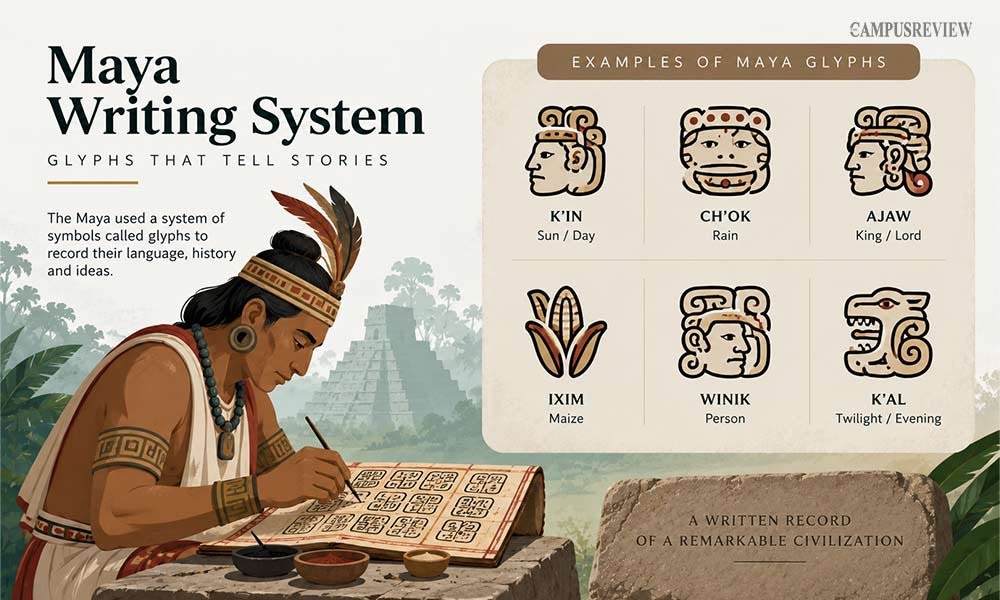
The Maya writing system was the most advanced in the ancient Americas. Its hieroglyphic script used signs for words and sounds.
Maya scribes carved Maya glyphs on stone stelae and temple walls and wrote in bark-paper books called codices. Only four Maya codices survive today, including records of Venus cycles and eclipses.
Scholars deciphered Maya glyphs during the second half of the 20th century. The inscriptions revealed the names of Maya kings, their battles, marriages, alliances, and coronation dates.
Maya Architecture
Maya builders created towering limestone step-pyramids without metal tools or wheeled carts. They used ramps, ropes, and manpower, and developed the corbel vault to create tall interior spaces.
Some famous examples include:
- Temple IV, Tikal: About 70 meters tall, making it one of the tallest pre-Columbian structures in the Americas.
- El Castillo, Chichén Itzá: A major temple linked to the equinox and Maya astronomy.
- Temple of the Inscriptions, Palenque: A royal tomb built over the burial chamber of King Pakal.
Maya cities also featured ballcourts, palaces, and large plazas for sports, royal life, and public ceremonies.
Why Did the Maya Civilisation Decline?
The Classic Maya Collapse happened around 800 to 900 CE. Climate stress, land overuse, and warfare all played a role. Historians do not point to one single cause.
Several problems made the situation worse:
- Drought: Severe droughts reduced rainfall and damaged crops.
- Deforestation: Clearing forests for farming and construction may have deepened the drought.
- Population pressure: Growing populations put more pressure on farmland and food supplies.
- Warfare: Conflicts between city-states disrupted farming, trade, and alliances.
These problems fed into each other. As food became harder to produce and conflicts increased, many southern lowland cities lost power and were gradually abandoned.
Maya Cities That Continued After the Classic Period
The collapse of the southern lowland cities did not end the Maya civilisation. It marked a shift in power toward the Yucatán Peninsula and other Maya regions.
During the Postclassic period, Chichén Itzá, Uxmal, and Mayapán became major centres. Tulum grew through sea trade, while Maya kingdoms in Guatemala continued their traditions. The Itza kingdom in Petén remained independent until 1697.
Life in these Postclassic cities looked different from the Classic period:
Fewer Monumental Stelae: Fewer kings commissioned massive carved stelae to record their reigns and achievements.
More Organised Warfare: Warfare became more common and organised, leading communities to build stronger defensive walls and fortifications.
Continued Religious Traditions: Religious practices remained important, including ceremonies at sacred cenotes such as the Cenote Sagrado at Chichén Itzá.
New Maya Books: Scribes wrote the Chilam Balam texts, which included Maya beliefs, history, and events from the Spanish period.
Far from a dead culture, the Postclassic Maya world stayed active, adaptive, and connected right up until European contact.
Legacy of the Maya Civilization
Today, an estimated 6 to 7 million Maya people live across Mexico, Guatemala, Belize, Honduras, and El Salvador. They speak more than 20 living Maya languages, including K’iche’, Yucatec, and Q’eqchi’.
Modern Maya communities blend ancient tradition with everyday life:
- Farmers still grow milpa, the traditional cornfield, using techniques passed down for generations
- Artisans weave textiles with patterns that echo ancient designs
- Many families celebrate festivals that mix Catholic and Maya beliefs
- Reverence for maize and the traditional Maya calendar remains strong in places like Guatemala’s highlands and Mexico’s Chiapas region
Final Thoughts
The Ancient Maya civilisation shows how knowledge can survive long after cities change. Their achievements in mathematics, astronomy, writing, and architecture still shape how we understand the ancient world. Most importantly, the Maya are not just part of history. Maya communities and traditions continue today.
FAQs
1. What language did the Maya speak?
The Maya spoke many different Maya languages, including K’iche’, Yucatec Maya, Q’eqchi’, and Kaqchikel.
2. What did the Maya eat?
The Maya mainly grew crops such as maize, beans, squash, and chilli peppers. They also ate fruits, vegetables, fish, meat, and other locally available foods.
3. How did the Maya build their cities?
The Maya built cities with temples, pyramids, palaces, plazas, and other large stone structures. They used local materials and developed advanced building techniques without modern machinery.
4. What did Maya homes look like?
Most Maya people lived in simple homes made from materials such as wood, stone, and thatch. Wealthier families lived in larger houses, while rulers and nobles lived in palaces.
5. Why is Maya civilisation important today?
Maya civilisation remains important because of its achievements in writing, mathematics, astronomy, architecture, and art. Maya communities also continue to preserve their languages, traditions, and culture.