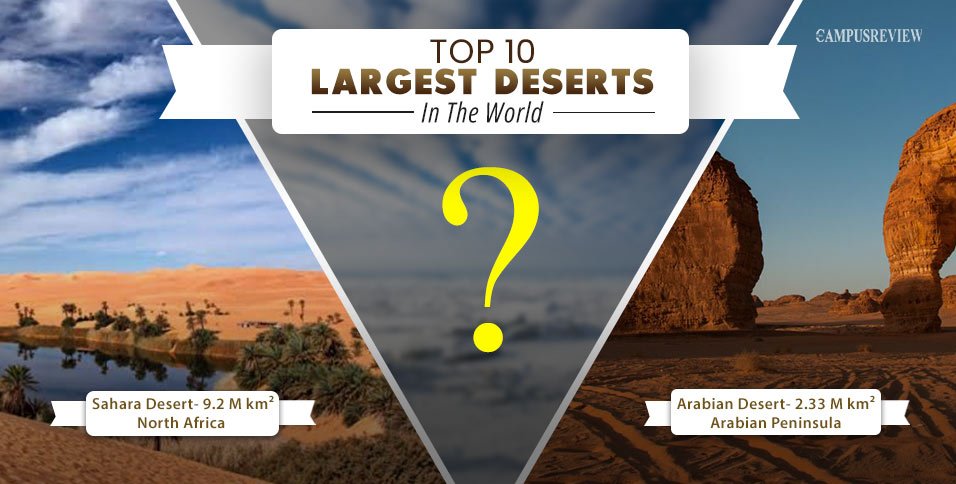
The Antarctic Desert is the largest desert in the world. It covers nearly 14 million square kilometers of ice and rock. Most people picture a desert as an endless stretch of hot sand. That picture is wrong. A desert is any region that gets very little rain. It does not have to be hot or sandy. This simple rule puts Antarctica and the Arctic at the very top of the list, ahead of the Sahara.
This guide ranks the top 10 largest deserts in the world by area. You will find each desert’s location, climate, wildlife, and standout facts. You will also learn which desert holds the record for the coldest temperature on Earth, and which one holds the record for the hottest.
Top 10 Largest Deserts in the World
Here is the full ranking of the largest deserts in the world by area. The list blends polar ice deserts with subtropical sand deserts, since both count as deserts under the same rule: low precipitation.
| Rank | Desert | Region / Countries | Area (approx.) |
| 1 | Antarctic Desert | Antarctica | 13.96M – 14.2M km² |
| 2 | Arctic Desert | Greenland, N. Canada, N. Russia, Svalbard | 13.7M – 13.9M km² |
| 3 | Sahara Desert | North Africa (11 countries) | 8.6M – 9.2M km² |
| 4 | Arabian Desert | Arabian Peninsula | 2.3M – 2.33M km² |
| 5 | Great Australian Desert | Central, Western & Southern Australia | 1.37M – 2.7M km² |
| 6 | Gobi Desert | N. China & S. Mongolia | 1.295M – 1.3M km² |
| 7 | Kalahari Desert | Botswana, Namibia, South Africa | 900,000 – 930,000 km² |
| 8 | Patagonian Desert | Argentina & Chile | 673,000 km² |
| 9 | Syrian Desert | Syria, Jordan, Iraq, Saudi Arabia | 500,000 km² |
| 10 | Great Basin Desert | Western United States | 492,000 km² |
Note: desert boundaries are not fixed lines on a map. Different sources measure arid zones differently, so you will see area ranges rather than single fixed numbers. The ranges above reflect that natural variation.
1. Antarctic Desert
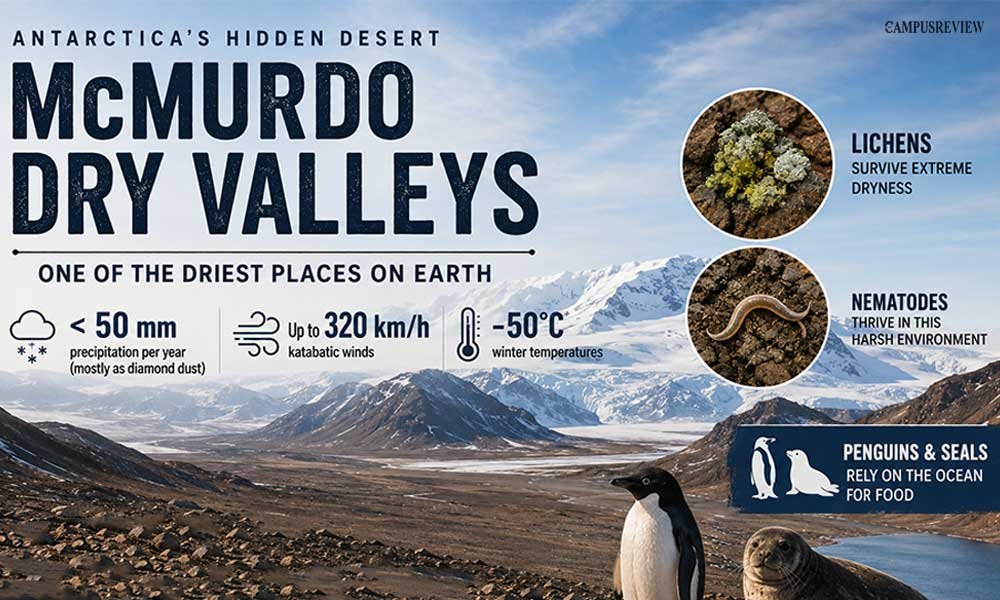
Antarctic Desert the largest desert on Earth, covering about 14 million square kilometers. Despite its vast ice sheet, Antarctica receives very little precipitation, with the interior getting less than 50 millimeters a year, mostly as tiny ice crystals called diamond dust. Strong katabatic winds sweep across the continent and keep some valleys almost completely free of snow.
These exposed landscapes, such as the McMurdo Dry Valleys, resemble the surface of Mars. Even in these extreme conditions, lichens and nematodes survive, while penguins and seals rely on the surrounding ocean for food.
2. Arctic Desert
The Arctic Desert ranks second among the largest deserts in the world, covering roughly 13.7 to 13.9 million square kilometers.
It stretches across Greenland, northern Canada, Svalbard, and Russia’s northern islands, with parts of the Arctic Ocean, the world’s smallest ocean, also covered by sea ice. The region receives only 100 to 250 millimeters of precipitation each year, mostly as dry snow.
Summers last just four to eight weeks, with temperatures rarely rising far above 0°C. Despite the harsh climate, Arctic poppies, muskoxen, Arctic foxes, and lemmings survive during the short summer season.
3. Sahara Desert
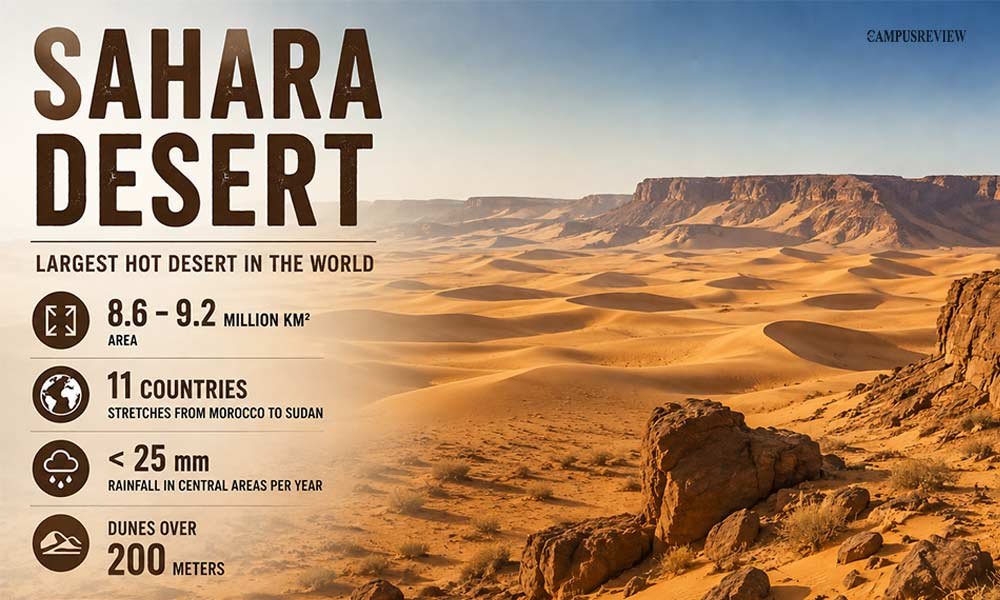
The Sahara Desert ranks as the largest hot desert in the world, with an area of approximately 8.6 to 9.2 million square kilometers. It stretches across 11 countries in North Africa, from Morocco to Sudan. The desert receives very little rainfall, with some central areas getting less than 25 millimeters a year. Despite its name, the Sahara is not covered entirely by sand.
It includes vast sand seas, gravel plains, and rocky plateaus, with dunes rising over 200 meters. The Sahara was once much greener, with lakes and grasslands spreading across the region during its “Green Sahara” periods. If only sand-covered deserts are considered, the Sahara ranks as the largest desert in the world.
4. Arabian Desert
The Arabian Desert spans 2.3 to 2.33 million square kilometers across the Arabian Peninsula, covering countries including Saudi Arabia, Yemen, Oman, the UAE, Qatar, Kuwait, Jordan, and Iraq. It is Asia’s largest desert. The desert contains the Rub’ al-Khali, or Empty Quarter, a vast sand sea covering about 650,000 square kilometers. Its dunes can rise above 250 meters.
Rainfall averages less than 100 millimeters a year, while summer temperatures can exceed 50°C. Despite the harsh conditions, animals such as the Arabian oryx and sand gazelle have adapted to survive here.
5. Great Australian Desert
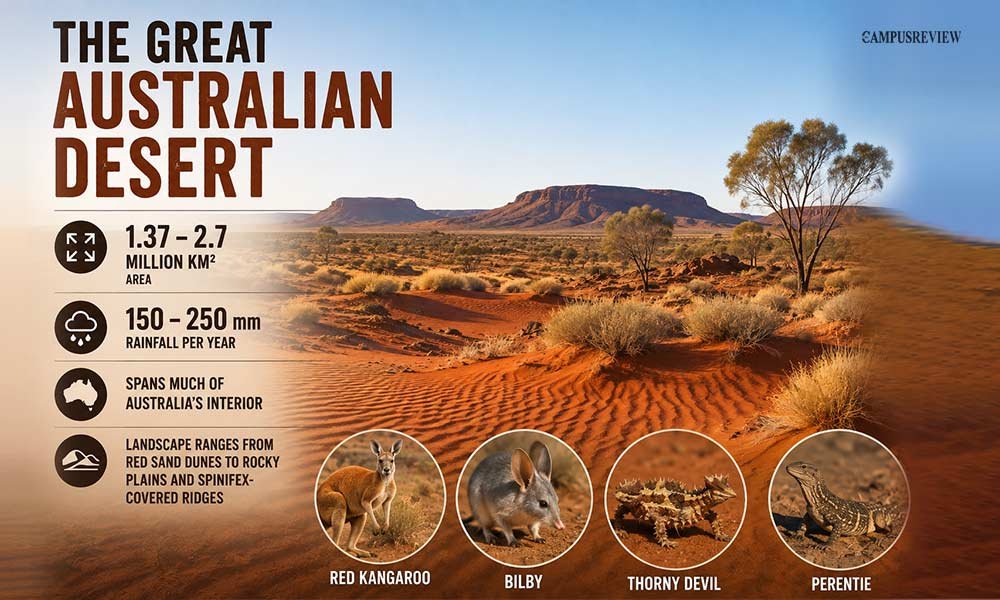
The Great Australian Desert covers about 1.37 to 2.7 million square kilometers, spanning much of Australia’s interior. It is not a single desert but a group of connected deserts, including the Great Victoria, Great Sandy, Little Sandy, Simpson, Gibson, and Sturt Stony Deserts.
The region receives about 150 to 250 millimeters of rainfall each year, with conditions varying widely. Its landscape ranges from red sand dunes to rocky plains and spinifex-covered ridges. Wildlife such as red kangaroos, bilbies, thorny devils, and perenties has adapted to the harsh environment.
6. Gobi Desert
The Gobi Desert covers about 1.3 million square kilometers across southern Mongolia and northern China. Gobi Desert is Asia’s largest cold-winter desert, sitting on a high plateau between 900 and 1,500 meters above sea level. The region experiences extreme temperatures, ranging from below -40°C in winter to over 40°C in summer. Unlike many deserts, only about five percent of the Gobi is covered by sand.
Much of the landscape consists of rock, gravel plains, and dry lakebeds. The Gobi is also known for its wild Bactrian camels, snow leopards, and well-preserved dinosaur fossils.
7. Kalahari Desert
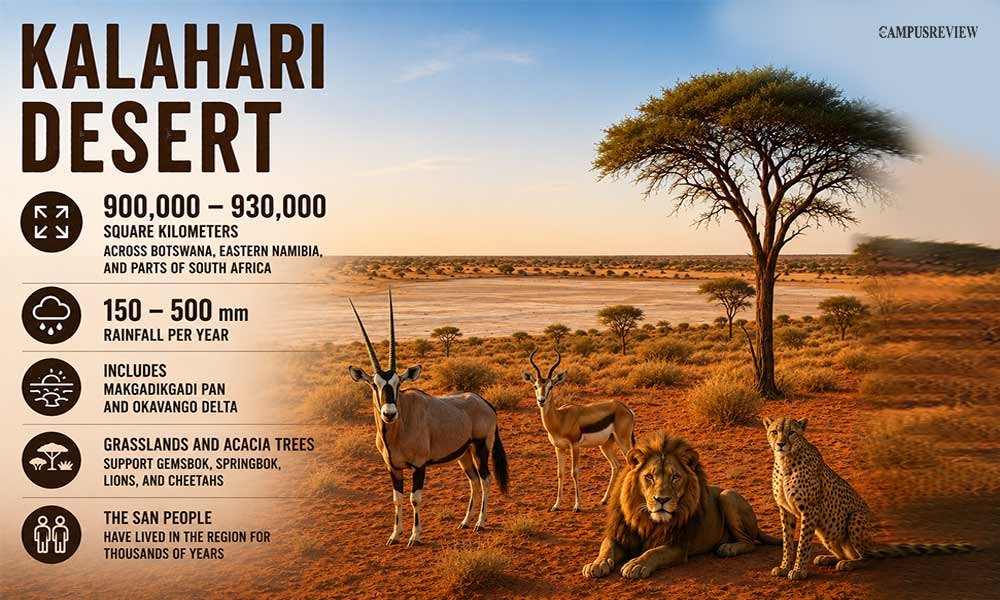
The Kalahari Desert covers about 900,000 to 930,000 square kilometers across Botswana, eastern Namibia, and parts of South Africa. It is often classified as a semi-desert because it receives 150 to 500 millimeters of rain each year. However, its red, sandy soil drains water quickly, leaving little surface water.
The region includes the Makgadikgadi Pan, a vast dry lakebed, and the Okavango Delta, which forms a seasonal wetland. Grasslands and acacia trees support gemsbok, springbok, lions, and cheetahs, while the San people have lived in the region for thousands of years.
8. Patagonian Desert
The Patagonian Desert covers about 673,000 square kilometers east of the southern Andes, mainly across Argentina with a smaller area in Chile. Patagonian Desert is the largest desert in the Americas. The Andes block moist Pacific air, creating a rain shadow that limits rainfall to about 100 to 200 millimeters a year.
Strong westerly winds shape its gravel terraces, dry canyons, and basaltic plateaus. Winters remain cold, with frequent snowfall. The desert supports wildlife such as guanacos, South American gray foxes, and Darwin’s rheas, which have adapted to its cold, dry conditions.
9. Syrian Desert
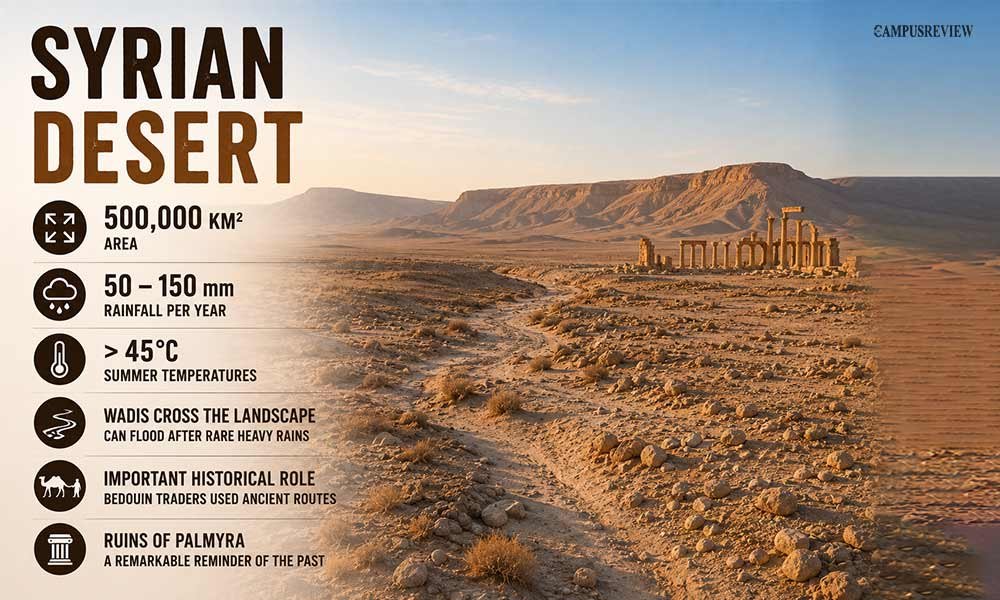
The Syrian Desert covers about 500,000 square kilometers across Syria, Jordan, Iraq, and northern Saudi Arabia. It is a limestone plateau covered with gravel and flint, with black lava fields in some western areas. Rainfall ranges from 50 to 150 millimeters a year, while summer temperatures can exceed 45°C.
Dry riverbeds called wadis cross the landscape and can flood quickly after rare heavy rains. The desert has also played an important role in history, with Bedouin traders using ancient routes across the region. The ruins of Palmyra remain a notable reminder of its past.
10. Great Basin Desert
The Great Basin Desert is North America’s largest desert, spanning about 492,000 square kilometers. It spans most of Nevada and parts of Utah, California, Oregon, and Idaho.
Mountain ranges and valleys shape the region, while limited drainage leaves water in inland lakes and salt flats. The desert receives about 100 to 300 millimeters of rain and snow each year, with winter temperatures often falling below -15°C.
Sagebrush covers much of the landscape, while higher elevations support pinyon-juniper woodlands and ancient bristlecone pines. Wildlife includes pronghorn, bighorn sheep, and kangaroo rats.
These deserts span several continents, from Antarctica and Africa to Asia and Australia, with each occupying a distinct geographic region on the world map.
Coldest Desert in the World
The Antarctic Desert is the coldest desert in the world, with temperatures dropping as low as −89.2°C (−128.6°F).
On July 21, 1983, Russia’s Vostok Station recorded a surface air temperature of -89.2 degrees Celsius (-128.6 degrees Fahrenheit). Satellite sensors on NASA and USGS spacecraft later found even colder radiant surface temperatures nearby, dropping to about -98 degrees Celsius (-144.4 degrees Fahrenheit), in small hollows between Dome Argus and Dome Fuji.
A few factors combine to create this extreme cold:
- High elevation above 2,500 meters, which thins the air and reduces its ability to hold heat
- Fresh snow that reflects 85 to 90 percent of incoming sunlight back into space
- Months of total darkness during the polar night, with no sunlight to offset heat loss
- Bone-dry air with almost no water vapor, which lets heat escape straight into space
- The circumpolar vortex, a wind pattern that blocks warmer air from reaching the interior
Hottest Desert in the World
The Dasht-e Lut Desert and Sahara Desert are both among the hottest deserts in the world. The Dasht-e Lut has the highest recorded land surface temperature, while the Sahara has the highest recorded air temperature.
| Metric | Record Holder | Peak Value | Key Driver |
| Air temperature | Death Valley, USA (Mojave Desert) | 56.7°C / 134.1°F (1913) | Sunken basin traps and compresses hot air |
| Land surface temperature | Dasht-e Lut, Iran | 80.8°C / 177.4°F | Dark volcanic gravel absorbs sunlight, no moisture to cool it |
By air temperature, Death Valley in California’s Mojave Desert holds the official record. On July 10, 1913, Furnace Creek Ranch recorded 56.7 degrees Celsius (134.1 degrees Fahrenheit). Some scientists question this old reading. Even so, modern instruments have recorded 54.4 degrees Celsius (130 degrees Fahrenheit) there, in August 2020 and July 2021.
Death Valley sits 86 meters below sea level. Its narrow walls trap hot air and compress it further as it sinks.
By land surface temperature, Dasht-e Lut in southeastern Iran recorded 80.8°C (177.4°F) in NASA satellite data. Its dark gravel and black sand absorb intense sunlight, while low moisture limits evaporative cooling, creating extreme surface heat.
Types of Deserts
Deserts fall into five main types. Each type forms through a different combination of wind, ocean currents, and mountains.
| Desert Type | How It Forms | Examples |
| Polar deserts | Extreme cold limits how much moisture the air can hold | Antarctic Desert, Arctic Desert |
| Subtropical (hot) deserts | Sinking, warming air from Hadley cell circulation blocks rain | Sahara Desert, Arabian Desert, Kalahari Desert |
| Rain-shadow deserts | Mountains block moisture from reaching the leeward side | Patagonian Desert, Great Basin Desert, Gobi Desert |
| Coastal deserts | Cold ocean currents create fog but suppress rain-bearing clouds | Atacama Desert (Chile), Namib Desert (Namibia) |
| Continental deserts | Distance from the ocean dries out air long before it arrives | Taklamakan Desert, interior Gobi, central Australian basins |
Polar Deserts
Polar deserts occur in extremely cold regions where low temperatures limit moisture in the air. Antarctica and the Arctic are the world’s largest examples.
Subtropical Deserts
Subtropical deserts form where dry air sinks over the subtropics. This creates hot and dry conditions, as seen in the Sahara and Arabian deserts.
Rain-Shadow Deserts
Rain-shadow deserts develop on the dry side of mountain ranges. Mountains block moist air and leave little rainfall beyond them. The Gobi and Great Basin deserts are examples.
Coastal Deserts
Coastal deserts form along cool coastlines influenced by cold ocean currents. They often experience thick fog but very little rainfall.
Continental Deserts
Continental deserts develop deep inside continents, far from moisture-rich oceans. The long distance from water sources makes these regions extremely dry.
End Note
Deserts prove that “dry” and “hot” are not the same thing. Some of the largest deserts in the world, like Antarctica and the Arctic, are locked in ice, not sand. What unites all ten on this list is a simple rule: very little rain falls, year after year. Yet nowhere on this list is truly empty.
Penguins, camels, lions, and tiny lichens have all found ways to survive on almost nothing. The next time someone pictures a desert as just an endless stretch of hot sand, this list is proof that the real picture is far bigger, and far stranger, than that.
FAQs
1. Why is Antarctica classified as a desert if it is covered in ice?
Antarctica is classified as a desert because it receives very little precipitation. Its interior gets less than 50 millimeters of precipitation each year, despite being covered by massive ice sheets. Extreme cold limits moisture in the air, so very little new snow falls.
2. What is the difference between ambient air temperature and land surface temperature?
Ambient air temperature measures the air about 1.5 to 2 meters above the ground, while land surface temperature measures the heat directly radiating from the ground. Dry, dark surfaces can become much hotter than the surrounding air, which explains why satellite readings in the Dasht-e Lut can exceed 80°C.
3. Are all deserts covered in sand dunes?
No. Most deserts are not covered in sand dunes. They can consist of gravel plains, rocky plateaus, salt flats, or permanent ice in polar regions. Sand dunes form only where loose sand and suitable wind patterns allow them to accumulate.
4. What is the world’s driest non-polar desert?
The Atacama Desert in northern Chile is the world’s driest non-polar desert. The Andes Mountains block moisture from the east, while the cold Humboldt Current limits rainfall from the Pacific. Some areas have gone decades without measurable rain.