Why did a small island change how the world makes things? The causes of the Industrial Revolution explain how better farming, coal and iron, growing trade, and new machines transformed production.
The Industrial Revolution began in 18th-century Britain, shifting work from farms and crafts to machine-powered factories. It later spread to the United States, India and other countries, bringing major technological, economic and social changes.
This guide covers its causes of industrial revolution with timeline, effects and development in Britain, the US and India.
What Were the Main Causes of the Industrial Revolution?
The causes of the Industrial Revolution came from several connected changes in Britain. Farming methods improved, coal and iron supported manufacturing, trade created demand for goods, and new machines increased production. Capital investment also helped businesses build factories and expand industrial activity.
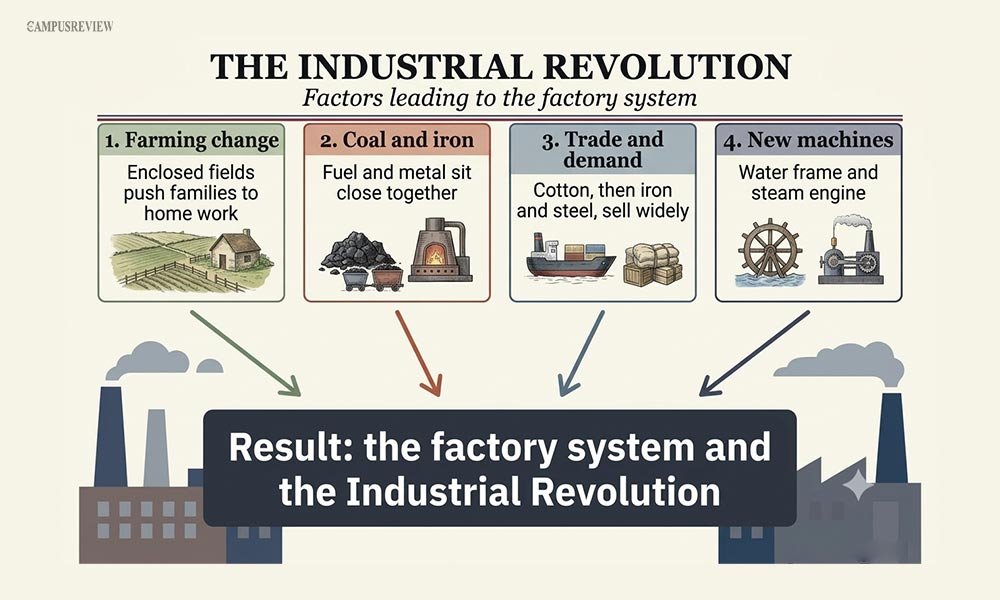
Figure 1: Industrial development in 18th-century Britain.
1. Agricultural Revolution and Changing Farming Methods
Improvements in farming increased food production and reduced the need for agricultural labour. Crop rotation, better livestock breeding and Jethro Tull’s seed drill improved productivity.
The enclosure movement changed land ownership and pushed some rural families away from traditional farming. This helped increase the workforce available for factories.
2. Availability of Coal and Iron
Britain had large deposits of coal and iron ore, essential for industrial growth. Coal powered steam engines and furnaces, while iron was used to make machinery, tools and railway equipment.
Abraham Darby advanced iron production by using coke instead of charcoal at Coalbrookdale in the early 18th century. Rivers, ports and coastal routes also helped transport goods and raw materials.
3. Growth of Trade, Colonial Markets and Demand
Growing domestic and overseas trade increased demand for manufactured goods, especially textiles. Colonial markets supplied raw materials such as cotton and provided buyers for finished products.
Rising demand encouraged manufacturers to produce more cloth at lower costs, creating a need for faster machines and larger factories.
4. Technological Inventions and Innovations
New machines increased production speed and reduced dependence on manual labour. Important inventions included the Spinning Jenny (1764) by James Hargreaves and the Water Frame (1769) by Richard Arkwright, which improved textile production.
James Watt’s separate condenser, patented in 1769, also made steam engines more efficient and useful in factories.
These innovations shifted production from homes and small workshops to mechanised factories.
5. Capital Investment and Financial Stability
Factories required money to build facilities, buy machinery and pay workers. Profits from trade, private investors and banks provided the capital needed for industrial expansion.
Britain’s financial institutions, protection of private property and relatively stable political environment encouraged investment in manufacturing.
How Did the Factory System Change Production?
The factory system put expensive machines and workers under one roof and one manager.
| Before factories | After factories | |
| Where | Small workshops and rural cottages | One building full of machines |
| Control | Merchants struggled to control quality and hours | Managers supervised work and set hours |
| Skill | One craftsperson made a whole item | Workers did narrow, repeated tasks |
According to NCERT, before factories, one merchant clothier could manage hundreds of rural workers. Each stage of wool work used 20 to 25 people, from spinners to weavers and dyers, and finishing happened in London. Uniform quality was hard to enforce.
Early factories appeared in England by the 1730s. They grew fast after Richard Arkwright mechanized spinning with his 1775 water frame. Mass production cut costs, but workers now repeated narrow tasks at the speed of the machine.
Industrial Revolution Timeline: From Steam to Smart Factories
Experts describe five overlapping waves of industrial change. Each wave builds on the one before it.
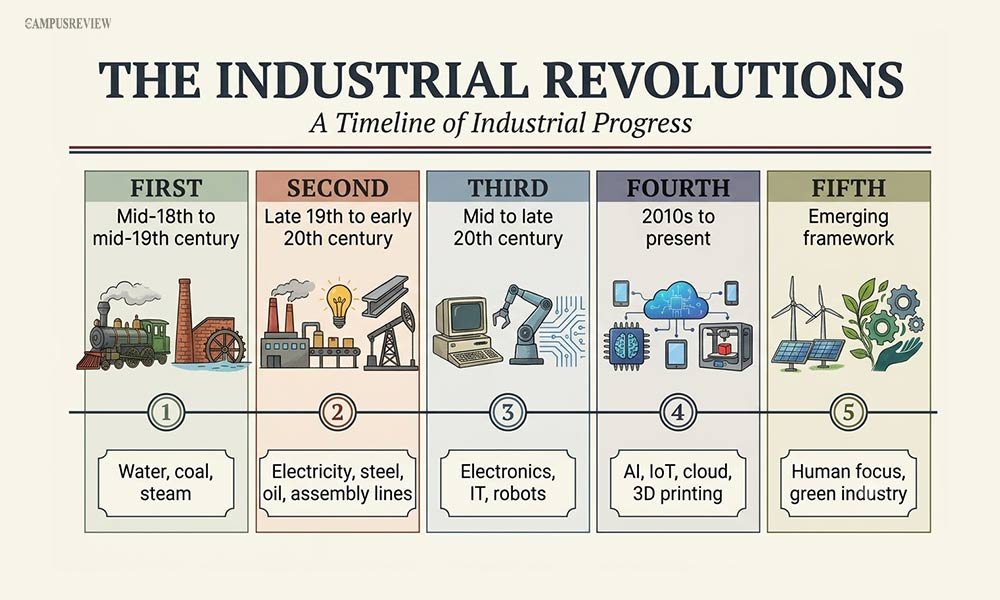
Figure 2: The five waves of industrial change at a glance.
| Phase | Period | Main technology | Main change |
| First | Mid-18th to mid-19th century | Water, coal, steam, coke-smelted iron | Hand work became machine work |
| Second | Late 19th to early 20th century | Electricity, steel, oil, assembly lines | Mass production for national markets |
| Third | Mid to late 20th century | Electronics, semiconductors, IT, robots | Digital control of production lines |
| Fourth (Industry 4.0) | 2010s to present | AI, IoT, cloud, 3D printing | Connected “smart factories” |
| Fifth (Industry 5.0) | Emerging framework | Humans working with digital and green tools | Worker focus and sustainability |
Timeline of the Industrial Revolutions
The Industrial Revolution developed through five stages, each introducing new technologies, energy sources and manufacturing methods.
First Industrial Revolution (c. 1760-1840)
The First Industrial Revolution transformed production through water power, steam engines, coal, iron and textile machinery. Manufacturers gradually moved from hand production to mechanized factories. Innovations in spinning and weaving increased textile output, while steam power supported industrial machinery and transportation.
Important developments included:
- 1764 – Spinning Jenny: James Hargreaves developed a machine that allowed workers to spin multiple threads at once.
- 1769 – Improved Steam Engine: James Watt patented an improved steam engine design that made steam power more efficient.
- 1775 – Water Frame: Richard Arkwright developed water-powered spinning machinery for textile factories.
- 1779 – Spinning Mule: Samuel Crompton combined features of earlier spinning machines to produce finer and stronger yarn.
- 1785 – Power Loom: Edmund Cartwright patented a power-operated weaving machine.
- 1804 – Steam Locomotive: Richard Trevithick demonstrated a steam locomotive capable of hauling a load on railway tracks.
- 1825-1830 – Railway Expansion: The Stockton and Darlington Railway opened in 1825, followed by the Liverpool and Manchester Railway in 1830.
These developments increased manufacturing capacity and helped establish the modern factory system.
Second Industrial Revolution (c. 1870-1914)
The Second Industrial Revolution expanded industrial production through electricity, steel, petroleum, chemicals and mass production. Factories adopted electric power and advanced machinery, making manufacturing faster and more efficient. New transport and communication technologies also connected markets across countries.
Important developments included:
- 1856 – Bessemer Process: Henry Bessemer developed a process for producing steel more cheaply and on a larger scale.
- 1869 – Transcontinental Railroad: The United States completed its first transcontinental railway, connecting its eastern and western rail networks.
- 1876 – Telephone: Alexander Graham Bell received a patent for his telephone invention.
- 1879 – Incandescent Light Bulb: Thomas Edison developed a commercially practical incandescent lighting system.
- 1885 – Automobile: Karl Benz developed an early practical automobile powered by an internal combustion engine.
- 1903 – Powered Flight: The Wright brothers achieved the first successful sustained, controlled powered airplane flight.
- 1913 – Moving Assembly Line: Henry Ford introduced a moving assembly line at his automobile factory, making large-scale vehicle production faster.
The Model T became an important example of mass-produced automobiles. Standardized parts and assembly-line production helped make manufactured goods more widely available.
Third Industrial Revolution (Mid-20th Century)
The Third Industrial Revolution introduced electronics, computers, semiconductors and information technology (IT) into manufacturing. Electricity remained essential, but digital systems began controlling machines and production processes. Factories increasingly used automation instead of relying entirely on manual operations.
Important developments included:
- 1950s-1960s – Electronics and Computers: Transistors, semiconductors and mainframe computers advanced computing and electronic control systems.
- 1961 – First Industrial Robot: Unimate, an industrial robot, began working on a General Motors production line in the United States.
- 1969 – ARPANET: The early computer network helped establish the foundations of the modern internet.
- 1969 – Programmable Logic Controllers: The Modicon 084, one of the first PLCs, helped automate industrial machinery and factory processes.
These technologies allowed factories to automate repetitive tasks, improve production accuracy and manage complex operations more efficiently.
Fourth (Industry 4.0) and Fifth Industrial Revolutions (2010s to Present)
The Fourth Industrial Revolution (Industry 4.0) connects machines, computers and data to make factories smarter and more automated. It began with Germany’s Industrie 4.0 initiative and introduced technologies that help factories monitor machines, improve production and reduce downtime.
Key technologies include:
- Industrial Internet of Things (IIoT): Sensors collect machine data, such as temperature, speed and vibration.
- Artificial Intelligence (AI) and Big Data: Software analyses data to identify problems and predict machine failures.
- Cloud Computing: Factories store and access data through remote servers.
- Digital Twins: Virtual copies of machines help engineers test changes before applying them to real equipment.
- 3D Printing: Machines create objects layer by layer, making customised parts easier to produce.
- Advanced Robotics: Modern robots perform complex tasks and assist human workers.
Example: Sensors detect that a factory motor is overheating. AI analyses the data and alerts workers before the motor breaks down. This helps prevent delays and costly repairs.
According to the European Commission, the Fifth Industrial Revolution (Industry 5.0) builds on these technologies by placing people, sustainability and resilience at the centre of production. It focuses on three main principles:
- Human-centrism: Technology should support workers, not simply replace them.
- Resilience: Factories should continue operating during disruptions such as pandemics or supply shortages.
- Sustainability: Industries should reduce waste, save energy and use environmentally friendly methods.
What Were the Effects of the Industrial Revolution?
The Industrial Revolution created huge growth in goods, jobs and technology. It also caused pollution, dangerous work and deadly disease.
Positive Effects of Industrial Revolution
- Economic Growth and Industrial Development: According to UK Parliament records, by 1873, Britain exported £77 million worth of iron and steel alone.
- Technological Advancements: Each wave sped up invention, from Watt’s engine to electric grids, cars, semiconductors and AI.
- Employment and Urban Development: Coal towns such as Trimdon in County Durham grew around their mines. According to UK Parliament, transport jobs in Britain doubled in the 1840s and again over the next 30 years as workers built roads, stations, tunnels and sewers.
- Improved Living Standards: Machines cut the cost of clothes and household goods. Over the long run, higher productivity and hard-won reforms raised living standards.
Negative Effects of Industrial Revolution
- Environmental Degradation: Burning huge amounts of coal changed the landscape. Philippe-Jacques de Loutherbourg captured the glow of ironworks in his 1801 painting Coalbrookdale by Night. The Science Museum notes that some observers see coal use in this era as the start of the Anthropocene, the age of human impact on Earth. Burning coal releases carbon dioxide, a greenhouse gas that drives climate change.
- Working Conditions and Labor Exploitation: Early factories had no safety laws, and unguarded machines caused severe injuries. According to The National Archives (UK), the 1833 Factory Act banned work for children under 9, capped hours for older children, banned night work, required two hours of daily schooling and created four factory inspectors.
Inspectors caught firms breaking the rules in 1836, so Parliament passed tougher laws in 1847 and 1867. Fear of job loss also grew. The Luddites smashed textile machines in 19th-century Britain, and UNIDO warns that Industry 4.0 can shrink middle-wage jobs.
- Social and Living Challenges: Crowded cities lacked sewers and clean water, which spread deadly cholera. The 1843 Health of Towns Commission studied 50 English towns. Public Health Acts followed in 1848, 1872 and 1875, along with Sanitary Acts from 1866 to 1870.
How Did the Industrial Revolution Spread Around the World?
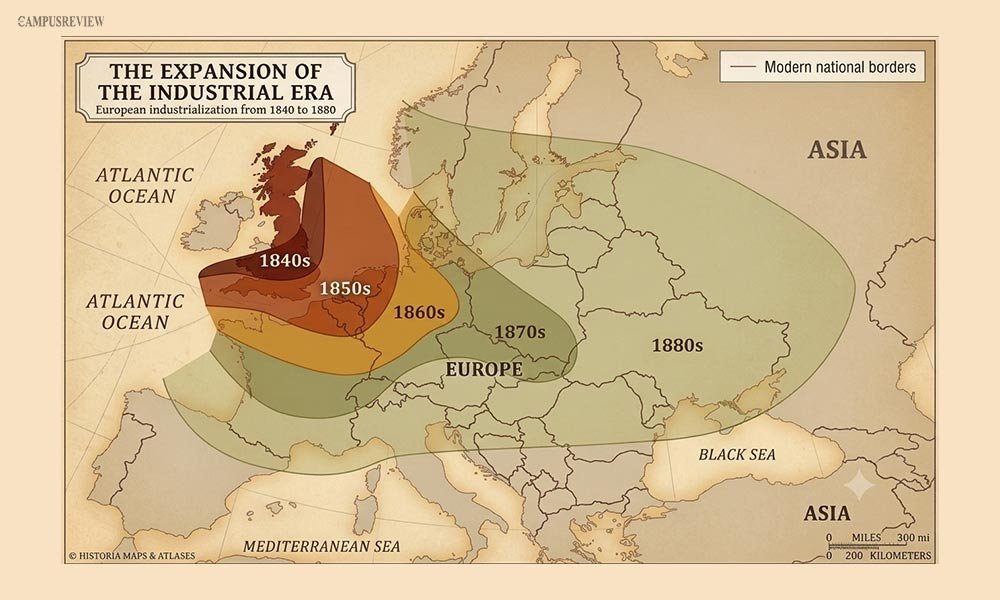
It spread unevenly. It grew fast in independent nations with capital and railways, such as the United States. It stayed limited in colonies such as India.
Industrialization in America
American industry took root in New England textile mills, such as Slater Mill in Pawtucket. After the American Civil War, the Library of Congress describes the “Rise of Industrial America” from 1876 to 1900. Large-scale car making followed.
Technological Innovations
- Steam Engine and Locomotive: American builders adapted British steam power. The Baltimore and Ohio Railroad began running trains in 1830.
- Railroad System: The Transcontinental Railroad (Union Pacific) and bridges such as the Eads Bridge in St. Louis joined distant regions into one market.
- Bessemer Process and Steel Industry: In Pittsburgh, steelmakers adopted the Bessemer process after the Civil War. Coke from the Connellsville seam fed blast furnaces such as Lucy and Isabella.
- Electrical Grids: Firms such as Westinghouse and inventors such as Thomas Edison powered factories and cities.
- Telegraph: The first telegraph message went out on 24 May 1844.
Here are the people behind the big ideas, with one lesser-known fact each:
| Person | Invention | Lesser-known fact |
| Eli Whitney | Cotton gin (1794 patent); pushed interchangeable parts | The gin also raised demand for enslaved labour in the South. |
| Samuel Morse | Telegraph and Morse code | Morse first trained as a painter. |
| Thomas Edison | Practical incandescent light bulb (1879) | His team tested many filament materials. His Pearl Street station in New York began supplying power in 1882. |
| Alexander Graham Bell | Telephone (patent 1876) | Bell taught deaf students. |
| Henry Ford | Model T (1908; over 15 million built by 1927, according to the Library of Congress) and moving assembly line (1913) | Ford announced a $5 workday in 1914, a very high wage then. |
Economic Impact
Mass production lowered prices. Railroads tied remote areas into one national economy and supported big mergers such as the United States Steel Corporation and busy Wall Street financial markets.
Social Transformations
Rural-to-urban migration and large waves of immigration between 1851 and 1900 drove fast urbanization in New York, Chicago and Pittsburgh. Society split into a wealthy industrialist class, a prosperous middle class and a vast blue-collar wage labour force.
Challenges and Consequences
- Income Inequality: Growth did not reach everyone. Many workers faced low pay and seasonal layoffs.
- Child Labour: Young “breaker boys” sorted coal in Kingston, Pennsylvania, and children worked in Maryland canneries. The National Child Labor Committee led reform.
- Factory Accidents: According to U.S. Department of Labor records, immigrant steelworkers faced high accident rates between 1906 and 1910.
- Labor Unions and the Labour Movement: Workers organized through the 1894 Railroad Strike, the Order of Railroad Telegraphers and the Industrial Workers of the World. Unions struggled for decades to organize huge steel and textile plants.
- Reform: Progressive Era investigations (1877 to 1917), including the New York Factory Investigating Commission, led to state factory inspection and safety laws.
Industrialization in India
Industrialization in India followed a different path from Britain. Under British Colonial Rule, India supplied raw materials such as cotton, jute and coal, while British manufactured goods competed with local products. This contributed to the deindustrialization of traditional textile and handicraft industries.
The Charter Act of 1813, colonial drain of wealth and shortage of domestic capital further restricted Indian industrial growth.
Despite these challenges, Bombay, Calcutta and Ahmedabad emerged as industrial centres, supported by railways, ports and raw material supplies. However, according to NCERT, registered factory workers made up only 5% of India’s industrial workforce in 1911 and 10% in 1931.
1. Handloom Weavers Adapted to Factory Competition
British mill-made textiles created strong competition for India’s traditional handicrafts and handloom industry. Many weavers responded by adopting new tools and improving production.
- Fly shuttle: This device helped weavers move the thread across the loom faster and increase output.
- Wider adoption: According to NCERT, by 1941, more than 35% of India’s handlooms used the fly shuttle.
- Production growth: According to NCERT, handloom cloth output nearly tripled between 1900 and 1940.
These changes helped traditional weavers remain competitive alongside mechanized textile mills.
2. Factory Workers Organized Strikes
Industrial workers faced low wages, long working hours and difficult factory conditions. Many workers came from rural areas affected by poverty, limited employment and the decline of traditional occupations. This provided industries with a large supply of cheap labour.
During the First World War (1914-1918), rising prices further reduced workers’ purchasing power. Workers began organizing strikes to demand better wages and working conditions.
- According to IGNOU’s eGyanKosh, around 30 strikes took place in Bombay’s textile mills during September and October 1917.
- Workers in Calcutta, Madras and Ahmedabad also participated in labour protests. These protests strengthened collective action among industrial workers.
3. Trade Unions Strengthened the Labour Movement
As worker protests increased, trade unions emerged to represent labourers and negotiate with employers.
| Person or organization | Contribution |
| B.P. Wadia | Founded the Madras Labour Union in April 1918. |
| Mahatma Gandhi | Helped establish the Textile Labour Association in Ahmedabad in 1918. |
| All India Trade Union Congress (AITUC) | Established in Bombay in 1920 to bring workers together through a national labour organization. |
Trade unions gave workers a collective voice and helped them raise concerns about wages, working hours and factory conditions.
4. Swadeshi Movement Encouraged Indian Industries
The Swadeshi Movement of 1905 encouraged Indians to boycott foreign goods and support locally made products. It created greater demand for Indian textiles and manufactured goods, giving domestic businesses new opportunities.
Indian industrialists, including Jamshedji Tata, contributed to the development of Indian-owned industries. His ventures helped expand the country’s cotton and steel sectors, including the establishment of Tata Iron and Steel Company in 1907.
The movement strengthened domestic enterprise and encouraged Indian businesses to compete with British imports.
India’s industrial growth remained restricted under colonial rule. However, the expansion of railways and mills, the adaptation of traditional weavers, the rise of Indian industrialists and the growth of labour organizations shaped India’s industrial development before independence in 1947.