The Campus Review
September 3, 2026
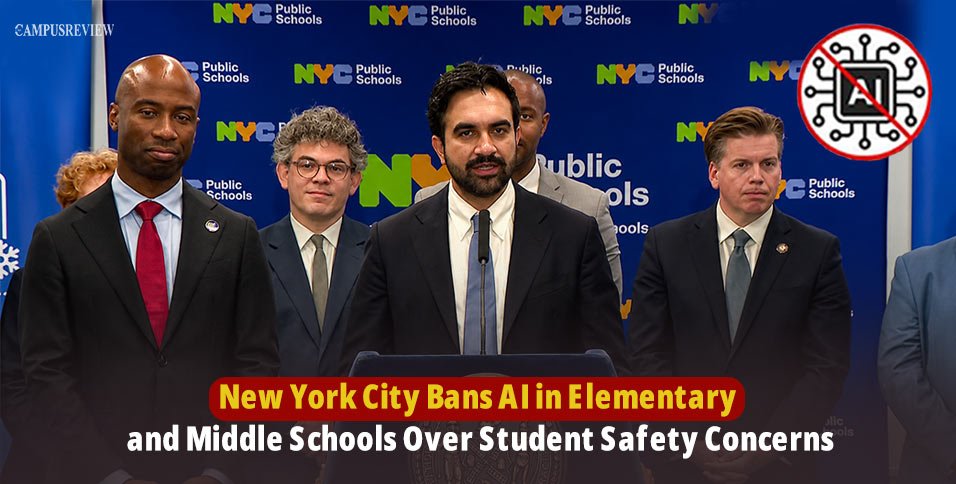
The New York City AI ban marks a shift in how the nation’s largest public school system approaches classroom technology. For the 2026–27 school year, NYC has introduced a one-year moratorium on student-facing generative AI for students from 2-K through eighth grade, affecting around 600,000 students. The policy aims to protect classroom focus, privacy, and foundational learning.
AI companion chatbots are also prohibited across all grades, while high school students retain limited access through supervised AI literacy pilots. The one-year pause will allow officials to evaluate AI’s impact on learning, critical thinking, and student well-being.
Why New York City Bans AI for Younger Students
City leaders announced the moratorium during a press conference at the Brooklyn Steam Centre, arguing that public education requires clear guardrails rather than unvetted tech adoption. Announcing the NYC schools AI ban, Mayor Zohran Mamdani emphasized that educational standards must take precedence over commercial priorities:
“The tech industry wants us to believe that AI-powered early education is not only inevitable, but necessary. We do not see it that way. We know the purpose of AI companies, whether they are making sports betting models or an education tool, is to produce a profit. Here in our New York City public schools, our purpose is our students.”
According to statements released by City Hall, Schools Chancellor Kamar Samuels echoed the need for direct human interaction in primary classrooms:
“We are putting guardrails in place to protect the critical human connection, curiosity, and creativity that help children grow. We need to prepare our older students carefully and deliberately for a world where AI is already a part of their daily life, but we will not treat more technology as the same thing as innovation.”
New York City Schools AI Policy
According to the district policy released by the NYC Department of Education, the updated New York City schools AI policy distinguishes between younger learners developing core academic skills and high schoolers preparing for higher education and modern careers.
| Grade Band | Student-Facing Generative AI | AI Companion Chatbots | High School Pilot Access | Instructional Focus |
| Early Childhood (2-K to Grade 2) | Paused under moratorium | Prohibited | Not Applicable | Foundational social and play-based learning |
| Elementary (Grades 3 to 5) | Paused under moratorium | Prohibited | Not Applicable | Core reading, writing, and math fundamentals |
| Middle School (Grades 6 to 8) | Paused under moratorium | Prohibited | Not Applicable | Analytical reasoning and peer collaboration |
| High School (Grades 9 to 12) | Supervised pilot courses | Prohibited | Supervised pilot access | AI literacy, critical evaluation, and ethics |
What the Moratorium Actually Restricts
The city is assessing digital software adoption by separating standard educational technology from generative conversational models. According to official briefings from the Department of Education, the rules focus specifically on student-facing generative AI in schools rather than everyday classroom utilities:
- Moratorium on Student-Facing AI: As stated by Mayor Mamdani, children from 2-K through eighth grade will not use software featuring student-facing generative AI during regular instruction.
- Prohibition on Companion Chatbots: According to city officials, the district explicitly bars conversational bots that simulate emotional relationships or offer mental health support across all grade levels.
- Review of Third-Party EdTech: According to the Mayor’s Office, the Department of Education is conducting an exhaustive review of software used in city classrooms, with plans to bar programs deemed not mission-critical to learning.
- Distinction Between Tools: General digital learning utilities, word processors, digital calculators, and approved instructional programs like e-books remain available.
- Supervised High School Pilots: According to district announcements, high schoolers will have access to five supervised pilot courses, alongside twice-yearly AI literacy lessons teaching them to evaluate algorithmic output, bias, and data privacy.
- Assistive Technology Protections: According to city policy guidelines, exemptions remain in place for students with disabilities who rely on assistive tools and for multilingual learners using translation aids.
What the Moratorium Means for AI in Education
The policy has prompted responses from state officials, labor leadership, and education advocates examining the future of AI in middle schools and early childhood education.
- State Leadership Support: In a public endorsement, New York Governor Kathy Hochul backed the district’s decision:
“We have a responsibility to ensure that rapidly-changing technology supports our children and their learning, rather than getting in the way of it. New York State has been leading the way in our efforts to keep kids focused on learning and growing not clicking and scrolling and I commend Mayor Mamdani for building on this work and pushing our shared commitment to supporting New York’s kids forward.”
- Union Response: According to public statements from the United Federation of Teachers, President Michael Mulgrew welcomed recommendations limiting screen time but noted that the policy left questions unanswered regarding software enforcement. He emphasized that the burden must be on technology vendors to demonstrate that their products are safe and effective before entering classrooms.
- Equity Considerations: In statements reported by education analysts, Jean-Claude Brizard, CEO of the education nonprofit Digital Promise, cautioned that an outright pause before high school could risk equity gaps. He noted that higher-income families often provide access to modern tools at home, making thoughtful, guided instruction in public classrooms essential for under-resourced students.
A New Precedent for Generative AI in Schools
By taking a deliberate one-year pause, New York City Public Schools is taking a cautious approach to generative AI in education. The district will use the 2026-27 school year to evaluate technology use, student privacy, and the role of AI in classrooms.
The New York City AI ban does not represent a permanent rejection of artificial intelligence. Instead, it places stricter limits on student-facing AI for younger learners while giving high school students controlled opportunities to build AI literacy. The policy could also influence how other school districts approach generative AI in schools.