The planet’s climate is changing, and the signs are hard to ignore. Longer heatwaves, shifting rainfall, melting glaciers, and rising seas are affecting communities and ecosystems worldwide. But what is climate, and why are these changes happening so quickly?
This guide explores climate change, its causes and effects, changing climate zones, and practical solutions in simple terms.
What Is Climate Change?
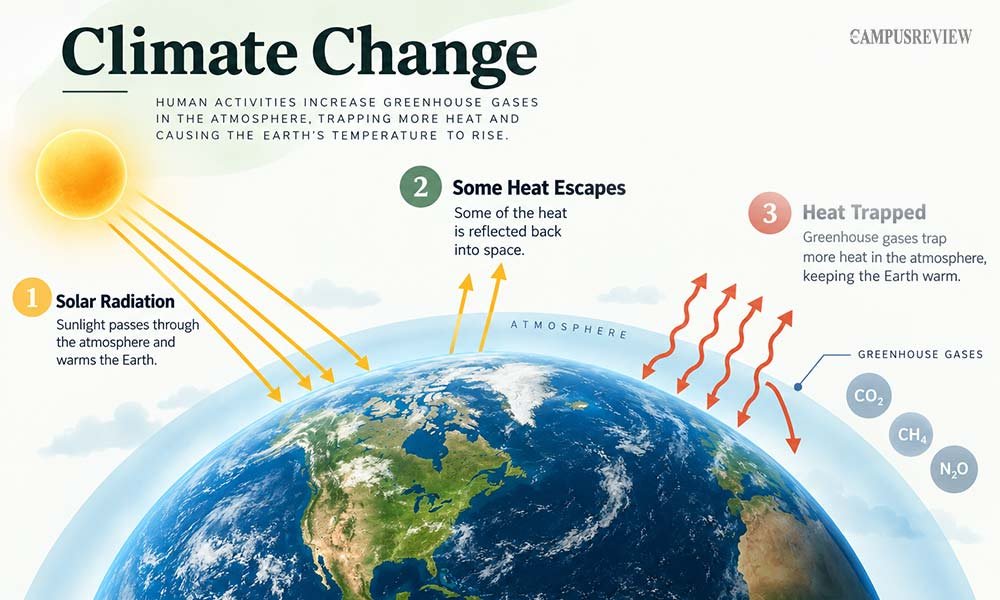
Climate change means the long-term change in temperature and weather patterns across the planet. It happens naturally over thousands of years, but the current shift is happening much faster because of human activities. Burning fossil fuels pushes extra greenhouse gases into Earth’s atmosphere. These gases trap heat like a blanket wrapped around the planet, a process scientists call the greenhouse effect.
The meaning of climate change goes beyond “hotter summers.” In real life, it shows up as:
- Longer, harsher heatwaves
- Unpredictable monsoons and rainfall
- Melting glaciers and rising seas
- Stronger storms and more frequent droughts or floods
Earth’s climate system is interconnected, so changes in one region can affect others. The IPCC confirms that global temperatures have risen by about 1°C since the pre-industrial era, largely due to human activity. Climate change and global warming are closely linked, but they are not the same.
Climate Zones World Map and How They Are Changing
The Earth has different climate zones based mainly on temperature and rainfall. The climate zones world map below shows the major zones and where they occur across the world.
Download the Climate Zones World Map in Word
Scientists commonly use the Köppen-Geiger climate classification to group the world’s climates into five major zones:
| Climate Zone | Main Feature | Examples |
| A – Tropical | Warm throughout the year, with the coolest month at 18°C or above | Amazon, Southeast Asia |
| B – Arid/Dry | Evaporation is greater than rainfall | Sahara, Australian Outback |
| C – Temperate | Mild winters and warm summers | Western Europe, southeastern US |
| D – Continental | Cold winters and warm summers | Canada, Siberia, northern China |
| E – Polar | Warmest month stays below 10°C | Antarctica, Arctic tundra |
How Are Climate Zones Changing?
Climate zones are not completely fixed. Rising global temperatures can shift climate patterns over time, with some zones moving toward the poles. Research shows that about 5% of the world’s land outside Antarctica shifted into a different major climate zone between 1901-1930 and 1991-2020.
These changes can affect farming seasons, water supplies, plants, and wildlife. A climate zones world map therefore helps show how Earth’s climate is distributed and how those patterns are changing over time.
What Causes Climate Change?
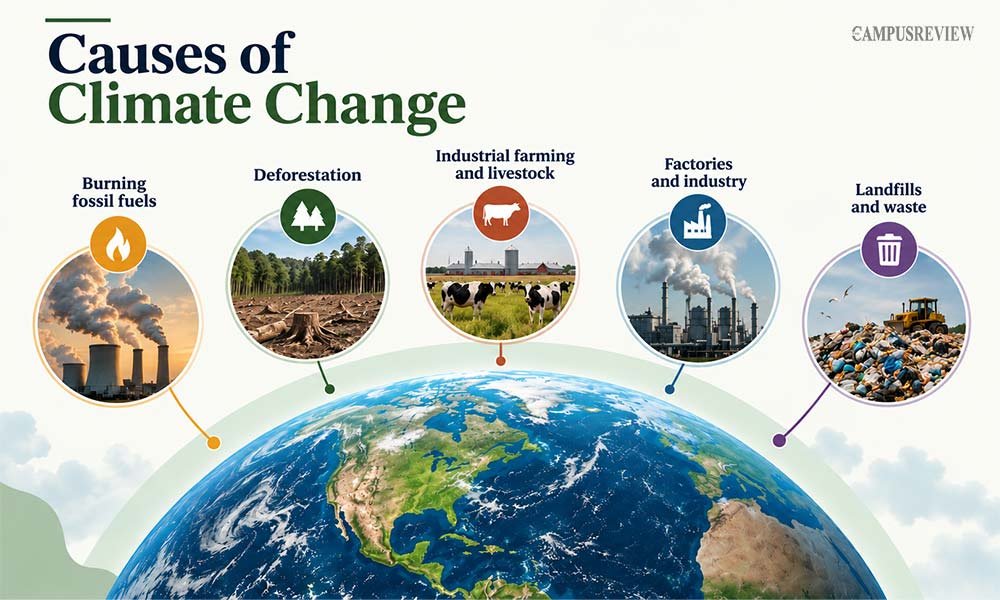
The causes of climate change come down to one thing: too many greenhouse gases building up in Earth’s atmosphere. Here is how each major human activity adds to that build-up:
- Burning fossil fuels: Coal, oil, and natural gas power our vehicles, factories, and electricity grids. Burning them releases large amounts of carbon dioxide, the single biggest contributor to climate change.
- Deforestation: Trees absorb carbon dioxide as they grow. When forests are cut or burned for farmland and timber, that stored carbon goes back into the air, and the planet loses a natural carbon absorber.
- Industrial farming and livestock: Cattle and other livestock release methane as they digest food. Fertilisers used in large-scale farming release nitrous oxide, another powerful greenhouse gas.
- Factories and industry: Manufacturing, cement production, and chemical processing release greenhouse gases directly, on top of the fossil fuels they consume for power.
- Landfills and waste: Food and organic waste release methane as they rot in landfills without enough oxygen to break down cleanly.
These activities have pushed carbon dioxide levels up by about 50% since pre-industrial times, and methane has more than doubled. Fossil fuels remain the single largest source, which is why the shift to clean energy sits at the centre of most climate change solutions.
| Greenhouse Gas | Main Source | How Long It Lasts | Warming Power vs CO2 (100-yr) |
| Carbon dioxide (CO2) | Fossil fuels, cement, deforestation | Centuries | 1 (reference gas) |
| Methane (CH4) | Oil & gas leaks, livestock, rice paddies, landfills | About 12 years | 28x |
| Nitrous oxide (N2O) | Fertilisers, industrial chemicals | Over 100 years | 273x |
Methane breaks down faster than carbon dioxide, but it traps far more heat while it lasts. Over a 20-year period, its warming power is even higher, close to 81 times that of CO2. That is why cutting methane emissions quickly is one of the fastest ways to slow near-term warming, even as the world works on longer-term carbon dioxide cuts.
What Are the Effects of Climate Change?
Climate change touches almost every part of life on Earth, from the weather outside your window to the price of your groceries. Here are the biggest climate change impacts happening right now.
More Extreme Weather
A warmer atmosphere holds more moisture, which fuels heavier rain and stronger storms in some places, while drying others out. Heatwaves that once struck about once a decade are now hitting far more often, and heat, drought, and floods increasingly overlap, straining regions that are not built to handle more than one crisis at a time.
Melting Glaciers, Polar Ice, and Rising Seas
Warmer oceans and air are speeding up ice loss across the Greenland and Antarctic ice sheets, which has roughly quadrupled since the early 1990s. That melting ice, plus oceans expanding as they warm, is why sea levels are rising, and the pace has nearly tripled since the early 1900s. Low-lying coastal cities and small island nations face the most risk, one of the most visible climate change consequences worldwide.
Health and Everyday Life
Climate change is a health issue too, not just an environmental one. The World Health Organisation estimates that about 3.6 billion people already live in places highly vulnerable to its impacts. Heat stress, disease, and unsafe water linked to climate change are expected to cause roughly 250,000 extra deaths a year between 2030 and 2050, hitting developing countries the hardest.
- A few everyday effects you may already notice:
- Higher food prices from disrupted harvests
- More frequent power cuts during heatwaves
- Longer, harsher allergy and disease seasons
- Damage to homes and roads from floods and storms
- Growing stress on water supplies in dry regions
Climate Change and Global Warming: What’s the Difference?
People often use climate change and global warming as if they mean the same thing. They are closely connected, but they are not identical.
| Global Warming | Climate Change | |
| What it means | Rise in Earth’s average surface temperature | The full range of long-term shifts in weather, temperature, oceans, and ice |
| Main cause | Greenhouse gas emissions trapping heat | Global warming, plus the chain of effects it triggers |
| What it covers | One measurable trend: temperature | Multiple connected systems: rainfall, storms, sea level, ecosystems |
| Example headline | “2024 was the hottest year on record” | “Monsoon patterns are shifting across South Asia” |
Think of global warming as the engine and climate change as everything that engine sets in motion. Human activities and climate change are linked in a clear chain: emissions raise temperatures, and higher temperatures reshape rainfall, ice, and storm patterns everywhere on the planet. Understanding this chain makes it easier to read climate news without getting confused by the two terms.
How Can We Reduce Climate Change?
Climate change solutions work best at two levels: big system-wide changes from governments and industries, and everyday choices from individuals like you.
What the World Needs to Do
According to the IPCC, global greenhouse gas emissions need to peak before 2025 and drop by 43% from 2019 levels by 2030 to keep long-term warming near 1.5°C. Reaching net-zero carbon dioxide emissions by 2050 is the target scientists point to for avoiding the most severe outcomes.
- Shift power grids to solar, wind, and other renewable energy
- Phase out coal, oil, and gas as primary energy sources
- Protect and restore forests, which absorb carbon dioxide
- Redesign cities for public transport, cycling, and walking
- Fund and scale up clean technology and climate policy
What You Can Do Today
You don’t need to wait for governments to act first. Small daily habits add up, especially when a lot of people do them together.
High-impact choices
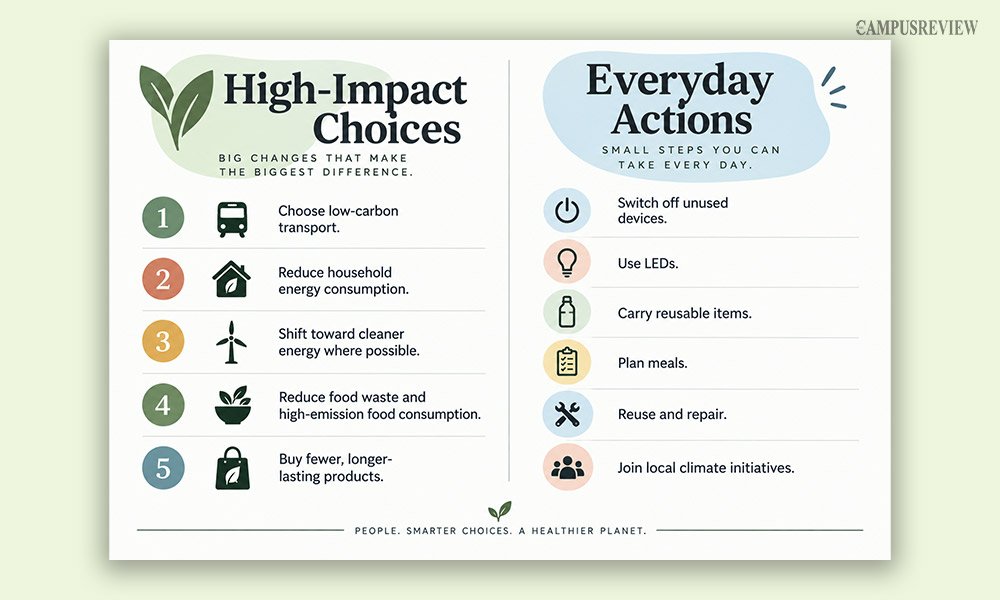
- Choose low-carbon transport.
- Reduce household energy consumption.
- Shift toward cleaner energy where possible.
- Reduce food waste and high-emission food consumption.
- Buy fewer, longer-lasting products.
Everyday actions
- Switch off unused devices.
- Use LEDs.
- Carry reusable items.
- Plan meals.
- Reuse and repair.
- Join local climate initiatives.
Final Thoughts
Climate change is already affecting everyday life through hotter temperatures, changing rainfall, and rising costs. What is climate change? It is a long-term shift in Earth’s climate, with human activities now driving much of the recent change.
A climate zones world map helps show how these changes can affect different regions. Understanding the causes, effects, and solutions can help us make smarter choices for a more sustainable future.